





In today's increasingly diverse global identity planning landscape, more and more high-net-worth individuals are focusing not just on "obtaining an identity," but on how to build a more independent, flexible, and clear international identity portfolio based on different nationalities and residency statuses.
Recently, a representative case emerged in the market: an applicant holding a Grenada Passport successfully obtained permanent residency (PR) in Panama. What is even more noteworthy is that the entire application process was conducted under Grenada's identity, without any connection to the original nationality, ultimately achieving a closed-loop identity combination of "Grenada Passport + Panama PR."
This type of case has attracted market attention not only because it is a "first case" but also because it reflects an increasingly clear trend: identity planning under different passport combinations is becoming an important choice for more and more clients.

A "First Case"
Why is it worth noting?
From publicly available information, the application process for this case was originally very smooth:
June 18, 2025, submitted the qualified investor certificate
July 4, 2025, certificate approved
July 23, 2025, submitted Panama PR
September 29, 2025, PR approved
January 16, 2026, PR amendment completed
The overall efficiency from the qualification certificate to PR approval was high, reflecting the practical operability of this pathway.
What is even more noteworthy is that this applicant did not proceed with a traditional single identity logic, but clearly planned for Panama permanent residency based on the Grenada passport, emphasizing no connection to the original nationality. Although a correction process was initiated due to a miswritten nationality information in the approval document, which took an additional approximately 5 months, it was ultimately completed smoothly, making the entire identity combination logic more complete and clear.
What signal does this first case release?
On the surface, this is just a case of "Grenada nationality obtaining Panama PR"; but at a deeper level, it reflects that global identity planning is shifting from "single identity acquisition" to "combinatorial configuration."
In this configuration approach:
Passport identity emphasizes international mobility and identity switching capability.
Permanent residency emphasizes long-term landing rights and regional layout value.
Multiple identity combinations emphasize mutual complementarity and enhancement.
The case of "Grenada Passport + Panama PR" is a typical reflection of this trend. It indicates that the market is gradually moving from "single point identity acquisition" to "systematic identity configuration."
Why is Panama
coming into the view of more and more clients?
In recent years, Panama's prominence in global identity planning has been on the rise, and this is not coincidental.
On one hand, Panama, as an important hub connecting North and South America, possesses strong international advantages in finance, logistics, and trade; on the other hand, Panama's identity program itself has strong practical appeal, especially suitable for those who wish to balance identity configuration efficiency, regional layout, and future options.
More importantly, the significance of Panama's identity is no longer just about "migration." For many high-net-worth individuals, it represents a key node in the global identity landscape, providing more possibilities for future life arrangements, family planning, and international identity connections.
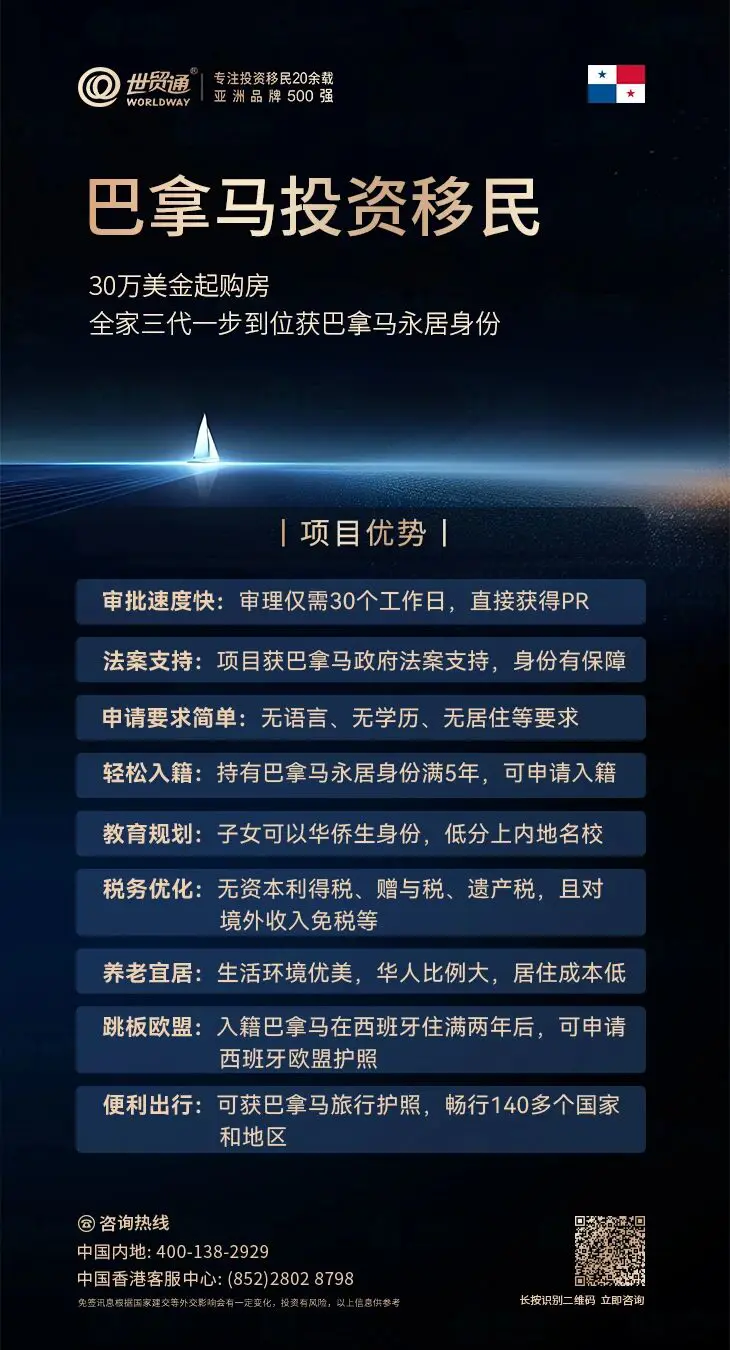
If you are interested in planning for Panama identity, currently, by purchasing real estate worth over $300,000 in Panama, you can apply for: permanent residency, national identity (ID), and travel passport, achieving a triple configuration of "identity + assets + life planning."
For detailed inquiries, please contact Mainland China: 400-138-2929, Hong Kong Customer Service Center: (852)2802 8798