As 2026 began, new changes emerged in the United States' policies regarding H-1B work visas.
At the end of January 2026, the Governor of Texas signed an executive order requiring all institutions reliant on state funding to suspend the hiring of H-1B visa holders.
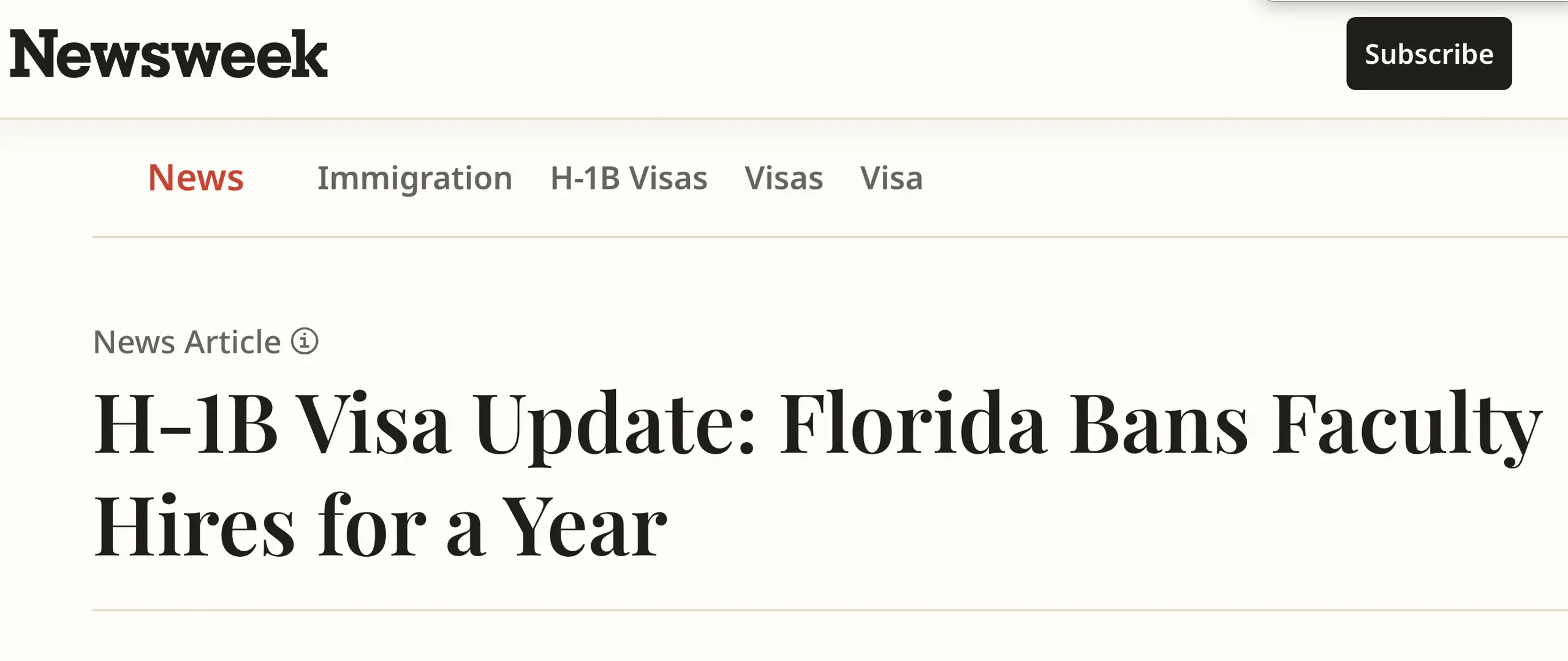
Just over a month later, a similar policy was swiftly implemented in another populous state.On March 2, the Board of Governors overseeing the state university system in Florida overwhelmingly passed a resolution with a vote of 17 to 2: to suspend the hiring of new H-1B visa holders in the state university system, with the freeze lasting until January 5, 2027. During this period, universities are prohibited from initiating new recruiting for H-1B visas, but this will not affect the renewals or extensions of contracts for existing employees.

1、Who Will Be Affected?
This policy primarily targets H-1B visas that are exempt from the lottery system, which are commonly used by public universities, affiliated hospitals, research institutions, and medical schools. Therefore, the group most affected is often researchers, doctors, and educators in the STEM fields.
According to publicly available research data, from 2017 to 2022, of the more than 1,300 H-1B applications approved by the Florida public university system, at least 315 were for doctors, PhDs, or STEM faculty members.
In other words, many crucial research positions heavily rely on international talent. This change has prompted a significant number of international talents working in the United States on H-1B status to contemplate a pressing question: if the policy environment continues to tighten, how can one balance career development with visa stability?
2、H-1B Uncertainty Is Increasing
The recent restrictions enacted by Texas and Florida indicate that some states in the United States are reassessing the role and utilization of the H-1B visa within the public system. For international students and professionals in technology, this again highlights a critical reality: H-1B remains a type of 'employer-bound status'.
The policy environment, employer decisions, and even the political climate of state governments can all impact its stability.
At the same time, the application mechanism for H-1B is also undergoing adjustments. Starting in February 2026, the U.S. Citizenship and Immigration Services began implementing a wage-based lottery system. The higher the job's salary level, the greater the chances of selection, while positions with lower salaries face significantly increased difficulty in getting selected. For many international talents developing their careers in the United States, relying solely on a work visa carries increasing risks.
3、An Increasing Number of People Are Considering EB-5
In this context, some international students and professionals working in the United States are beginning to reassess an alternative pathway — EB-5 investment immigration.
Unlike H-1B visas, EB-5 does not rely on employer sponsorship but directly grants a U.S. green card. Under the current policy framework, eligible applicants can also submit their immigration petition and adjustment of status application simultaneously through a process known as “concurrent filing,” and apply for work authorization and advance parole. This allows applicants to continue to work and live legally while awaiting approval.
\u003 \u003 \u003 \u003 \u003 \u003 \u003 \u003 \u003 \u003 \u003 \u003 \u003 \u003 \u003 \u003 \u003