Recently, TIME, in collaboration with the globally renowned data firm Statista, released the inaugural World’s Top Universities of 2026.
This "debut list" has quickly garnered attention within the global educational community and among high-net-worth families. Its results clearly reaffirm one point——the United States remains a nation with a systemic advantage in the global higher education system.
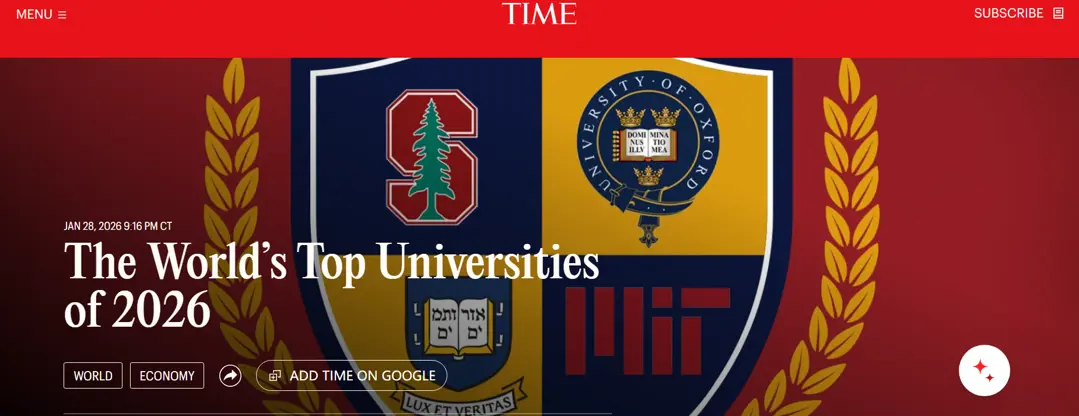
U.S. Universities Excel in the Rankings
In this ranking:
• A total of 42 U.S. universities entered the global Top 100
• 27 of these made it into the global Top 50
• The U.S. holds 7 spots in the global Top 10
The U.S. universities ranked in the top ten include:
• Yale University (2nd)
• Stanford University (3rd)
• Massachusetts Institute of Technology (4th)
• University of Chicago (5th)
• Harvard University (6th)
• University of Michigan, Ann Arbor (9th)
• University of Pennsylvania (10th)
The Three Core Assessment Dimensions
This ranking considers both academic strength and the institution's prestige and influence, focusing on three major dimensions:
• Academic Capability and Performance (60% weight): Focuses on teaching resources, research output, the number of highly cited scholars, and the presence of alumni or staff who have won Nobel Prizes or Fields Medals.
• Innovation and Economic Impact (30% weight): Focuses on patent value, knowledge dissemination (e.g., public courses/MOOCs), and graduate employment achievements (especially the proportion of alumni who are executives at large global publicly traded companies).
• Global Engagement (10% weight): Assesses the proportion of international students and faculty, as well as the international traffic to the institution's official website.
Long-term Considerations in Education Planning
Through the Lens of University Rankings
For many families, paying attention to international university rankings is not just about comparing the schools themselves, but about evaluating:
• Whether the education system their children will enter offers long-term stability
• Whether educational investment can connect with career development, research opportunities, and international mobility
• Whether the family's overall planning has the flexibility for multi-path choices
In this process, immigration status often becomes an important variable influencing the educational path.
The Real-World Connection Between Educational Resources and Residency Status
In practical terms, many families are realizing that:
• In the U.S., residency status significantly affects university admissions, tuition structures, scholarships, and research project eligibility
• Long-term resident status helps families participate in local educational and social systems earlier and more systematically
• Education planning and residency planning are increasingly influencing and complementing each other
Therefore, education choices are shifting from 'single-stage decisions' to holistic planning that prioritizes the long-term institutional environment.
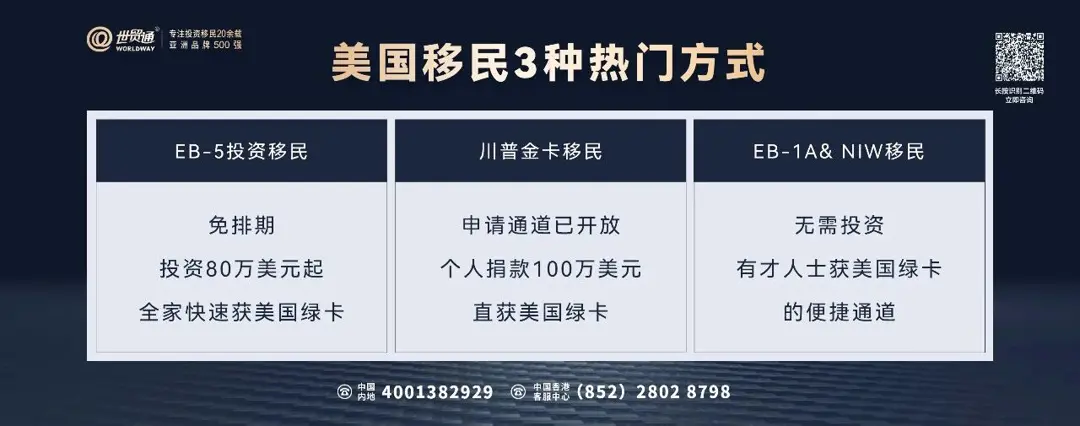
The Role of EB-5 in Identity Planning
Among the various pathways to U.S. residency, the EB-5 investment immigration program has become one of the primary options for families engaged in long-term planning, thanks to its clear policy structure and wide applicability.
Under the new EB-5 law, rural EB-5 projects are exempt from visa retrogression and benefit from priority processing. The 'concurrent filing' policy allows applicants to file Form I-526E and I-485 simultaneously in the U.S., enabling them to obtain a Combo card in approximately 3 months, quickly achieving legal residency and work eligibility. Now is the critical window to secure your U.S. status and gain the first-mover advantage.
WorldWay offers two high-quality EB-5 rural projects to help investors achieve their U.S. residency goals steadily, without retrogression, and efficiently, fast-tracking their path to a new life in the United States. Global quotas are limited; slots are rare and available on a first-come, first-served basis!