





As 2026 begins, the U.S. tech industry has been jolted by a major development. According to reports from the American Broadcasting Company (ABC) and Reuters, Amazon Senior Vice President Beth Galetti confirmed in an internal email that the company will lay off 16,000 employees. If added to the 14,000 workers already laid off in October 2025, Amazon has cut a total of 30,000 jobs in just three months, marking the largest wave of layoffs in the company's 30-year history.


Layoffs were not "sudden"
but were written into the script in advance
What truly caused panic among employees was not the layoff figures themselves, but the internal email that was "accidentally exposed" ahead of time.
This past Tuesday, Amazon Web Services (AWS) employees suddenly received an internal email titled "Project Dawn," which provided a detailed blueprint of the layoffs. In a short span, internal communication channels with over 36,000 people were overwhelmed, with employees asking each other: "Will I be the next to be laid off?"
The email was subsequently recalled in a rush, but the panic had already spread. This type of "pre-leaked layoff" has a psychological impact on employees that is even more damaging than the official layoff notice itself.
It was not until 3:00 AM Pacific Time that Amazon HR officially announced the plan: a 90-day internal transfer window and associated severance benefits.
However, for international employees, such arrangements are far from enough.
The positions most concentrated with international students
are being systematically eliminated
Judging from the structure of the layoffs, the areas truly under pressure are not "fringe businesses" but rather job categories where international students are highly concentrated.
In this round of layoffs, nearly 10% are corporate and technical positions, heavily affecting core departments where international students are clustered. These positions were once the "landing spots" for many international students to obtain H-1B status after years of hard study in U.S. undergraduate and graduate programs; now, they are being systematically phased out.
Tech layoffs are not just Amazon's problem
If one thinks this is an isolated case, they underestimate the depth of this adjustment. Over the past four years, the global tech industry has laid off more than 700,000 people. Early in 2026, companies like Meta and Pinterest followed suit, cutting non-core business areas.
General process-oriented positions are being continuously compressed, and the path of "building a stable career through seniority" is disappearing.
More dangerous than layoffs
is the tightening visa shackle
Many international students instinctively comfort themselves: "I am in a technical role with strong skills, so it should be fine." But the reality is: layoffs are just the first impact; the more fatal aspect is the systemic risk associated with the visa system.
• H-1B is turning from a "channel" into a "shackle": Once unemployed, you must find a new employer to take over within 60 days; otherwise, your status will immediately expire, and you must leave the country. In the current layoff environment, these 60 days are almost an "impossible mission" for international employees.
• Salary-weighted lotteries, with new graduates being systematically marginalized: The lottery winning rate for recent graduates and entry-level positions has dropped significantly, directly cutting off the path of "getting in first and then slowly increasing your salary."
• Comprehensive escalation of enforcement and screening: Academic credentials, work experience, and social media are all under full review, with unannounced spot checks.
A one-sentence summary: Unemployment ≈ a countdown to losing legal status.
Under the dual uncertainty of layoffs and visas, where does true security come from?
In such an environment, more and more international students are realizing one issue: the problem is not "which company to join," but "whether your legal status is independent of your job."
As long as your status remains tied to an employer, a position, and government policy, any layoff or policy shift will leave you in a vulnerable position.
EB-5: Take control of your status into your own hands
It is precisely against this backdrop that the EB-5 investment immigration program has returned to the spotlight. Under the current policy framework:
• The new EB-5 law allows for concurrent filing (I-526E + I-485).
• It provides legal long-term stay and simultaneous application for an Employment Authorization Document (EAD) and Advance Parole (AP).
• Status is no longer dependent on the employer.
• The approval process is relatively stable with a clear path.
For families who are still in the U.S. or planning long-term development in the U.S., this means: taking back the initiative of "whether to stay" into your own hands.
Especially for families with children, completing the status layout during middle or high school not only resolves the parents' status risks but also secures a complete path for local education and development for the children.
More importantly, the current EB-5 policy is still protected by the "grandfathering" clause: applications submitted before September 30, 2026, can lock in the current policy framework and are not affected by future changes in law.


The window is clear, and time is limited. Currently, Worldway Group holds two high-quality EB-5 rural projects, helping investors achieve their U.S. status plans safely, efficiently, and without visa backlogs, allowing them to embark on a new life in the U.S. quickly. Global quotas are limited and spots are scarce; first come, first served!




Additionally, the Trump Gold Card immigration program is officially open for applications. Worldway Group has taken the lead in launching Gold Card acceptance services, assisting applicants in efficiently advancing their application processes and seizing this critical time window.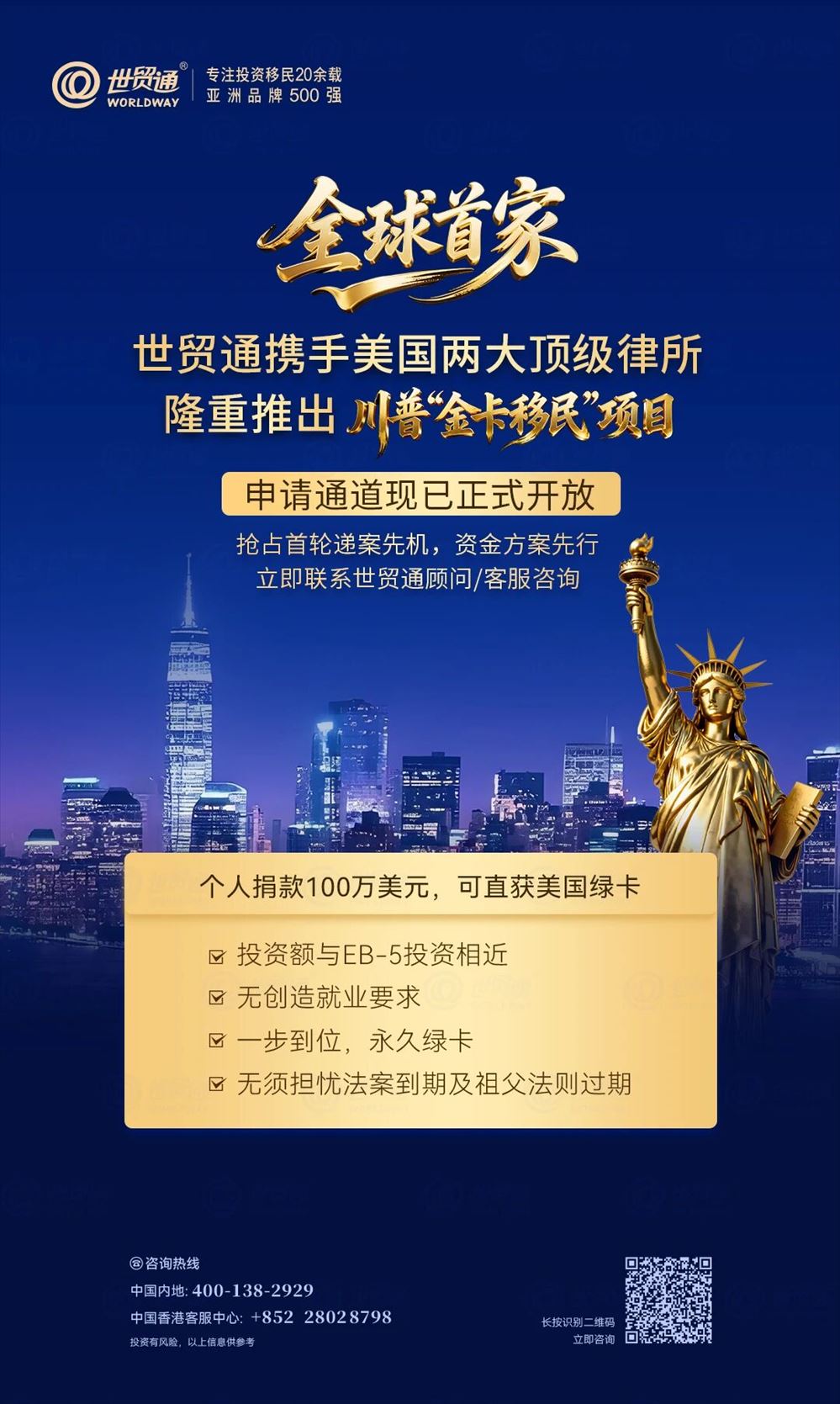
For inquiries in Mainland China: 400-138-2929; for the Hong Kong customer service center: (852)2802 8798