





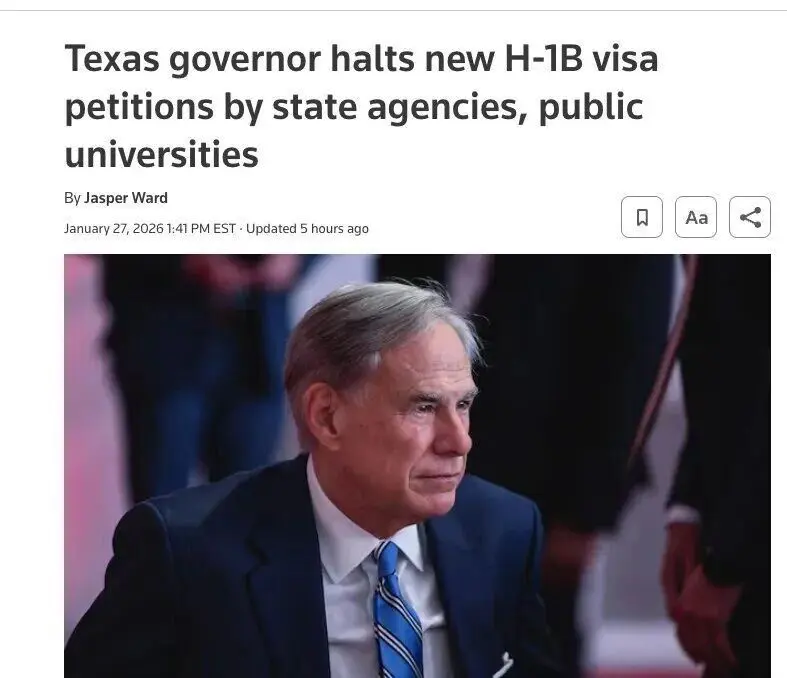
Recently, Texas Governor Greg Abbott issued a directive requiring all government agencies and public universities in the state to immediately cease submitting new H-1B visa applications. This ban is not a short-term measure and may last until May 31, 2027.
It is not merely a "pause," but a comprehensive review
What is even more concerning is that this is not a simple halt but is accompanied by a thorough review of H-1B usage. The governor has requested all relevant agencies to submit detailed reports within the stipulated timeframe, including:
• The number of new or renewed H-1B visas in the past year
• The current roster of H-1B employees, their positions, countries of origin, and visa expiration dates
• Whether "reasonable opportunities for application" have been provided to eligible local candidates in Texas
• Evidence that "application opportunities have been left for locals"
The governor has even stated: "I see no reason for public schools in Texas to need employees on H-1B visas." Additionally, he hinted that some visa holders may have entered before and after the Biden administration took office, and there could be issues with overstays.
Such statements are no longer just a "policy adjustment" but a "rewriting of employment logic."


Texas is not an isolated case: Florida has already signaled similarly
It should be emphasized that Texas is not the first state to take action against H-1B visas. As early as October last year, the Governor of Florida ordered all state universities to stop using the H-1B visa program to hire international employees.
At that time, this action was seen more as a "test" at the state level; now, Texas directly provides a clear freezing deadline and a comprehensive review mechanism in early 2026, which undoubtedly pushes this direction toward a higher intensity and more replicable stage.
It can be foreseen that more states may follow similar policy paths in the future.
Uncertainty around H-1B is rising, and identity risks are accumulating
Each adjustment of H-1B visa policy directly impacts the residency and career planning of international students and foreign workers in the U.S. Recent changes have demonstrated a clear trend:
• At the federal level, the H-1B has continuously raised its thresholds
• Including high additional fees and enhanced background checks
• The lottery system is gradually skewed towards high-salary positions
At the state government level, restrictions on H-1B have begun to shift from "statement of attitude" to "substantial implementation."
In such a policy environment, continuing to bind personal career development and family planning entirely to the highly uncertain H-1B system is, in itself, a risk accumulation. For individuals wishing to stay in the U.S. long-term, rather than passively awaiting clearer rules, it would be prudent to assess more stable and controllable pathways for remaining in the U.S., reserving ample safety space for themselves and their families.
Current ideal identity planning solution: Rural EB-5 projects
Within the current policy framework, the new EB-5 program offers applicants a long-term identity path that does not rely on employers and is unaffected by the lottery. In particular, rural EB-5 projects hold several practical advantages at this stage:
• No waiting period, quick immigration
• "Dual submission": the policy allows applicants to submit both I-526E and I-485 simultaneously in the U.S., allowing for the receipt of a Combo Card in about three months and quickly achieving legal residency and employment eligibility.
• Enjoying priority approval: According to the latest data from the American Immigrant Investor Alliance (AIIA), from the implementation of the new EB-5 law in March 2022 to July 2025, rural projects account for 81% of the approved I-526E applications, while high-unemployment area projects only account for 16%. Furthermore, only 8% of high-unemployment area projects have been approved, and over 92% of applications are still pending. This clearly indicates the substantial "priority approval" enjoyed by rural projects.
Meanwhile, the current EB-5 policy also has a clear "grandfather clause" protection mechanism: applications submitted before September 30, 2026, can secure the current policy and are unaffected by future legal changes. Now is a precious time to plan for U.S. residency.


WorldWay Communications holds two high-quality rural EB-5 projects, assisting investors in safely, efficiently, and without waiting periods in achieving their U.S. residency planning and quickly stepping onto the path of a new life in America. Global quotas are limited and seats are scarce; first come, first served!




In addition, the Trump Gold Card immigration project is officially open for applications. WorldWay Communications has taken the lead in launching Gold Card acceptance services to help applicants efficiently advance their application process and seize critical time windows.
For inquiries, please contact Mainland China: 400-138-2929, Hong Kong Customer Service Center: (852) 2802 8798