





Recently, the "Six Major Immigration Trends for 2026" released by WorldWay Group has attracted widespread attention within the industry. Among them, "U.S. immigration continues to become more 'merit-based,' highlighting the core value of the EB-5 system" was listed as one of the six trends, clearly outlining the key trajectory for U.S. immigration policy and market developments over the coming year.
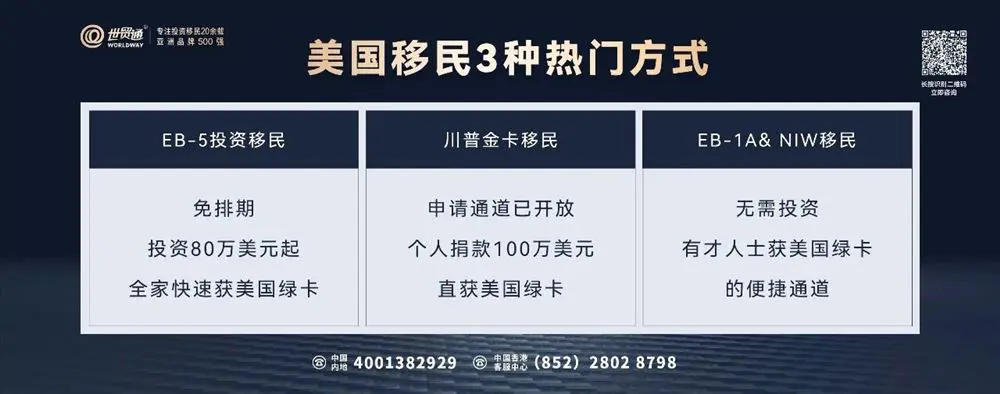
In 2026, while the United States remains one of the world's most important immigration destinations, it has bid farewell to the "era of low-threshold access." Against a backdrop of increasing volatility in traditional pathways such as student visas, work visas, and temporary status, applicants with financial resources and compliant backgrounds now have a clearer scope for choice. On one hand, the Trump administration's "Gold Card Immigration" program policy is expected to move into more detailed implementation and substantive execution stages in 2026, and its specific implementation path may have a diversionary effect on the immigration decisions of high-net-worth individuals. On the other hand, within the framework of the new policy, the EB-5 investment immigration program continues to be a highly certain immigration path, thanks to set-aside visas and institutional stability. It is worth noting that the grandfathering clause under the new EB-5 act expires on September 30, 2026; it is expected that more investors will complete their filings early and accelerate the actual consumption of quotas, making it highly likely that visa categories for set-asides will face retrogression in 2026. 2026 will serve as a critical window for investors to lock in existing policy dividends and plan their U.S. investment immigration.


01. The Value Logic of Investment Immigration
Is Undergoing Substantive Changes
As this trend indicates, the value assessment system for U.S. investment immigration is undergoing a substantive transformation.
In the past, some applicants viewed EB-5 as an "optional" or "backup plan"; however, in the 2026 policy environment, EB-5 is gradually returning to its essential positioning—a institutionalized channel that exchanges compliant capital for long-term, stable U.S. residency. As the uncertainty of other pathways continues to amplify, the "policy certainty," "status certainty," and "time predictability" represented by EB-5 have, instead, become scarce resources.
02. The Core Advantages of EB-5
Are Being Focused on by the Market
Under the framework of the new act, the EB-5 investment immigration program continues to gain attention and recognition from the market and investors due to its core advantages:
• The set-aside visa program provides a relatively independent visa channel for eligible applicants, and rural EB-5 projects enjoy priority processing advantages.
• It currently still possesses the advantage of no visa retrogression. However, it must be soberly realized that as the volume of applications continues to rise, this advantage is not fixed for the long term but is a typical "window-of-opportunity."
• At the same time, the new act allows eligible applicants to conduct "concurrent filing," meaning they can simultaneously submit Form I-526E and I-485 while in the U.S. Applicants can receive a Combo card in about three months, quickly achieving legal residency and employment eligibility, effectively alleviating pressures regarding status and time.
03. The Era of High Scrutiny
Truly Tests 'Planning Ability'
In recent years, the external environment for U.S. immigration policy has remained in a state of high volatility. Traditional pathways involving changing status from student visas, work visas, and various temporary statuses have exhibited obvious uncertainty regarding quotas, lottery rules, approval processes, and policy continuity, with time costs and outcome risks rising in tandem.
Against such a policy backdrop, immigration planning is no longer a matter of choosing a single project or a single path, but rather a comprehensive judgment on policy rhythm, windows of opportunity, and execution stability.
For investors, the earlier they engage in professional planning, the more likely they are to complete their layout within the policy window; otherwise, they may face higher time and opportunity costs.

04. 2026: From 'Whether to Do It'
To 'Whether There Is Still Time'
Judging from comprehensive policy trends and market rhythms, 2026 is not an ordinary year but a distinct watershed point.
Under the multiple impacts of the countdown to the grandfathering clause (expiring September 30, 2026), the speed of set-aside visa consumption, and the continuous recovery in global application volumes, EB-5 investment immigration is rapidly shifting from being "relatively relaxed" to a competitive stage where time is the core variable.
For families with clear needs for U.S. status planning, 2026 is no longer just a year to observe policies, but a critical year to assess their own conditions, complete path selection, and lock in policy dividends.
In general, U.S. immigration in 2026 does not belong to the hesitant, but to those who can discern trends, make firm decisions, and carry out systematic planning.




For inquiries in Mainland China: 400-138-2929; for the Hong Kong Customer Service Center: (852)2802 8798