





In recent years, the number of Chinese students pursuing education in the United States has continued to rise, but an undeniable reality is emerging—the number of students who can successfully remain in the U.S. for their careers after graduation is steadily declining.
Many families invest heavily in their children's education before they go abroad. They assume that "academic success" naturally leads to a "promising future," but when they reach the point of graduation, they realize that completing their studies does not equate to maintaining legal status.
A large number of families with students abroad face a highly similar dilemma: their children are about to graduate but cannot find an employer willing to sponsor an H-1B visa; the OPT internship period is counting down, and their legal status is approaching its end.
The problem is not that the students are not talented, but that the U.S. "retention mechanism" is becoming increasingly stringent.

01. Studying in the U.S. ≠ Staying in the U.S.
Separated by Three "High Walls"
In the past, many families had a relatively simple understanding of the U.S. pathway: F-1 → OPT → H-1B → Green Card, which seemed to be a mature and clear channel. But reality has long since changed.
The First Wall: The multiple thresholds for H-1B are being systematically raised.
• Changes to the lottery system: The random lottery mechanism has been abolished in favor of a comprehensive weighted ranking system based on salary levels. This is extremely disadvantageous for fresh graduates with lower starting salaries. In fact, most new graduates are already in a "supporting role" position.
• High application fees: Some new H-1B applications may require fees as high as $100,000.
• Expanded social media screening: Since December 15, 2025, the U.S. Department of State has expanded "online presence screening" to all H-1B and H-4 applicants.
• Increased travel risks: Recently, major companies like Google and Apple have issued reminders to internal employees, advising those holding H-1B visas to be cautious when leaving the country, as returning to the U.S. could be delayed by up to one year!
The Second Wall: Employer costs and risks have risen sharply.
High surcharges, compliance risks, and extended review cycles have made more and more companies unwilling to sponsor H-1B visas for entry-level positions.
It is not that students cannot find jobs, but that companies are afraid of, and unwilling to, bear the visa risks.
The Third Wall: OPT duration is limited, and the margin for error in status is extremely low.
OPT is usually only for 1 year (up to 3 years for STEM majors). Once the status conversion is not completed within the validity period, one must leave the country. Many families only realize at this stage that the time left for choices is very limited.
The final result is often lamentable—having completed an expensive and difficult journey of studying abroad, they are unable to truly put down roots due to status issues.
02. 2026 H-1B:
It is not just difficult; the logic has changed.
In the past, people often said that H-1B was about "luck"; now, it is more like a systematic screening process with high thresholds, low tolerance for error, and long cycles.
Salary grading, surcharges, and social media screening are transforming the H-1B from a "graduation pathway" into a tool suitable only for a small number of high-salary, core-position talents.
More importantly, even if one wins the H-1B lottery, it does not mean stability.
The H-1B is essentially still a non-immigrant visa, strongly tied to the employer; layoffs, job hopping, or industry fluctuations can directly terminate one's status within 60 days. Once the six-year limit is reached, if the Green Card has not yet been obtained, one must still leave the country.
For families with students abroad, this means that betting their entire future on the H-1B is systematically amplifying risks.
03. A Truly Secure Path
Comes from Earlier Status Planning
Often, the problem is not with the children, but that the planning started too late.
When the OPT is already counting down and the prospects for an H-1B are highly uncertain, looking for "remedial solutions" leaves very little room for choice.
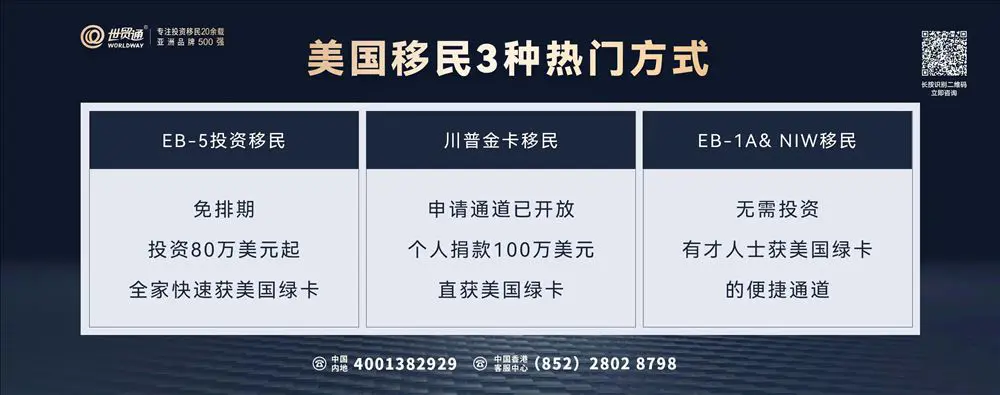
In the current policy environment, EB-5 investment immigration is becoming a realistic choice for more and more families with students abroad. The core value of EB-5 is not in the "investment" itself, but in:
• Directly obtaining a Green Card, rather than a temporary visa.
• Not relying on an employer and not being affected by the lottery.
• Being able to obtain an Employment Authorization Document (EAD) and legal residency status as early as possible through "concurrent filing."
• Allowing children to freely choose their careers and change tracks without being tied to a visa.
For many families, this is a strategy of replacing uncertainty with certainty.

04. Studying abroad is the starting point, not the end point.
The United States still possesses the world's top educational resources and vast space for development, but the rules for "staying" have fundamentally changed.
Rather than passively dealing with a status crisis on the eve of graduation, it is better to prepare a more secure Plan B for your child during their studies. Planning for a Green Card early is not giving up on effort, but allowing your child to take every step of their development in the U.S. more calmly and securely. True success in studying abroad is not just getting a diploma, but having the right to choose one's future.
Under the new EB-5 law, rural EB-5 projects are exempt from visa backlogs and have priority processing advantages; the "concurrent filing" policy allows applicants to file I-526E and I-485 simultaneously in the U.S., enabling them to obtain a Combo card in about 3 months, quickly achieving legal residency and employment eligibility. Now is the critical window to plan for U.S. status and seize the opportunity.
WorldWay holds two high-quality rural EB-5 projects, helping investors achieve their U.S. status planning securely, without backlogs, and efficiently, quickly embarking on the path to a new life in the U.S. Global quotas are limited, spots are scarce, and they are available on a first-come, first-served basis!




In addition, the Trump Gold Card immigration program is officially open for applications. WorldWay has taken the lead in launching Gold Card acceptance services, helping applicants efficiently advance their application process and seize the critical time window.
For detailed inquiries in Mainland China: 400-138-2929, Hong Kong, China Customer Service Center: (852)2802 8798