





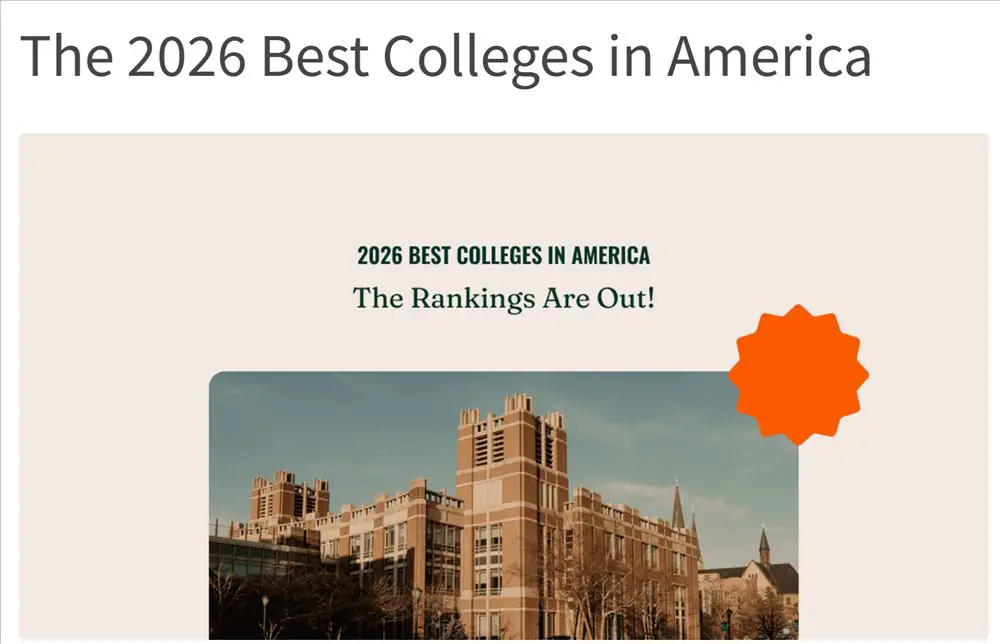
Recently, Niche released its 2026 rankings for the best colleges in the United States. Unlike traditional rankings that emphasize the prestige of elite schools, Niche focuses more on the overall student experience—from academic support and campus life to actual post-graduation outcomes.
Based on official data from the U.S. Department of Education, the FBI, and other sources, combined with over 100 million authentic reviews from students and parents, this ranking is increasingly becoming an important reference for more and more families when making college selection decisions in the U.S.

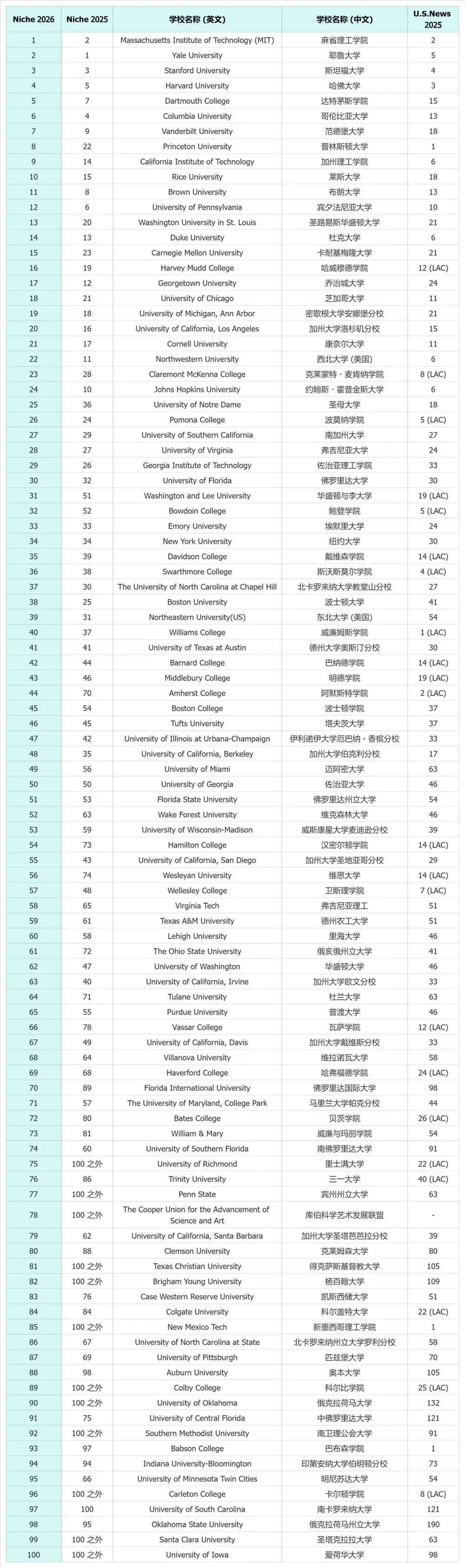
2026 Niche Top 100 Best Colleges in the U.S. Ranking
Key Highlights of the Niche 2026 Rankings
In this year's rankings, the shifts in position for several schools have drawn widespread attention:
• Massachusetts Institute of Technology (MIT) takes the top spot, surpassing Yale
• Many private universities remain firmly at the forefront, with private institutions occupying almost the entire Top 15
• Princeton University surged 14 places, jumping from 22nd to 8th
• Some prestigious schools known for research have seen their rankings decline
• Public universities have generally regressed, with only 37 public institutions making it into the Top 100
• Multiple schools in the UC system have dropped in rank
• Liberal arts colleges performed impressively, with over 20 liberal arts colleges entering the Top 100
These changes do not imply a drastic fluctuation in the academic strength of U.S. universities, but rather reflect shifts in the focus of the evaluation criteria.


Ranking Indicators
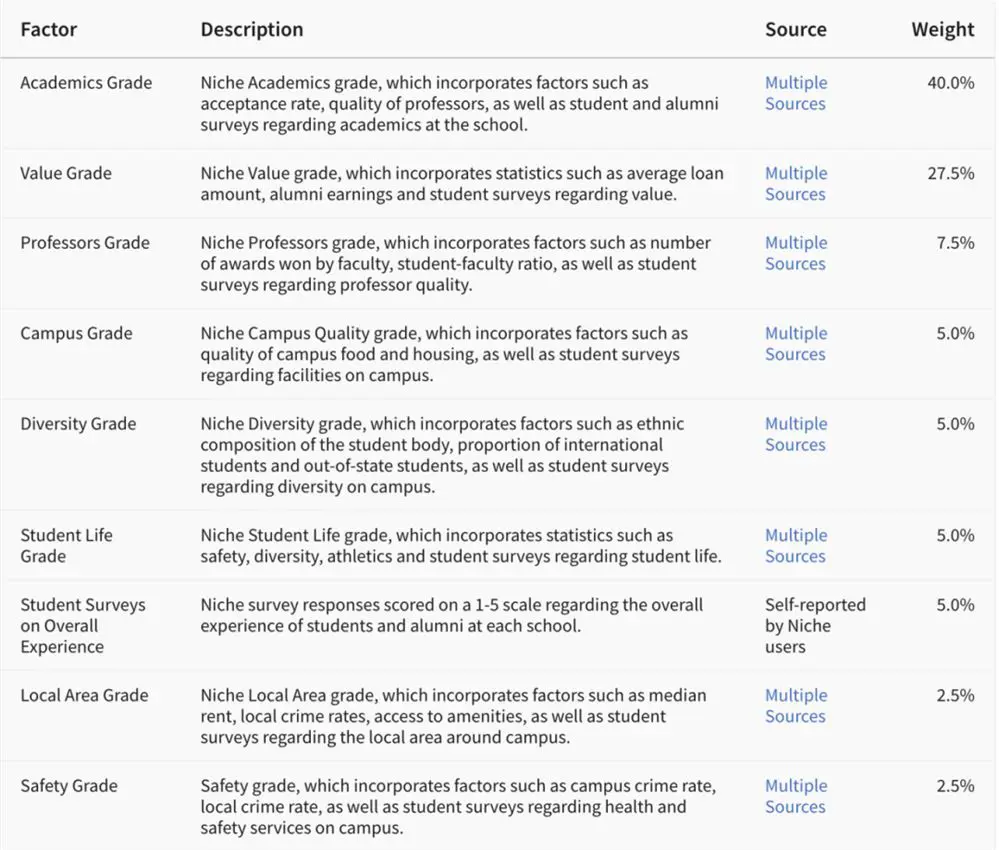
In 2026, Niche's overall methodology continues its previous framework, but the weight distribution of various indicators clearly reflects its evaluation orientation—student experience is no longer just a reference factor, but a core variable that directly affects the ranking results. The specific indicators are as follows:
• Academics Grade (40%): Includes acceptance rate, quality of professors, alumni ratings of academics, etc.
• Value Grade (27.5%): Includes average loan amount, alumni earnings, student surveys, etc.
• Professors Grade (7.5%): Includes number of faculty awards, student-faculty ratio, student surveys, etc.
• Campus Grade (5%): Includes dining, housing, student ratings of campus facilities, etc.
• Diversity Grade (5%): Includes ethnic composition of students, ratio of international and out-of-state students, student ratings of diversity, etc.
• Student Life Grade (5%): Includes safety, diversity, student surveys, etc.
• Student Surveys on Overall Experience (5%): Students and alumni rate the school on a scale of 1-5.
• Local Area Grade (2.5%): Includes local rent, crime rate, convenience of living, etc.
• Campus Safety Grade (2.5%): Includes campus crime rate, local crime rate, campus health services, etc.

In summary: This is a comprehensive university ranking centered on "whether it is comfortable to live in, whether learning is sustainable, and whether there are realistic returns after graduation."
The Niche 2026 U.S. College Rankings do not tell us which school is the "strongest," but rather remind all families to re-examine a question:
A good education is not just about being admitted, but about whether one can successfully complete it, live with peace of mind, and develop sustainably.
In the actual process of studying in the U.S., these factors are often not entirely determined by the school itself. For international students, tuition costs, housing resources, internship and research opportunities, and post-graduation paths are all influenced by their immigration status at different stages.
For example, international students usually face higher tuition standards, with limited access to scholarships and on-campus resources; internship, research, or off-campus practical opportunities during their studies are often uncertain due to status restrictions; and at the graduation stage, employment paths and visa cycles directly affect the stability of long-term planning.
These issues are not reflected in a single admission result, but they will continuously affect a student's overall educational experience throughout several years of study and even longer-term development.
Status Planning is Becoming a Key Link in Educational Planning
It is precisely for this reason that more and more families, while paying attention to U.S. college rankings and educational quality, are extending their perspective to a more fundamental issue—how to provide a more stable and sustainable status foundation for their children's U.S. education.

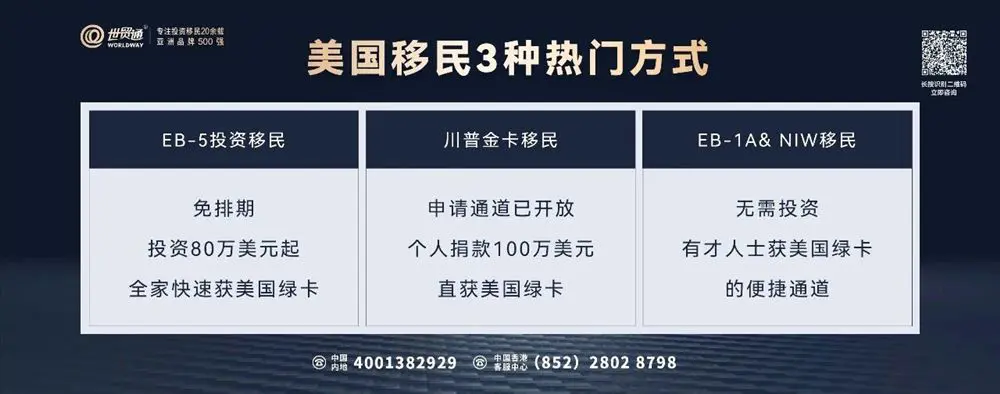
Within existing pathways, EB-5 is being viewed by some families as a status solution that leans more towards long-term planning. Its value is not only reflected in the immigration result itself, but in providing a more certain foundation for education and future development.
Under the new EB-5 law, rural EB-5 projects are visa-bulletin-free and have priority processing advantages; the "concurrent filing" policy allows applicants in the U.S. to file Form I-526E and Form I-485 simultaneously, enabling them to obtain a Combo card in about 3 months, quickly achieving legal residency and employment eligibility. Now is the critical window to lay out U.S. status and seize the opportunity.
WorldWay holds two high-quality rural EB-5 projects, helping investors achieve their U.S. status planning steadily, without visa backlogs, and efficiently, quickly embarking on a new life in the United States. Global quotas are limited, spots are scarce, and they are available on a first-come, first-served basis!




In addition, the Trump Gold Card immigration program is officially open for applications. WorldWay has taken the lead in launching Gold Card acceptance services, helping applicants efficiently advance their application process and seize the critical time window.
For detailed inquiries in Mainland China: 400-138-2929, Hong Kong Customer Service Center: (852)2802 8798