






On December 23, 2025, the U.S. Department of Homeland Security (DHS) and U.S. Citizenship and Immigration Services (USCIS) officially confirmed: The H-1B visa process will shift from the long-standing random lottery system to a new mechanism of wage-level-based weighted selection.
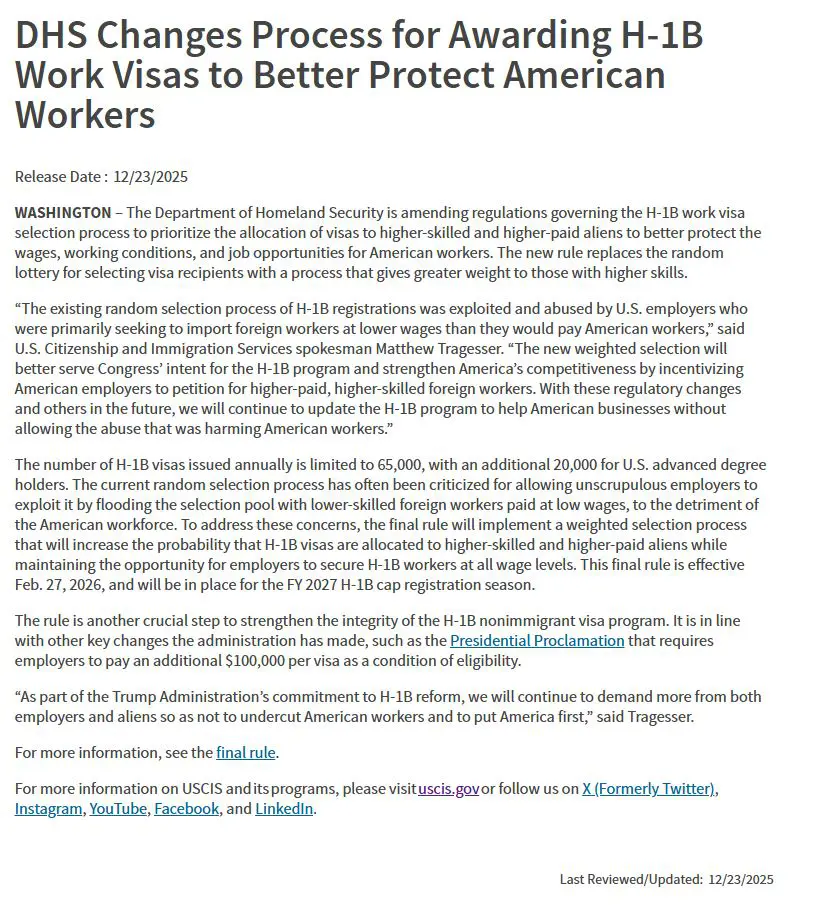
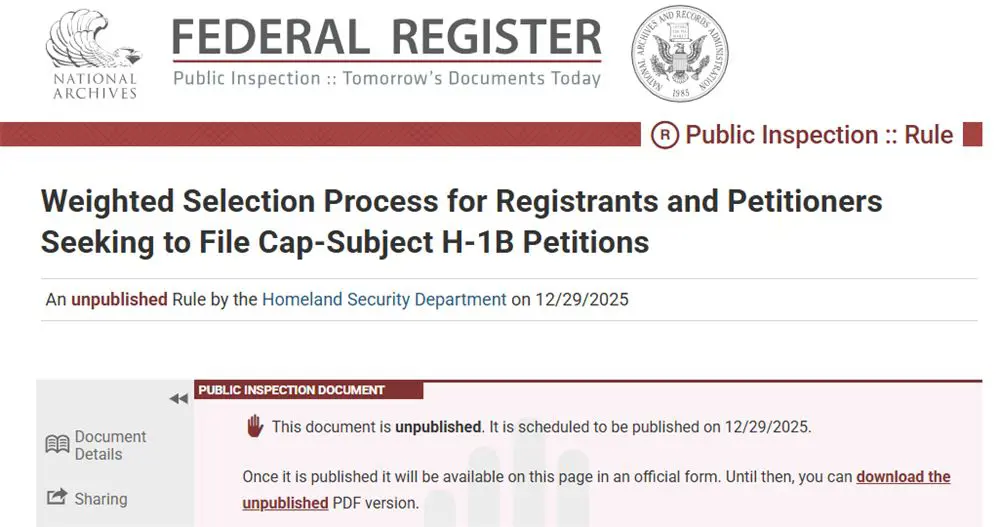
According to the official announcement, the new rule will be formally published in the Federal Register on December 29, 2025, and will take effect 60 days later, on February 27, 2026. This means that the H-1B application season for fiscal year 2027 (expected to begin in March 2026) will fully implement the wage-weighted lottery rules.

Core of the Rule:
Wage-based classification and weighted lottery
The annual quota structure for H-1B remains unchanged:
• 65,000 regular cap slots
• 20,000 slots for individuals with a U.S. master's degree or higher
The real change is that H-1B quota allocation will no longer be a matter of "luck," but will depend more on salary levels.
The new mechanism uses the current Occupational Employment and Wage Statistics (OEWS) wage standards as a baseline to divide positions into four levels, with different weights assigned:
Level 1 (Entry Level): 1 lottery chance
Level 2 (Beginning Professional): 2 lottery chances
Level 3 (Experienced): 3 lottery chances
Level 4 (Fully Competent/Expert): 4 lottery chances
This means that the higher the salary and the more senior the position, the greater the "weight" in the lottery pool.
Changes in Selection Rates: No Longer "Everyone Is Equal"
According to official projections, selection rates will diverge significantly based on wage levels:
• Level 1: 15.29% selection rate
• Level 2: 30.58% selection rate
• Level 3: 45.87% selection rate
• Level 4: 61.16% selection rate
The differences in selection rates show that H-1B selection is clearly tilting toward high-paying, senior positions. The opportunities for applicants in lower wage levels are being compressed, while the certainty for mid-to-high level positions is significantly increased. This means that for recent graduates and entry-level positions, the H-1B is no longer a "universally viable" path.
Registration Phase Advanced:
Stratification Before the Lottery
Another severely underestimated change is that the key information required for the lottery has been significantly moved forward.
Starting from fiscal year 2027, during the H-1B online registration phase, employers must submit:
• The wage amount for the position
• The corresponding wage level (Level I-IV)
• Work location
• SOC occupational classification code
In other words, even before the lottery, USCIS already knows whether you are "worth selecting." This greatly compresses the room for "post-submission remedies" and closes off paths for false or vague declarations.
Multiple Thresholds for H-1B Applications Are Rising
This weighted lottery is not an isolated adjustment but part of a broader tightening of H-1B policy. Applicants should also pay attention to several other important changes:
• High Application Fees: According to a presidential proclamation issued in September 2025, some new H-1B applications may be subject to fees as high as $100,000, significantly increasing hiring costs for employers and further strengthening the institutional advantages of large corporations.
• Expanded Social Media Screening: Effective December 15, 2025, the U.S. Department of State has expanded "online presence screening" to all H-1B and H-4 applicants. Applicants must declare social media accounts and may be subject to reviews of their historical behavior, significantly raising compliance requirements.
• Increased Travel Risks: Recently, major companies like Google and Apple have issued reminders to internal employees, advising those holding H-1B visas to be cautious about leaving the country, as returning to the U.S. could be delayed by up to one year!
Rising Uncertainty for Staying in the U.S. on H-1B:
Early Status Planning Becomes Critical
Against the backdrop of rewritten lottery rules, redistributed probabilities, and continuously increasing uncertainty, more and more international students are beginning to re-examine a question: Is it necessary to pin long-term prospects in the U.S. on a non-immigrant visa system that is constantly changing?
This is why status planning is becoming a key variable in U.S. residency planning earlier than ever.

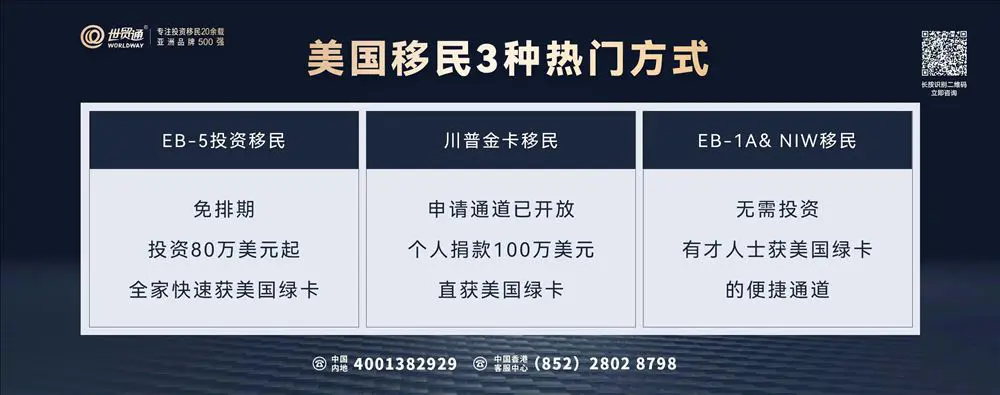
At this stage, EB-5 investment immigration is becoming an important option for more and more professionals during these turbulent times due to its stability and autonomy.
What is even more noteworthy at present is that the new EB-5 law has brought an unprecedented window of opportunity: rural EB-5 projects are exempt from visa backlogs and have priority processing advantages; the "concurrent filing" policy allows applicants to file Form I-526E and Form I-485 simultaneously in the U.S., enabling them to obtain a Combo card in about 3 months, quickly achieving legal residency and employment eligibility.




In addition, the Trump Gold Card immigration program is officially open for applications. Worldway has taken the lead in launching Gold Card acceptance services to help applicants efficiently advance their application process and seize critical time windows.

For detailed inquiries, please contact Mainland China: 400-138-2929, Hong Kong Customer Service Center: (852) 2802 8798