





On December 16, local time, U.S. President Donald Trump signed a presidential proclamation announcing the expansion of the list of countries subject to U.S. entry restrictions. The number of restricted countries will increase from the previous 19 to 40, with the relevant measures expected to take effect on January 1, 2026. The official justification remains “national security and public safety risks.”
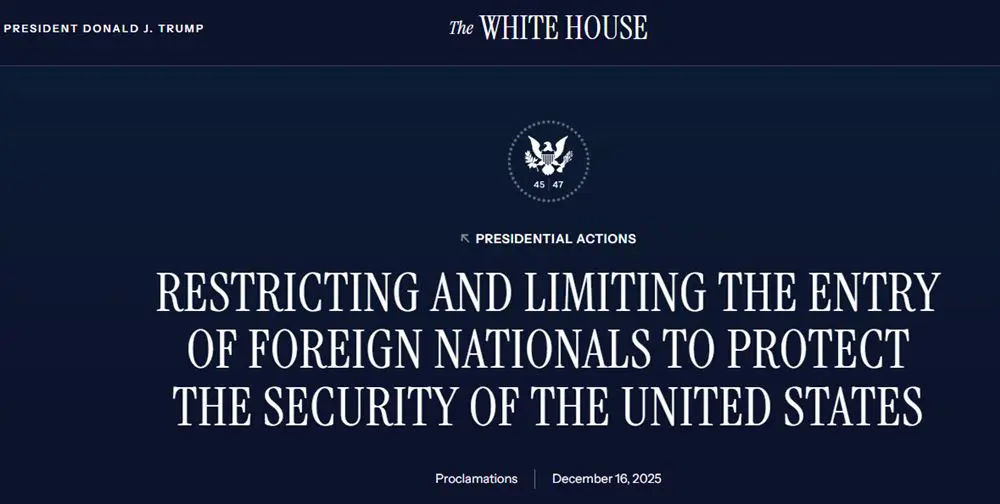
This is not an isolated executive decision, but a continuation and institutional upgrade of the tightening of U.S. immigration and visa policies since 2025.
Comprehensive Expansion of Entry Restrictions:
From 19 to 40
1. Countries Subject to Comprehensive Entry Restrictions Increased to 20
This proclamation, while maintaining the existing comprehensive entry restrictions on 12 high-risk countries (Afghanistan, Myanmar, Chad, Republic of the Congo, Equatorial Guinea, Eritrea, Haiti, Iran, Libya, Somalia, Sudan, and Yemen), adds Burkina Faso, Mali, Niger, South Sudan, and Syria to the list. Furthermore, it upgrades Laos and Sierra Leone—previously subject to partial restrictions—to comprehensive restrictions, and specifies that the same restrictions apply to individuals holding travel documents issued by the Palestinian Authority. With this, the number of countries under comprehensive restrictions has increased to 20.
Policy Substance:
• The U.S. Department of State and U.S. Citizenship and Immigration Services (USCIS) have essentially suspended the issuance of immigrant and non-immigrant visas.
• Existing valid visa holders are generally not automatically invalidated; however, they face significant uncertainty regarding entry, renewal, and changes of status.
• Background checks and administrative processing have become the norm.
2. Countries Subject to Partial Entry Restrictions Also Increased to 20
?“Partial Restrictions” do not equate to a total ban, but they significantly raise the threshold for visas and entry, mainly affecting: tourist visas (B1/B2), student visas (F/M/J), and certain short-term exchange and training visas.
Affected countries include: Angola, Antigua and Barbuda, Benin, Burundi, Cuba, Dominica, Gabon, The Gambia, Ivory Coast, Malawi, Mauritania, Nigeria, Senegal, Tanzania, Tonga, Zambia, Zimbabwe, Togo, Turkmenistan, and Venezuela.
Potential measures include: higher approval standards, shortened visa validity periods, significantly longer processing times, and an expanded scope for social media and background investigations.

Policy Focus Shift:
From “Restricted Subjects” to a “Continuous Review Mechanism”
Unlike the previous “list-based management,” the key change in this round of policy is that reviews are no longer directed solely at “new applicants” but globally cover existing visa holders.
1. Large-scale visa revocations have become a reality
Official data shows that approximately 80,000 non-immigrant visas have been revoked since 2025. Among these, student visas have become a primary target:
• May: Publicly acknowledged that “hundreds, if not thousands” had been revoked.
• August: Cumulative student visa revocations exceeded 6,000.
• October: Cases have emerged where individuals lost their visa eligibility due to deemed “inappropriate” social media comments.
2. Continuous institutional reinforcement
• Approximately 55 million U.S. visa holders have been brought under the scope of systematic review.
• On December 5, USCIS announced the establishment of a new Immigration Review Center.
• Social media screening and background check standards have been upgraded simultaneously.
This means:
The “stability” of legal visas is declining.
Compliance ≠ Security; Having a visa ≠ Long-term control.

In an Era of Uncertainty,
Status Stability is Paramount
In the current policy environment, the core issue for non-immigrant statuses such as F-1, B-1/B-2, and H-1B is no longer just whether they will be approved, but: Can the status be maintained long-term? Will it be subject to “retroactive review”? Or will eligibility be lost due to non-criminal or non-immigration-related factors? Uncertainty has become part of the system.
Precisely for this reason, for those wishing to secure status stability and long-term planning space in an uncertain environment, immigration-based programs that rely on clear regulations, long-standing practice, and relatively mature adjudication mechanisms are becoming a more rational and predictable choice.
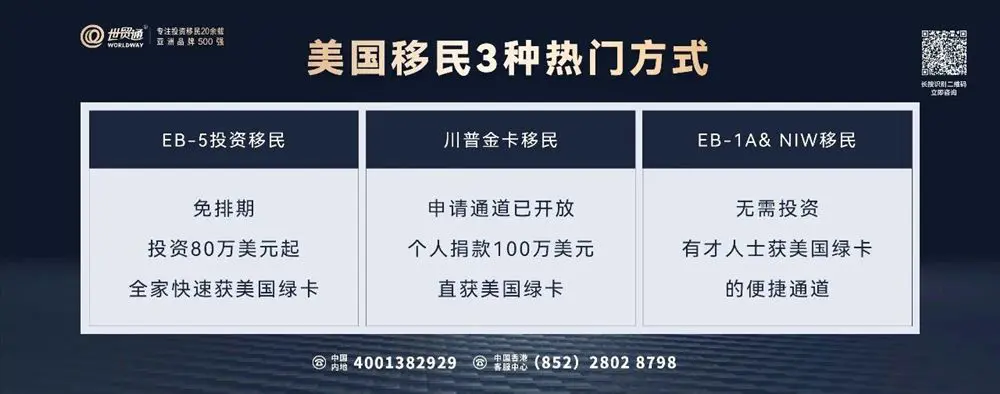
Among many options, the EB-5 Investment Immigration program is currently one of the most mature and broadly applicable pathways to obtain U.S. status within the American immigration system. No backlog, investments starting from $800,000, and fast-tracked U.S. Green Cards for the entire family.




In addition, the Trump Gold Card program is now officially open for applications. Visas Consulting Group (WorldWay) has taken the lead in launching Gold Card acceptance services, assisting applicants in efficiently advancing their applications and seizing the critical window of opportunity.

For detailed inquiries, please contact Mainland China: 400-138-2929; Hong Kong, China Customer Service Center: (852) 2802 8798