





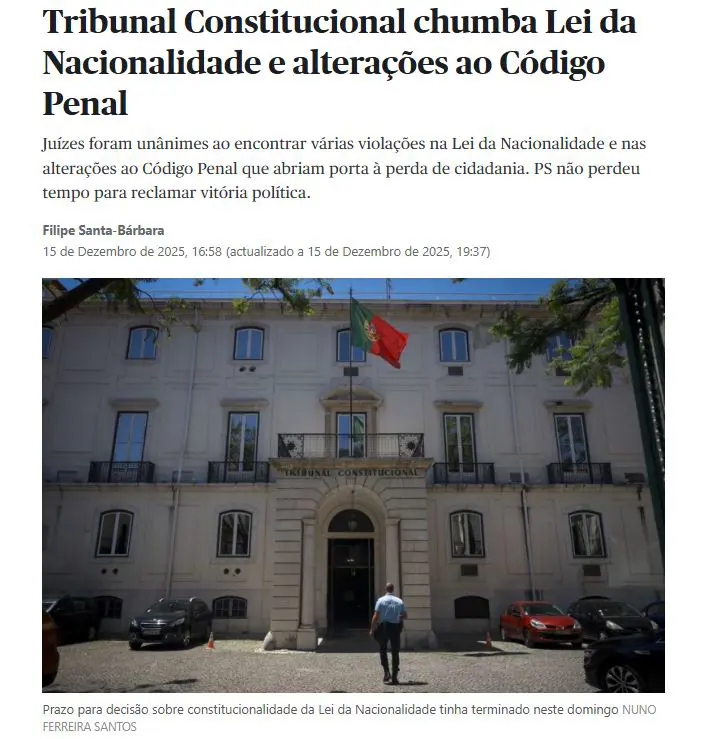
On December 15, 2025, the Portuguese Constitutional Court issued a landmark ruling: several core provisions in the draft Nationality Law reform passed in October were declared unconstitutional. Consequently, the legislation cannot enter into force in its current form and will be returned to the President of the Republic for a veto and referral back to Parliament for reconsideration.
This ruling not only immediately "halts" the controversial reform but, more importantly, defines the bottom-line rules of the Portuguese immigration system at the constitutional level. For applicants who are currently planning or already hold Portuguese residency, this is an extremely critical and meaningful positive development.
What did the Constitutional Court reject?
The Constitutional Court has ruled the following provisions to be unconstitutional:
1. The retroactive change to the "start date" of legal residency.
The proposed law attempted to change how the required years of legal residency for naturalization are calculated, stipulating that the count would only begin from the date the residence card is issued, rather than from the date the application is submitted.
The Constitutional Court deemed this provision unconstitutional on the grounds that it violates the principle of protection of legitimate expectations. Applicants should not be adversely affected by administrative delays that are not caused by them.
2. Deprivation of nationality as an additional criminal penalty.
The proposed amendment to the Criminal Code aimed to allow the deprivation of nationality as an ancillary penalty for naturalized citizens convicted of serious crimes.
The Constitutional Court ruled this provision unconstitutional, stating that it violates the principles of equality and proportionality, artificially creates different ranks of citizens, and imposes excessively harsh penalties.
3. Automatic exclusion mechanism for criminal records (the two-year prison sentence threshold).
The draft proposed that anyone sentenced to two or more years of imprisonment would be automatically excluded from naturalization eligibility.
The Constitutional Court deemed this provision unconstitutional, reasoning that automatic legal consequences without individual case assessment do not conform to the principle of proportionality and also violate existing constitutional jurisprudence.
4. An undefined "manifest fraud" clause.
The draft introduced "manifest fraud" as a basis for refusing or revoking nationality without providing a clear definition of the concept.
The Constitutional Court found that this clause violates the principle of legal certainty, leads to unpredictable legal consequences, and grants excessive discretionary power to administrative authorities.
In summary: The Court did not negate immigration itself, but rather rules that were unclear, unpredictable, and excessively expanded administrative discretion.

What happens next?
Judging by the practical timeline, the subsequent legislation of the new Nationality Law cannot be implemented in the short term. According to constitutional procedures, the current draft will be sent back to Parliament for revision and a new vote. Further information is expected between February and March of next year.
In the meantime, the current Nationality Law remains fully effective.
What does this mean for immigration applicants?
• Nationality and residency application conditions remain unchanged: Currently, there are no issues regarding the effectiveness of any new nationality system; all applications are still processed under the existing law.
• Legal residency time is still counted from the date of application submission: This is the most critical and practical point of this ruling.
• Pending applications are protected by constitutionally mandated "protection of legitimate expectations": The Constitutional Court clearly emphasized in its ruling that the identity planning of applicants based on the laws at the time is protected by the Constitution and cannot be overturned by retrospective rules. This is of significant importance for those who have already submitted nationality applications or are accumulating years of residency.
• Even if there is further legislative revision, these constitutional bottom lines cannot be crossed: Parliament can only legislate within the constitutional framework and cannot "bypass" the court's conclusions through technical amendments.
WorldWay Warm Reminder: Legal bottom lines are clear, and identity planning remains certain.
WorldWay will continue to monitor the subsequent deliberations of the Portuguese Nationality Law amendment and the key timelines for presidential signing and promulgation. We will share updates with all investors as soon as they become available.
As a member of the European Union, Portugal has consistently maintained high performance in political stability, social security, public healthcare, educational resources, and overall standard of living, making it suitable for families to conduct long-term identity and lifestyle planning. If you are interested in immigrating to Portugal, you can apply for the Portuguese Golden Visa through the fund investment program, where a minimum investment of 500,000 euros allows three generations of the family to apply for Portuguese Golden Residency.


Additionally, you may also immigrate to Portugal through the Cultural and Artistic Donation Program. According to the law, applicants only need to invest 200,000 euros to enable three generations of the family to apply for Portuguese Golden Residency, obtaining an EU passport easily and at a low cost.



For more information on Portuguese immigration, please contact us. Mainland China: 400-138-2929, Hong Kong, China Customer Service Center: (852)2802 8798