





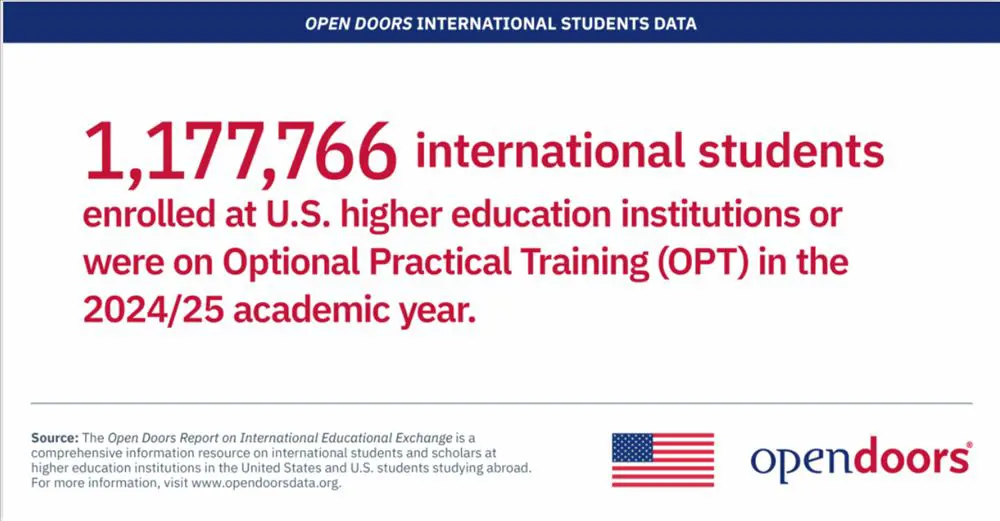
Recently, the Institute of International Education (IIE) released the "2025 Open Doors Report," providing valuable insights into global study abroad trends: for the 2024/2025 academic year, the total number of international students enrolled in various higher education institutions in the United States reached approximately 1.178 million, an increase of 4.5% from the previous year, setting a new historical high. This marks the fourth consecutive year of growth in the number of students studying in the U.S.
However, beyond the overall growth, structural changes have occurred across various dimensions such as source countries, stages of study, and field of study, particularly reflecting the trends among Chinese students, indicating that the Chinese study abroad market is transitioning from an era of "quantity" to "quality competition."

India Surpasses China for the First Time:
Global Study Abroad Landscape Reshaped
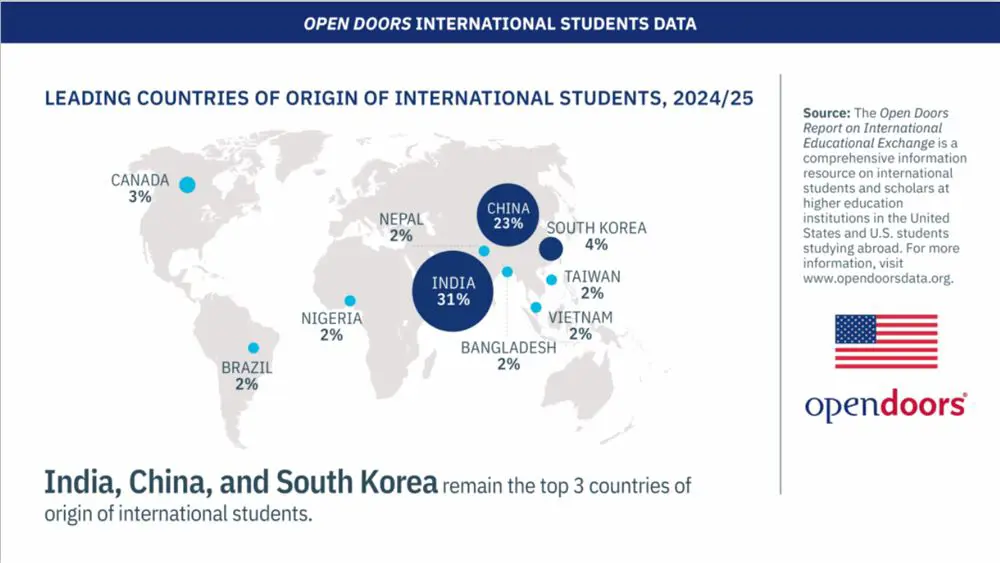
The report shows significant changes in the ranking of major sources of international students in the U.S. for the 2024/25 academic year:
• The number of Indian students in the U.S. reached 363,000, a year-on-year increase of 9.5%, accounting for 30.8% of the total.
• The number of students from mainland China in the U.S. was 266,000, a year-on-year decrease of 4.1%, accounting for 22.6%.
• The combined number of students from China and India accounted for 53.4% of the total international student population in the U.S., still dominating the U.S. international education market.
• Other top ten source countries include South Korea, Canada, Vietnam, Nepal, Taiwan, Nigeria, Bangladesh, and Brazil.

Structural Differentiation in Stages of Study
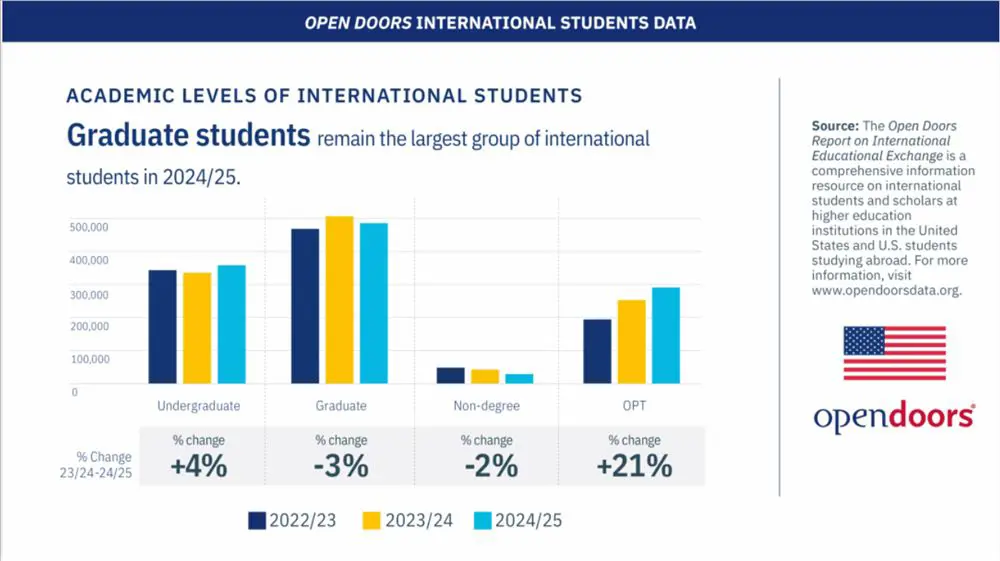
From the perspective of the stages of study for international students in the U.S., the 2024/25 academic year presents the following characteristics:
• There are 357,231 international students pursuing undergraduate degrees, an increase of 4% year-on-year.
• There are 488,481 international students pursuing graduate degrees, a decrease of 3% year-on-year.
• The number of students holding OPT visas is 294,253, a significant increase of 21% year-on-year.

Among these, for the 2024/25 academic year, the number of Chinese students pursuing undergraduate degrees in the U.S. plummeted by 10.2% year-on-year, totaling only 78,583; the number of graduate students was 120,229, a slight decrease of 2.1%; the number of Chinese students holding OPT (Optional Practical Training) increased to 61,981, a growth of 0.7%.
The surge in OPT is particularly noteworthy. As a key status for internships in the U.S. after graduation, it has become a core bridge for international students transitioning from campus to the workplace. The conclusion behind the data is clear: students are no longer solely focused on "studying" but are beginning to place greater emphasis on "employment" and future development.
STEM Fields Continue to Thrive
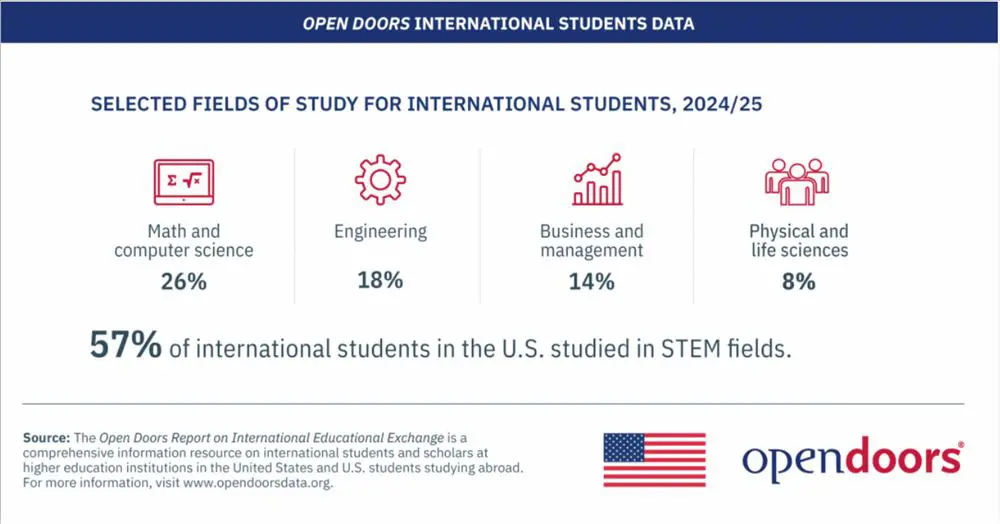
STEM majors (Science, Technology, Engineering, and Mathematics) remain highly favored by international students, with 57% of international students choosing STEM fields. Specifically:
Mathematics and Computer Science are the most popular fields, with 305,377 students choosing them, accounting for 26% of the total.
Engineering majors have 217,016 students, accounting for 18%.
Business and Management majors have 159,857 students, accounting for 14%.

The trend among Chinese students is even more pronounced: Mathematics and Computer Science account for 23.6%, and the STEM field has seen continuous growth for 14 years.
The Era of Rational Study Abroad Has Arrived
Considering multiple trends, Chinese families are transitioning from the past approach of "broad net study abroad" to a more refined and pragmatic educational planning: focusing more on the return on investment (ROI) of U.S. education; emphasizing the alignment between majors and future employment; prioritizing long-term development for their children rather than short-term diplomas; and paying more attention to the decisive impact of identity on internships, employment, and industry choices.
In other words, studying abroad is no longer just about "reading books," but rather a complete system encompassing identity, employment, and future development.

The Biggest Variable in the Study Abroad Path:
Uncertainty of Visa and Identity
Despite the strong appeal of U.S. educational resources, the core challenges faced by international students have not diminished: the costs of H-1B work visas have risen significantly, and the H-1B lottery will be weighted by wage levels; the F-1 student status is proposed to be adjusted to fixed-term management; signals of tightening or even canceling the OPT internship policy have emerged; and employment opportunities in the U.S. are highly dependent on the stability of identity... In the context of increasing global competition, identity has become a decisive factor in whether students can successfully develop.
More and more Chinese families are realizing that what truly limits their children's future competitiveness is not the school or grades, but the uncertain identity.
In this context, an increasing number of families are choosing to plan for long-term identity in the U.S. before their children go abroad. Among various pathways, the EB-5 investment immigration program, with its stability and certainty, has become the preferred option for families studying abroad.
Under the new EB-5 law, rural EB-5 projects are exempt from waiting periods and have priority approval advantages; the "dual submission" policy allows applicants to submit both I-526E and I-485 in the U.S. simultaneously, obtaining a Combo card in about three months, quickly achieving legal residency and employment eligibility. Now is a critical window for planning U.S. identity and seizing opportunities.
WorldWay holds two high-quality EB-5 rural projects, further assisting investors in achieving stable, no-wait, and efficient U.S. identity planning, quickly stepping onto the new path of life in the U.S. Global quotas are limited, and seats are scarce; first come, first served!


For inquiries in mainland China: 400-138-2929, Hong Kong customer service center: (852)2802 8798