





Recently, U.S. immigration policy has been undergoing a “sharp turn”!
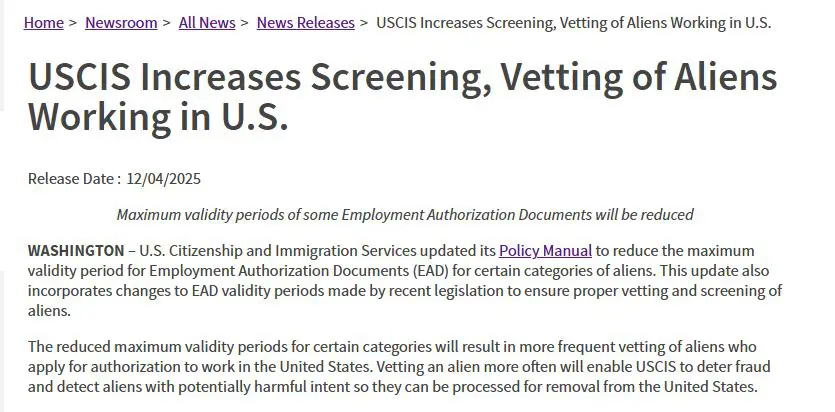
Following Trump's announcement to suspend all immigration applications from 19 countries and the re-examination of individuals with statuses such as H-1B, a major announcement from U.S. Citizenship and Immigration Services (USCIS) on December 4th once again shattered the calm for those in the U.S.: starting December 5, 2025, the maximum validity period for initial and renewal EADs (Employment Authorization Documents) for foreign nationals, including those in employment-based and family-based immigration categories, has been adjusted from 5 years to 18 months.


Who is affected?
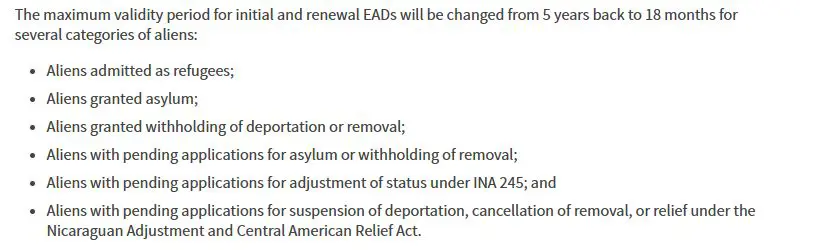
According to the latest policy manual released by USCIS, this policy applies to EAD applications in the following categories that are filed or pending on or after December 5, 2025. This includes:
• Refugees granted admission
• Foreign nationals granted asylum
• Foreign nationals granted withholding of removal/deportation
• Foreign nationals currently applying for asylum or withholding of removal
• Individuals filing Form I-485 for adjustment of status under INA 245
• Foreign nationals who have filed for cancellation of removal or under the Nicaraguan Adjustment and Central American Relief Act (NACARA)

Key Takeaway!
New policy has limited impact on EB-5 applicants
This tightening of U.S. work authorization policy has limited overall impact on EB-5 employment-based immigration applicants. The core focus of the new policy is to strengthen the review of work authorization applications and increase the frequency of oversight, rather than blocking the EB-5 immigration channel. Applicants do not need to worry excessively about the stability of their status pathway.
• It does not affect concurrent filing of I-526E and I-485; the core application process and approval path remain unchanged;
• EB-5 investors who already hold valid work authorization are not affected; existing validity periods remain unchanged;
• New EB-5 applicants can simply renew their cards on schedule; this only increases paperwork and renewal costs, with no legal-level risks.
Behind the policy shift
“High-pressure control” of U.S. immigration has arrived
Behind the sudden policy shift is the layering of U.S. immigration policies. The sharp reduction in EAD validity is just the tip of the iceberg regarding the uncertainty of U.S. immigration policy.
In fact, this is not an isolated case—the termination of automatic EAD extensions in October 2025, the surge in H-1B application fees to $100,000, and stricter OPT reviews have built a “high-pressure control network,” and the former “era of policy leniency” is becoming a footnote in history.
Currently, U.S. status-related policies have entered a tightening cycle, and it is highly probable that USCIS will continue to raise the threshold for applications. For those planning their U.S. status, now is truly a golden window—the sooner you initiate your application, the better you can lock in existing policy benefits, minimize the uncertainty and additional costs brought by future policy changes, and build a strong defense for your status planning.
From “passive renewal” to “proactive planning”
EB-5 becomes a key option
Facing policy tightening, the strategy of “relying on temporary status to survive” is no longer sustainable. The real solution is to lock in a long-term status path in advance—the EB-5 investment immigration program, with its triple advantages of “no visa backlog + concurrent filing + fast work authorization,” has become the “stabilizer” for current U.S. planning.
Advantage 1: Reserved visa categories with “no backlog,” ensuring seamless status transition
EB-5 rural projects currently enjoy “no backlog” status, and USCIS grants them priority processing. This means applicants do not need to spend time in long backlogs and can quickly advance the status adjustment process, fundamentally eliminating the “dependence on temporary work authorization.”
Advantage 2: “Concurrent filing” policy implementation, enjoy quasi-green card benefits in advance
For eligible applicants within the U.S. (such as international students or work visa holders), they can simultaneously file the I-526E immigration petition and the I-485 adjustment of status application, while also applying for travel authorization (I-131) and work authorization (I-765). This means that during the green card approval period, one can obtain a Combo card (work authorization + advance parole), achieving a “quasi-green card life” with legal residence, free employment, and convenient travel.
Advantage 3: Leading approval efficiency, getting a card in 3 months is not a myth
Compared to the processes of other immigration pathways, the Combo card approval speed for EB-5 projects has a clear advantage. Taking Worldway Group as an example, many batches of investors have successfully received their Combo cards about 3 months after filing, significantly shortening the waiting time for the “status gap” and providing stable protection for work and life.
Status planning: it is always better to be early than late
This announcement from USCIS is like an alarm bell, waking up everyone who is still watching and waiting. It tells us with the cruelest reality: the era of relying on temporary status is passing; proactive planning and locking in permanent status is the right way. Opportunities are always reserved for those who are prepared and have foresight. Now is the best time to take action!
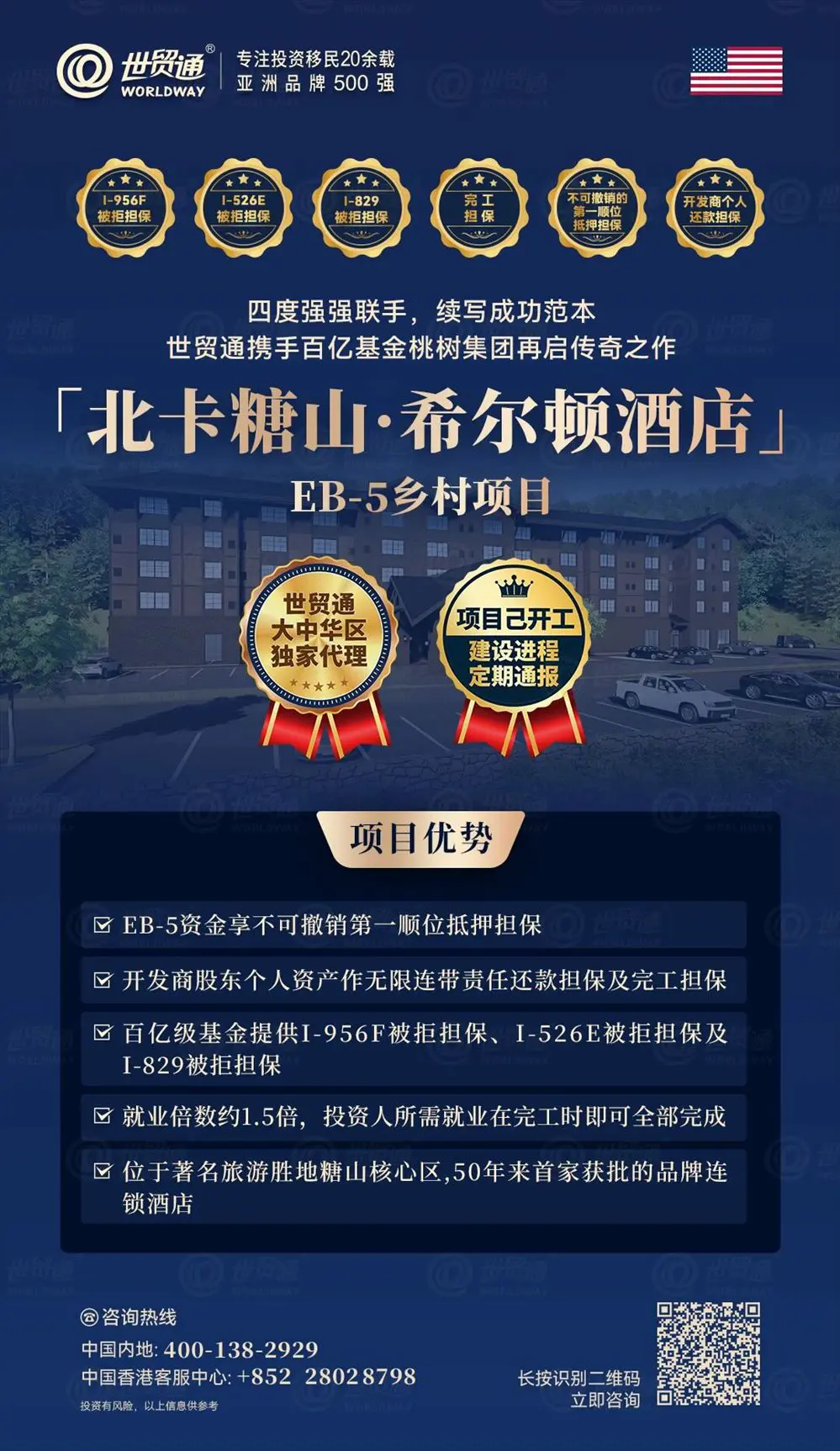
Worldway Group holds two high-quality EB-5 rural projects, which can help investors achieve their U.S. status planning steadily, without backlogs, and efficiently, quickly embarking on a new life in the United States. Global quotas are limited, seats are scarce, first come, first served!



For detailed inquiries in Mainland China: 400-138-2929, Hong Kong Customer Service Center: (852)2802 8798