





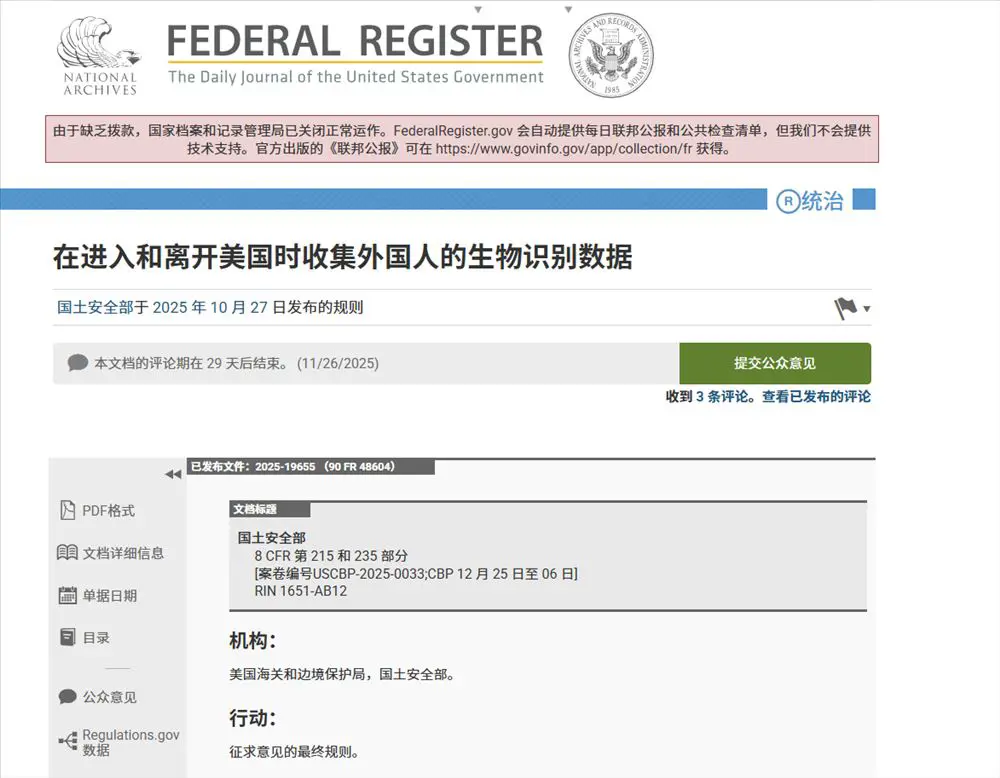
Recently, the U.S. Department of Homeland Security (DHS) officially announced new border management regulations in the Federal Register: it will require all non-U.S. citizens (including green card holders) to undergo mandatory facial recognition and other biometric data collection upon entry and exit.

Core Content:
Mandatory collection for all, no age exemptions
The core requirement of the new regulations is that all non-U.S. citizens must undergo facial recognition upon entry and exit. This includes visitors entering on visas, work visa holders, student visa holders, and permanent residents (green card holders).
The U.S. Customs and Border Protection (CBP) will significantly expand the scope of biometric data collection, implementing facial recognition and photo collection measures at land, sea, and air ports simultaneously.
Specific changes include:
• Comprehensive mandatory collection: Regardless of entry or exit, all U.S. ports will photograph "non-U.S. citizens" and may collect fingerprints and other biometric data.
• Elimination of age exemptions: The new regulations remove exemptions for children under 14 and elderly travelers over 79, meaning that nearly all age groups of non-citizens will have their facial data collected.
• Integration of existing systems: CBP has already been using facial recognition technology for incoming travelers at most international airports; this new regulation will expand that process into a mandatory procedure for all entry and exit phases.
• Data comparison mechanism: CBP will establish a unified image database to compare photos from passports, visas, and other travel documents with images collected in real-time during entry and exit to verify traveler identities and prevent document fraud.
Implementation Timeline:
Effective by the end of 2025, gradually expanding nationwide
The new regulations entered the comment period on October 27, 2025, and are expected to officially take effect after the comment period ends (December 26, 2025).
CBP anticipates that within the next three to five years, the biometric entry and exit system will be fully implemented at all commercial airports, seaports, and major land border ports. Currently, the system will first be piloted at high-traffic international flight ports and major ports, gradually expanding nationwide.
From fingerprinting to facial recognition, U.S. border control is fully entering the "biometric era." While this new regulation enhances national security and customs efficiency, it has also sparked widespread discussions about personal privacy boundaries and data security.
In the future, the U.S. government will be able to track non-citizens' entry and exit records more accurately through the biometric system. For various visa holders and green card holders, it is advisable to regularly verify visa and entry-exit information to ensure accurate identity records, avoiding impacts on future visa renewals, green card adjustments, or citizenship applications.
Of course, this policy is still in the comment phase, and the final plan may be adjusted. WorldWay will continue to monitor the latest developments and provide you with subsequent updates.
EB-5 Investment Immigration:
A fast track to the United States
As a traditional immigration powerhouse, the United States has a strong attraction for global talent due to its robust economic strength, high-quality educational resources, free social environment, and stable legal system. In light of increasingly stringent entry and exit regulations, whether you are studying, working, or living in the U.S., a legal and compliant immigration status is always the most secure choice.
Among various pathways, EB-5 investment immigration is undoubtedly the most direct and efficient method: the application requirements are simple, with no age, language, education, or business background requirements; one application allows the whole family to immigrate. Under the new EB-5 legislation, investors can choose visa reserved category projects for expedited immigration to the U.S. Currently, EB-5 rural project quotas are ample and enjoy priority approval from the immigration bureau; applying early secures an earlier priority date.
The two projects approved by I-956F, exclusively represented by WorldWay in the Greater China region, are: "Great Smoky Mountains - Marriott Hotel" EB-5 rural project and "Florida Lakeside Jewish Community Phase II" EB-5 rural project, which further assist investors in achieving U.S. identity planning safely, without waiting periods, and efficiently, quickly embarking on a new life in the United States.
Global quotas are limited, and seats are scarce—first come, first served; opportunities should not be missed!


It is worth noting that the EB-5 grandfathering rule has entered the final 11-month countdown (expires on September 30, 2026). Applications submitted before this date will be protected under current policies. Opportunities are fleeting; the earlier you submit, the more secure!

For inquiries in mainland China: 400-138-2929, Hong Kong customer service center: (852)2802 8798