





On October 20, 2025, U.S. Citizenship and Immigration Services (USCIS) released the latest guidance regarding the $100,000 H-1B visa application fee, clarifying the scope of applicability and exemption conditions. Please join the WorldWay Group to take a look.
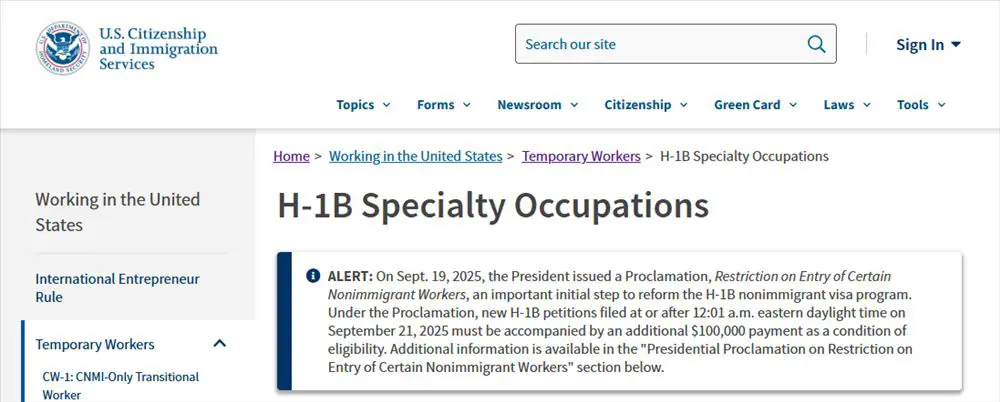

Situations requiring the $100,000 fee
1. New H-1B applications filed by employers for applicants who are outside the United States and do not hold a valid H-1B visa (on or after the early morning of September 21, 2025).
2. H-1B applications for applicants who are within the United States but must process their visa via consular notification, port of entry notification, or pre-flight inspection due to loss of status, departure, or other reasons.
3. Applications for change of status, extension, or amendment filed within the United States, where USCIS determines the applicant does not meet the eligibility requirements (e.g., lack of a valid non-immigrant visa, or the applicant departing the U.S. before the adjudication of the change of status request, rendering the status conversion invalid).
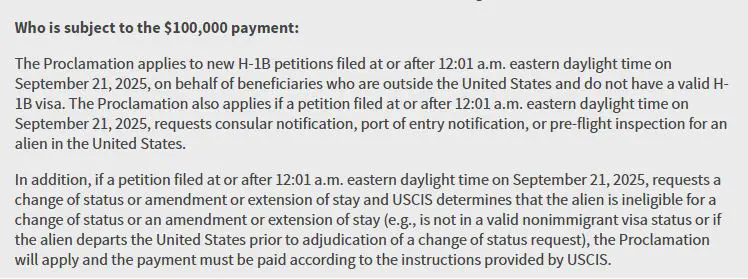

Situations exempt from the $100,000 fee
1. Applicants who already hold a valid H-1B visa are not affected by entry/exit or renewal.
2. H-1B applications submitted before September 21, 2025, will continue to be processed under the old rules.
3. Applicants within the United States who apply for an H-1B via "change of status" or "visa extension" while in legal status (e.g., F-1/OPT) and do not depart before approval are not subject to the $100,000 surcharge. If an applicant departs and re-enters the U.S. after receiving an H-1B visa approval while in the country, they are not considered subject to this fee as long as they hold a currently valid H-1B visa.
4. Applicants transitioning from F-1 student status to H-1B within the United States are not affected, even if they subsequently depart the country to obtain a visa stamp.
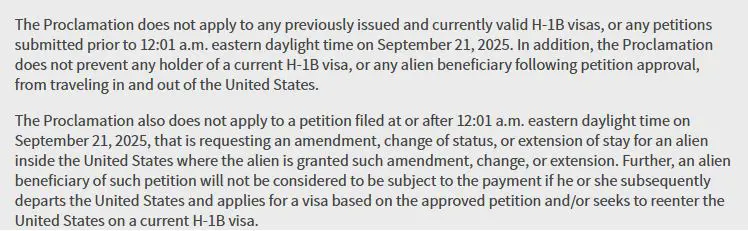

Fee Payment Method
Employers must pay the $100,000 via Pay.gov (https://www.pay.gov/public/form/start/1772005176) before submitting the H-1B application and include the payment receipt with the case. If the applicant meets the "National Interest Waiver" criteria of the Secretary of Homeland Security, the waiver certification must be attached. Applications submitted without the required proof will be rejected.
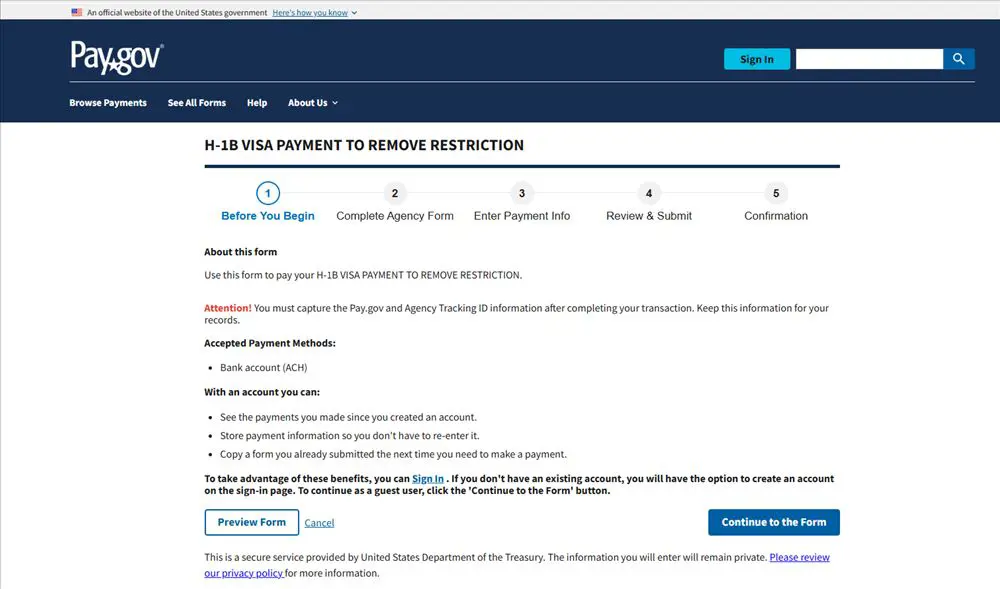

Exemption Conditions
The Secretary of Homeland Security may approve a waiver in "extremely rare" circumstances, provided the following conditions are met:
(1) The foreign employee's work serves the U.S. national interest;
(2) No U.S. worker is qualified for the position;
(3) The foreign employee will not endanger U.S. security and welfare;
(4) Paying the fee would "severely harm" U.S. interests.
This policy is not the "one-size-fits-all" approach initially feared by the public, but rather a more refined adjustment: it primarily affects applicants who are outside the U.S. and do not yet hold a valid H-1B, while providing a certain "protective layer" for international students who have studied and accumulated work experience within the U.S. In the short term, this objectively alleviates anxiety within the international student community.
Although the current impact is limited, the trend has changed!
1) Short-term: Domestic pathways are more "stable," and anxiety is becoming manageable.
Applicants studying and working in the U.S. generally do not trigger the $100,000 surcharge as long as they maintain continuous legal status and complete their status change/extension within the country. This provides predictability in compliance and costs for a large number of international students (F-1/OPT → H-1B).
2) Mid-term: Structural changes in quota competition.
The high fee will significantly suppress direct applications from abroad, "squeezing" more demand into the domestic application pool. The focus of competition will shift more toward graduates of U.S. universities and those already working in the U.S.
3) Employer side: Dual considerations of cost and compliance.
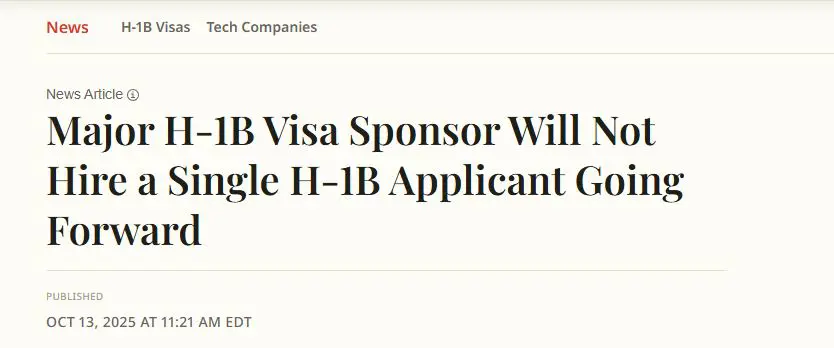
Faced with increased costs and process uncertainty, corporate human resources strategies may shift: hiring preferences will turn toward talent already in the U.S. who can directly complete a status change, and reliance on H-1B will be reduced. Take Tata Consultancy Services as an example—this is one of the largest employers of visa-holding staff in the U.S., with 5,505 H-1B approvals in 2025, second only to Amazon's 10,044. Its CEO has stated that they will stop hiring new employees via H-1B in the future and shift to a "local-first" approach to implement a strategy of "reducing reliance on visas." In other words, even top employers known for H-1B usage are starting to lean toward "hiring only locally and using fewer visas"; the shift in employment trends is self-evident.
4) Linkage risk with the "salary lottery" logic.
Future lotteries will shift to using salary levels as a key variable, amplifying the quota advantage for high-paying positions and top-tier offers; conversely, pressure on entry-level/fresh graduate and small-to-medium enterprise positions will increase. With the cumulative effect of the $100,000 new case threshold, the focus of competition will further tilt toward a combination of high-paying, U.S.-based, and status-stable applicants and employers.

Status Prioritization:
From "Seeking a Visa" to "Securing Status"
Against this backdrop, status stability has become the primary variable in academic and career planning: any uncertainty in the lottery, loss of status, or departure will translate into uncertainty in opportunity and time costs. Relying solely on an offer letter is difficult to hedge against policy and quota fluctuations.
Therefore, more and more families are beginning to prioritize status planning, using EB-5 as the main path: with the goal of obtaining a Green Card, the path is more predictable and does not rely on employer sponsorship or salary weighting; with status secured first, career and geographic choices are freer, and children's education and family settlement can proceed simultaneously.
Since the implementation of the "Reform and Integrity Act" in 2022, EB-5 has ushered in three key innovations: sufficient reserved visa quotas, enjoying exemption from waiting periods; rural EB-5 projects, enjoying priority processing rights; and allowing "concurrent filing," submitting I-526E and I-485 applications simultaneously, with the possibility of obtaining a Combo card in as fast as about 3 months, achieving legal residence and work authorization. Now is the best time to immigrate via EB-5.


It is worth noting that the EB-5 grandfather clause has entered its final year countdown (expiring September 30, 2026). Applications submitted before this date will be protected by current policies. Opportunities are fleeting; the earlier you submit, the more secure you are!

For detailed inquiries in Mainland China: 400-138-2929, Hong Kong Customer Service Center: (852) 2802 8798