





In the common perception, a degree from Stanford University is like a shining gold-plated sign that paves a smooth path to a successful career. However, reality is often much crueler than imagined.
Recently, Emma, a Chinese international student holding both a bachelor's and a master's degree in English Language and Literature from Stanford, has found herself mired in a job-hunting quagmire.
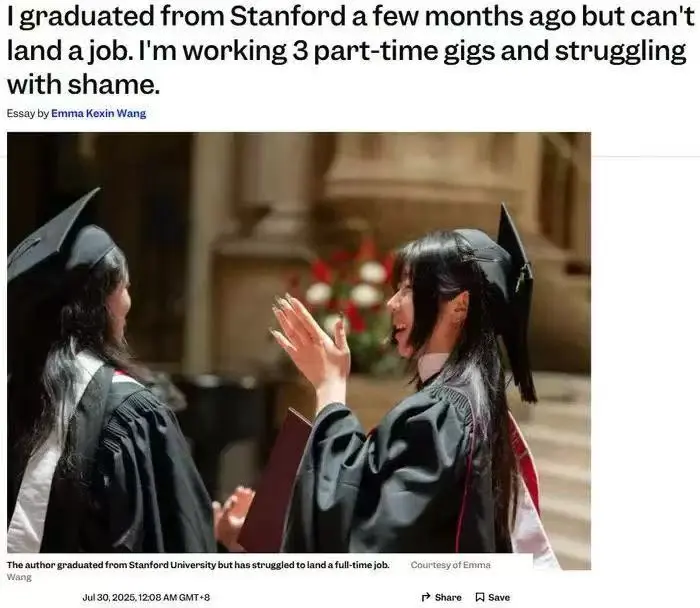
She might have once believed that this path, paved with countless hours of hard work and the prestige of a top-tier university, would lead directly to a bright and brilliant professional future. However, the reality after graduation dealt her a heavy blow: after submitting over 100 resumes and enduring countless applications that sank without a trace and very few interviews, she failed to find a full-time job that could provide her with a work visa (H-1B). Today, she relies on three part-time jobs—college application essay coaching, editing for an ed-tech company, and freelance writing for an AI startup—to barely maintain her legal status in the U.S., while struggling with the high cost of living in Silicon Valley and mounting anxiety.

Her story has quickly resonated widely on social media. It is not an isolated case, but a mirror reflecting the cruel reality faced by countless international students in the U.S. under the multiple barriers of visas, economics, and culture.
Why does the prestige of a top university fail to overcome the barriers of reality?
Emma's case exposes the structural difficulties international students face when job hunting in the U.S. Despite having a background from a top-tier university like Stanford, she still repeatedly hit walls on her job search and ultimately had to rely on three part-time jobs to make ends meet.
International students face unique identity challenges when job hunting in the U.S. Students holding an F-1 visa can apply for Optional Practical Training (OPT) work authorization after graduation, but they must strictly comply with relevant regulations: during the OPT period, the cumulative number of unemployment days must not exceed 90 days (a total of 150 days for STEM majors), otherwise the SEVIS record will be terminated and the OPT status will immediately expire. It should be noted that although the USCIS grants a 60-day grace period for departure or change of status, the OPT work authorization has already terminated.
Even if they successfully obtain a job offer, international students still need to apply for an H-1B work visa before their OPT ends to continue working in the U.S. In recent years, the number of H-1B applications has continued to rise, and the winning rate has decreased year by year. This application process is not only time-consuming and labor-intensive, but the results are also highly uncertain, leading many small and medium-sized employers to be cautious about hiring international students.
Meanwhile, the current slowdown in the tech industry, coupled with frequent hiring freezes and waves of layoffs, has made the already fierce job market competition even more intense. Even Stanford graduates must compete with a large number of experienced job seekers for limited entry-level positions.
Policy Tightening:
The future path for international students to find jobs in the U.S. is becoming increasingly difficult
The predicament Emma faces may become even more severe for international students in the coming years. The U.S. government's policy on work visas for international students is showing a trend of continuous tightening:
• OPT duration may be shortened or cancelled: There are proposals to shorten or even cancel the OPT period for non-STEM majors, which will significantly compress the job-hunting window for students.
• H-1B lottery rule reform: To improve fairness, although a "one person, one registration" system has been implemented to reduce abuse, the total visa quota has not been increased, and whether one is selected still depends entirely on luck. In addition, the USCIS is considering replacing the current purely random lottery model with a wage-level priority model, where high-paying positions will have a higher probability of being selected.
• Higher requirements for employer qualifications: The qualification review for employer companies applying for H-1B is more stringent, requiring proof of the professional nature of the position and the reason for "being unable to find a suitable U.S. worker." This increases the employer's recruitment costs and legal risks, making them more inclined to hire local candidates.
This means that in the future, even if international students overcome all obstacles to get an offer, they still need to become the "chosen ones" in the H-1B lottery, a difficulty that can be described as "hell mode."
Alternative paths under the identity dilemma
As Emma wrote, "Is the long road of studying abroad really worth it?" The return on a top-tier education cannot always be directly exchanged for a stable job and visa. All signs indicate that future policies related to international students, such as F-1 visas and OPT, will continue to become more stringent, and the risk of relying on the single "F-1→OPT→H-1B" path for long-term development in the U.S. is becoming increasingly high. For students planning to go to the U.S. or currently studying there, Emma's experience is a crucial warning: You must conduct career planning as early as possible, choose majors rationally, actively expand your network, and fully understand all possible paths to stay in the U.S., including EB-5 investment immigration, EB-1A & NIW immigration, etc., and be well-prepared with multiple plans.
Currently, coinciding with the 19th Anniversary Celebration of WorldWay's U.S. Investment Immigration, this immigration gala, covering the period from September 1, 2025, to September 30, 2025, brings rare exclusive offers to families in need. Interested parties should seize the opportunity, act immediately, and process as soon as possible.

The "Wealthy" Choice: EB-5 Investment Immigration
Choose the EB-5 reserved visa project, invest $800,000, and submit I-526E and I-485 applications simultaneously. You can obtain a Combo card in about 3 months. Waiting for the green card does not affect entry and exit, allowing you to legally reside, study, and work in the U.S. without employer sponsorship, enjoying quasi-green card freedom in advance. Under the new policy, there is no visa backlog, making it the fastest way to obtain a green card currently. At present, two high-quality rural projects selected by WorldWay are highly favored:
• "Great Smoky Mountains • Marriott Hotel" EB-5 Rural Project: Combines numerous advantages, approximately 1.5 times real estate first-priority guarantee + developer shareholders provide joint and several liability repayment guarantee with personal assets; a multi-billion fund provides I-956F rejection guarantee, I-526E rejection guarantee, and job creation guarantee; the job multiplier is as high as 1.7 times; the project is located in the Great Smoky Mountains National Park, which has tens of millions of visitors, far exceeding Yellowstone; it is located in the prime town of Gatlinburg, where property is in high demand; the project has already started, hotel development has entered the substantive construction stage, supervision is transparent, construction progress is reported regularly, and it is your preferred choice for your whole family to obtain a U.S. green card quickly without a backlog.

• "Florida Lakeside Jewish Community" Project: Has achieved "three approvals" for I-956F, I-526E, and green card, the project is under full construction, and currently only a small number of precious spots remain. First come, first served; please hurry if you are interested.

Talented: EB-1A & NIW Immigration
The EB-1A Extraordinary Ability and NIW National Interest Waiver projects have many advantages, such as fast approval, accelerated processing, one person applying for the whole family to immigrate, no investment required, low input costs, and obtaining a U.S. green card in one step. If you are interested, you can contact WorldWay for qualification assessment and personalized solution customization services.

Facing the increasingly tightening policies for staying in the U.S., instead of passively waiting in the anxiety of job hunting and visas, it is better to actively seize the opportunity to lock in a more stable future for yourself and your family. For detailed inquiries, please contact Mainland China: 400-138-2929, Hong Kong Customer Service Center: (852) 2802 8798
Some materials in this article are from public platforms on the Internet and were not first collected or published by this official account. If there is any infringement, please contact us.
Note: 1. Within the scope permitted by law, the right of final interpretation of this promotional activity belongs to WorldWay Group. 2. Investment involves risks; the above information is for reference only.