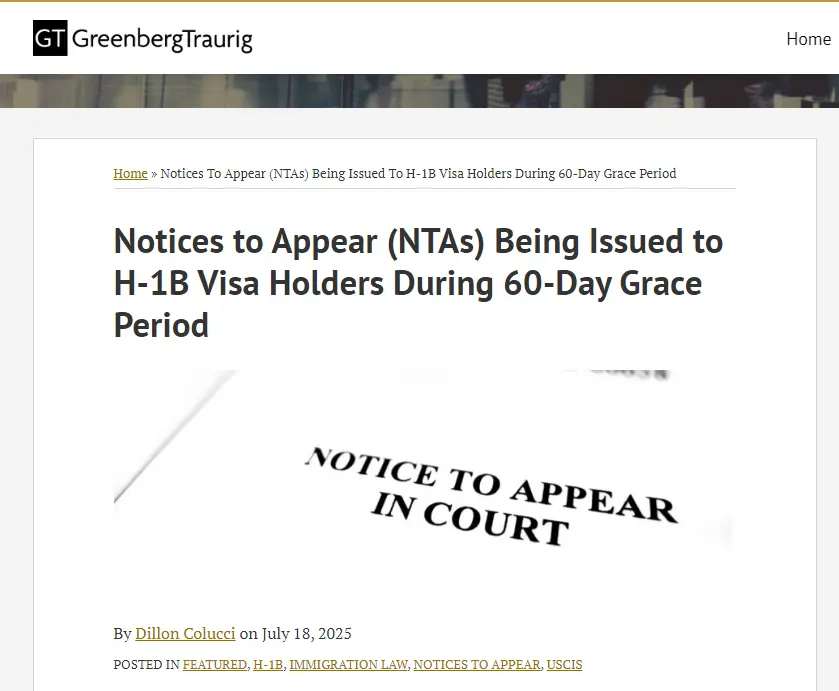
Recently, changes in U.S. immigration policy have caused anxiety among many H-1B visa holders. The 60-day unemployment grace period, traditionally seen as a "safety buffer," is losing its protective function. According to a notice from the U.S. Citizenship and Immigration Services (USCIS), some H-1B visa holders have received Notices to Appear (NTA) during the 60-day grace period, which means they may face the initiation of deportation proceedings.

H-1B Grace Period Policy Tightened: From "Buffer Period" to "Deportation Countdown"
According to the provisions of 8 CFR 214.1 (l)(2), H-1B visa holders are entitled to a maximum grace period of 60 days after employment termination, or until the expiration of their I-94, whichever is shorter. However, the regulation also states that "the Department of Homeland Security (DHS) may, in its discretion, cancel or shorten this 60-day grace period." Recent cases show that USCIS may exercise this discretion in certain situations, terminating the grace period early.
In the past, USCIS typically considered enforcement actions only after the grace period had ended. The current practice of initiating deportation proceedings during the statutory grace period is an unprecedented tightening of policy.
WorldWay Immigration advises H-1B visa holders to take action as soon as employment ends, seeking a new employer or applying for a change of status to avoid losing their status due to an early termination of the grace period.
Systemic Risks of the H-1B Visa: From Unemployment Crisis to Green Card Dilemma
The challenges faced by H-1B visa holders extend beyond the tightening of the grace period. The recent wave of layoffs in the U.S. high-tech industry has left many foreign professionals in a "unemployment equals loss of status" predicament. Under current immigration regulations, the H-1B visa is highly tied to the employer, and once laid off, the visa status becomes invalid. Laid-off employees have only 60 days of grace period to find a new employer and complete the status transfer; failure to do so means they must leave the country. More severely, USCIS has recently begun exercising discretion by issuing NTAs to some visa holders during the grace period, rendering the buffer period virtually meaningless.
The validity limit of the H-1B visa is another risk. This visa is typically valid for 3 years and can be extended to a maximum of 6 years. After expiration, if there is no PERM labor certification or I-140 green card application, the holder must leave for one year and re-enter the H-1B lottery. The acceptance rate for H-1B applications continues to decline, making competition exceptionally fierce.
Even if one is fortunate enough to win the lottery, the path from H-1B to green card remains long, requiring a waiting period of over 10 years, during which the risk of policy changes is extremely high.
EB-5 Investment Immigration: An Alternative and Fast Track for H-1B Holders
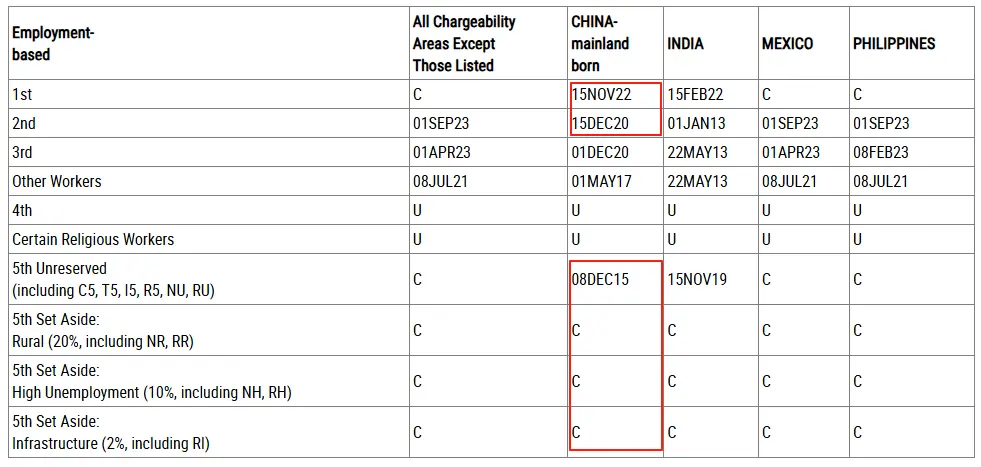
In the face of increasing uncertainty surrounding the H-1B visa, more and more professionals in the U.S. are beginning to view EB-5 investment immigration as a "fast track" to obtaining a U.S. green card. Especially after the implementation of the EB-5 Reform and Integrity Act in 2022, the new EB-5 policy provides applicants with a golden window period with no backlog and the ability to "file concurrently," making it an ideal choice for resolving identity crises.
The core advantage of the new EB-5 policy is that its reserved visa category currently has no backlog. EB-5 applicants in the U.S. can adopt a "concurrent filing" strategy, submitting the I-526E immigration application and the I-485 adjustment of status application simultaneously, along with the I-765 work permit application and the I-131 application for re-entry. This strategy allows applicants to obtain a Combo Card while waiting for I-526E review, enabling them to legally reside, work, study, and live in the U.S., almost enjoying full green card rights.
It is worth noting that the window for EB-5 reserved visas will not exist indefinitely. USCIS has issued its first "backlog warning" in the visa bulletin for January 2025, and with the continuous increase in applications, the emergence of an official backlog is only a matter of time. Once a backlog begins, the "concurrent filing" privilege will automatically become invalid, and applicants will lose the opportunity to quickly obtain a Combo Card. Given the current situation, wise planning and prompt action are the preferred options for identity planning. It is recommended that interested applicants seize the current policy window, choose quality EB-5 projects, and submit applications early to lock in the current policy benefits.
Currently, the popular "Great Smoky Mountains • Marriott Hotel" EB-5 rural project is in high demand. This project is becoming a hot choice for EB-5 investment due to the following core advantages:
Project Highlights Include:
☑ Approximately 1.5 times first lien real estate guarantee + developer shareholders providing personal asset guarantees for repayment
☑ A billion-dollar fund providing guarantees for I-956F denials, I-526E denials, and job creation guarantees
☑ Project employment multiplier as high as 1.7 times
☑ Located in the Great Smoky Mountains National Park, which attracts tens of millions of visitors, far surpassing Yellowstone
☑ Situated in the prime town of Gatlinburg, where real estate is in high demand
☑ The project has commenced construction, and hotel development has entered a substantial construction phase, with transparent supervision and regular updates on construction progress

For inquiries in mainland China: 400-138-2929, Hong Kong customer service center: (852)2802 8798