





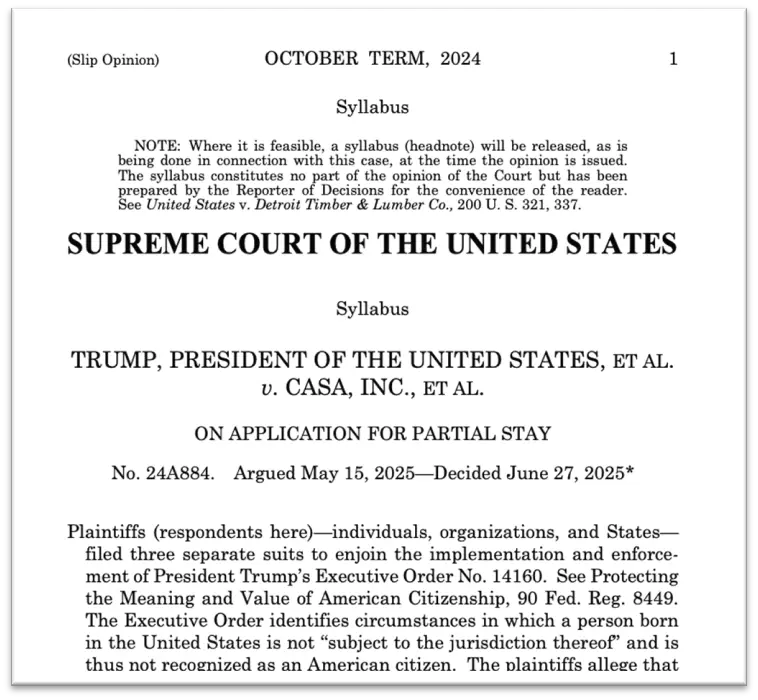
The executive order to 'end birthright citizenship' signed by the Trump administration on its first day in office has reached a new development following a complex series of legal battles involving federal court injunctions and Supreme Court rulings. The U.S. Supreme Court, in a 6-3 conservative majority decision, has limited the power of federal judges to issue 'nationwide injunctions.' This ruling means that President Trump's executive order to end 'birthright citizenship' will take effect nationwide, while injunctions from federal district judges will only apply to specific plaintiffs. This ruling has sparked intense controversy across the United States regarding nationality law.
Trump stated on social media: This is a "GIANT WIN! The Supreme Court ruled in our favor!"

01. Policy Roots: The Legal Basis for U.S. 'Birthright Citizenship'
The 14th Amendment to the Constitution stipulates that anyone born in the United States or subject to its jurisdiction is entitled to U.S. citizenship. This amendment, ratified in 1868, is the primary legal basis for those who support 'birthright citizenship.' This means that as long as a child is born on U.S. soil, they automatically acquire U.S. nationality, even if their parents are not U.S. citizens or permanent residents.
02. Policy Impact: Core Content and Controversy of the Trump Executive Order
On January 20, U.S. President Trump signed an executive order at the White House to abolish 'birthright citizenship' for children born in the U.S. to non-U.S. citizens and illegal immigrants. According to the executive order, the following two categories of newborns will be denied birthright citizenship:
• Parents residing illegally: If the mother is residing in the U.S. illegally and the father is not a U.S. citizen or green card holder, their child will not have citizenship at birth.
• Parents on temporary legal visas: Including holders of F-1 student visas, H-1B work visas, B-2 tourist visas, etc., even if they are residing legally, their children will not automatically acquire citizenship.
This order directly challenges the 14th Amendment and is expected to affect the nationality status of more than 150,000 newborns annually, triggering a joint lawsuit from 22 states and sparking a 'head-on collision' in politics and law.
03. Supreme Court Ruling: The U.S. Enters a State of 'Citizenship Division'
On June 27, the U.S. Supreme Court made a key ruling limiting the power of federal judges to issue 'nationwide injunctions,' further complicating the situation. This ruling has directly led to a division among U.S. states regarding 'birthright citizenship' policy:
• 22 Plaintiff States (Blue States): California, New York, New Jersey, and 19 other states, having jointly sued the Trump administration, still have effective injunctions issued by federal judges within their jurisdictions, and the birthright citizenship policy remains unchanged for now.
• 28 Non-Plaintiff States (Red States): Texas, Florida, and 28 other states did not participate in the lawsuit. Trump's executive order will be formally implemented 30 days after the ruling takes effect, meaning newborns whose parents are not U.S. citizens or green card holders will no longer automatically acquire U.S. nationality.
Although the Supreme Court supported the Trump administration on procedural grounds, it did not make a final ruling on the constitutionality of the executive order. The 22 plaintiff states can still challenge the legality of the policy within their own state judicial systems and may appeal to the Supreme Court again in the future. Worldway Group will continue to monitor the situation and share any new information with you immediately.
04. How Should Chinese Families Respond? Identity Planning Becomes a 'Necessity'
It is not difficult to see from the specific content of the executive order that for parents with green cards, children born in the U.S. remain U.S. citizens; green card status is once again protected amidst policy changes. Conversely, for parents without status or on temporary visas, their children will face significant policy risks. Therefore, for families planning to stay in the U.S., proactive planning for legal status has shifted from an 'optional choice' to a 'survival necessity.'
Families intending to go to the U.S. or already in the U.S. should plan for legal status as soon as possible. Main pathways include:
For the Wealthy: EB-5 Investment Immigration
Choose the EB-5 reserved visa category, invest $800,000, and simultaneously file Form I-526E and Form I-485. You can obtain a Combo card in about 3 months. During the wait for the green card, your ability to enter and exit the country is not affected, and you can legally reside, study, and work in the U.S. without employer sponsorship, enjoying quasi-green card freedom in advance. Under the new policy, there is no visa backlog, making it the fastest way to obtain a green card currently.

For the Talented: EB-1A & NIW Immigration
The EB-1A Extraordinary Ability and NIW National Interest Waiver programs offer numerous advantages, such as fast approval, accelerated processing, one application for the whole family, no investment required, low costs, and obtaining a U.S. green card in one step. If you are interested, please contact Worldway for a qualification assessment and personalized solution customization service.

For inquiries in Mainland China: 400-138-2929, Hong Kong Customer Service Center: (852)2802 8798