





Recently, Harvard University officially announced that it will waive tuition for students from families with an annual income of $200,000 or less! For students from families with an annual income of $100,000 or less, Harvard University provides not only tuition waivers but also free room, board, and medical services.

According to data from the U.S. Census Bureau, the actual median household income in the United States in 2023 was $80,610, an increase of 4.0% from the 2022 estimate of $77,540. This means that approximately 86% of American households will be eligible for free admission to one of the world's top universities!
It is also worth mentioning that Harvard University is currently one of the few elite institutions that implements a need-blind admission policy for international students. This means that during the admission stage, the applicant's financial situation is not considered; evaluations are based solely on academic ability, comprehensive quality, and potential. Even if a student indicates a need for financial aid, it will not have a negative impact on their admission results. This expansion of Harvard's tuition waiver scope undoubtedly provides more students with academic dreams the opportunity to study at an Ivy League school. The President of Harvard University stated: "Making Harvard affordable for more people broadens the backgrounds, experiences, and perspectives of all our students, fostering their intellectual and personal growth. By bringing together promising, outstanding talent to learn from one another, we truly realize the immense potential of the university."
It is reported that the new round of financial aid expansion will begin in the 2025-26 academic year, with the general details as follows:
Students from families with an annual income of $100,000 or less will be able to attend Harvard University for free. This will cover all billed expenses, including tuition, meals, housing, health insurance, and travel costs. In addition, these students will receive a $2,000 startup grant in their first year and a $2,000 startup grant in their junior year to help them transition smoothly to life beyond Harvard.
Students from families with an annual income of $200,000 or less will have their tuition waived and may receive additional financial aid based on their actual circumstances.
Students from families with an annual income higher than $200,000 may receive some financial assistance based on their individual situations.
For many years, Harvard University has been committed to lowering the financial barriers to higher education. Since 2004, Harvard has continuously raised the income threshold for tuition-free families: in 2004, students from families with an annual income of $40,000 or less could enjoy free tuition; in 2006, this threshold was raised to $60,000; in 2023, students from families with an annual income of $85,000 or less could enjoy free tuition; today, the threshold has been raised to $200,000, covering the vast majority of American households.
In recent years, an increasing number of universities in the United States have begun to offer free tuition based on family income, aiming to reduce the burden on low- and middle-income families and improve the accessibility of quality education. Harvard University is not the only elite institution expanding its tuition-free policy. Various schools are also stepping up efforts to address affordability. According to reports, last November, the Massachusetts Institute of Technology (MIT) and the University of Pennsylvania also announced tuition waivers for students from families with an annual income of $200,000 or less. In addition, schools such as Dartmouth College, New York University, and the University of Texas System have also launched similar tuition assistance programs in recent years.
It is worth noting that while enjoying the above policy benefits, one reality cannot be ignored: there are significant differences in tuition policies and admission competition between international students and domestic students. International students not only bear a tuition burden far exceeding that of domestic students, but they are also deeply mired in a vortex of intense competition when applying for admission, and they face even fiercer competition during the selection process.
Looking at the current situation, for families who dream of immigrating to the United States and hope for their children to study there, planning ahead to obtain a U.S. Green Card is undoubtedly a highly forward-looking and wise move. Once a U.S. status is successfully obtained, one can freely access American education just like a U.S. citizen. During university admissions, children with Green Cards have a much higher chance of admission than international students, enjoy equal application opportunities as domestic students, can choose popular majors, and benefit from more affordable university tuition. More importantly, after graduating from university, children with Green Cards face no restrictions on employment, do not need to get involved in the intense competition of the H-1B visa lottery, and enjoy more freedom and smoothness in their career development.
So, how can one quickly obtain a U.S. Green Card? Currently, the U.S. EB-5 investment immigration program is a highly favored method among investors. Under the new policy, applicants born in mainland China do not currently face a visa backlog. Submitting an application as early as possible to lock in a priority date is the way to realize the dream of immigrating to the United States sooner. At the same time, investors in the U.S. can simultaneously submit I-526E and I-485 applications while in the country to lock in "small Green Card" status (Employment Authorization Document + Advance Parole) in advance, enabling free work, study, and travel. The "concurrent filing" policy is the first time in U.S. immigration history that applicants are allowed to submit an adjustment of status application before their immigration petition is approved, and they can obtain a Combo card in as fast as about 90 days.
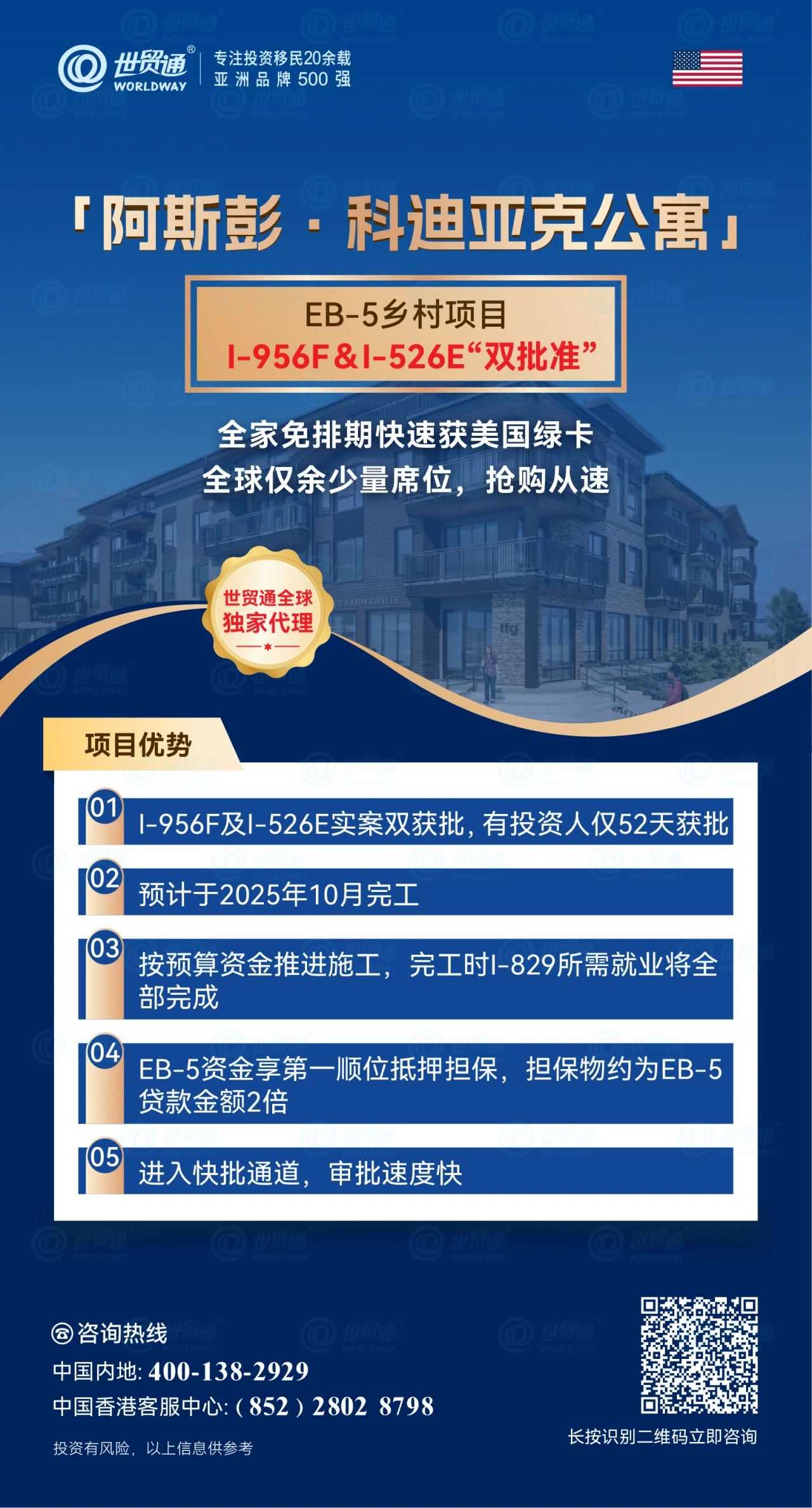
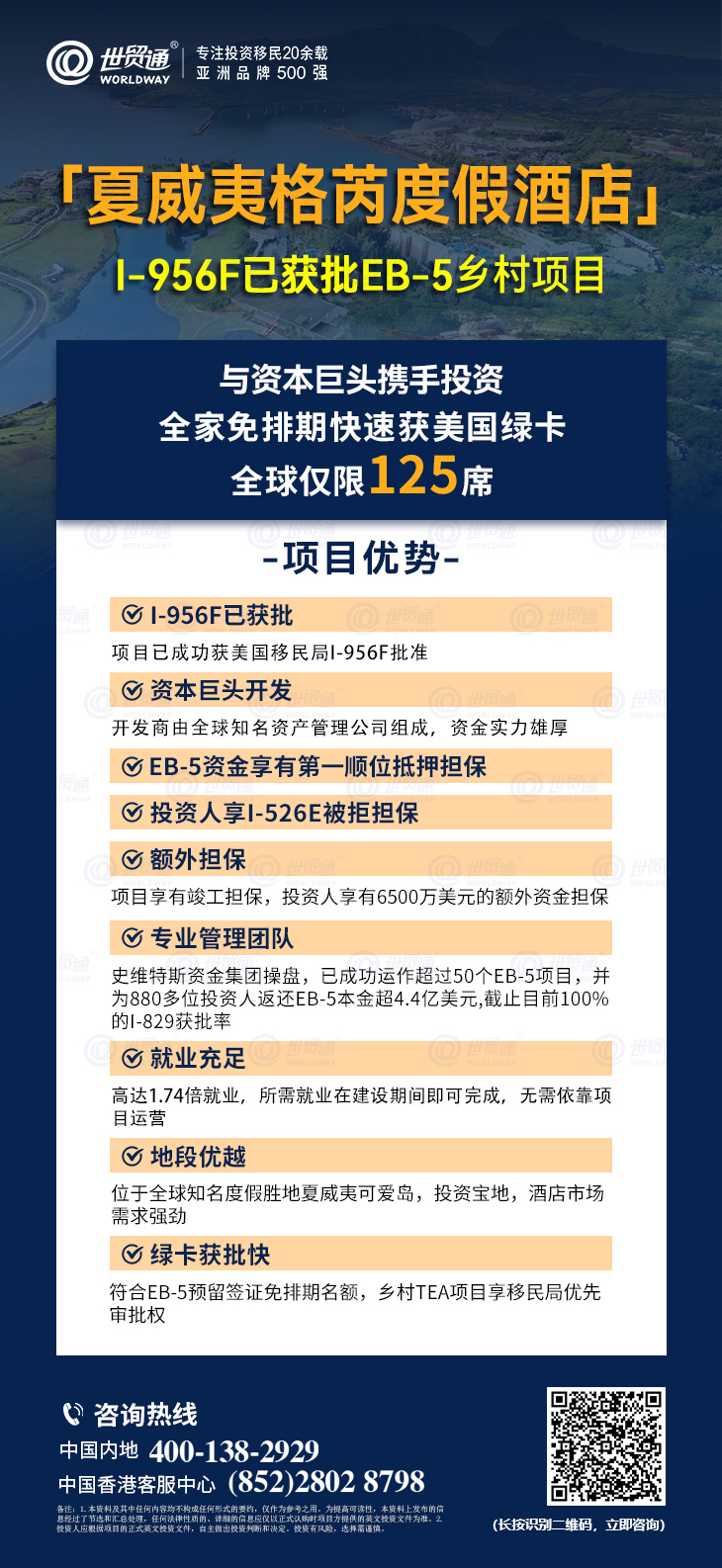
Currently, the rural project within the EB-5 reserved visa category is the preferred choice among the best options for quickly obtaining a U.S. Green Card. The two best-selling premium EB-5 projects on the market, the "Aspen Kodiak Apartments" which has received both I-956F and I-526E project approvals, and the "Hawaii Greystone Resort" which was created by capital giants and has received I-956F approval, are both high-quality EB-5 rural projects that have been screened and strictly vetted by the Worldway Group, making them your excellent choice for quickly immigrating to the United States.

For inquiries in mainland China: 400-138-2929, Hong Kong, China Customer Service Center: (852)2802 8798 *Investment involves risks, the above information is for reference only.*