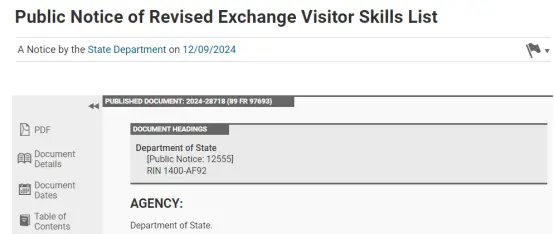
Recently, the U.S. Department of State announced an update to the Exchange Visitor Skills List. This revision includes the removal of 34 countries from the list, including China, India, South Korea, Saudi Arabia, and the United Arab Emirates. This means that J-1 visa holders from these countries will no longer be subject to the two-year home-country physical presence requirement. The new policy officially took effect on December 9, 2024!

The J-1 visa is a non-immigrant visa issued by the U.S. government to foreign nationals for purposes such as studying, advanced training, or conducting research in the United States. The U.S. government mandates that individuals entering the U.S. on a J-1 visa must return to their home country for two years upon the expiration of their stay. This policy adjustment means that if you entered the U.S. or obtained J-1 status before December 9, 2024, and your country is not on the 2024 Skills List, you are no longer required to fulfill the two-year home-country service requirement. Following the implementation of this new policy, the direct benefit for J-1 exchange scholars from China is that they can now directly submit an I-485 application to adjust their status and obtain a U.S. Green Card without needing to fulfill the two-year service requirement or apply for a J-1 waiver. To a certain extent, this reduces the difficulty for J-1 holders in their professional development in the U.S. or the obstacles to immigrating to the U.S., providing them with greater flexibility.

It is worth noting that not all J-1 visa holders are exempt from the "two-year home-country service requirement" under the new policy. The following three situations still require compliance:
● Government-funded exchange programs: If the visa holder participated in a program funded by the U.S. government or their home country's government.
● Medical graduates: Visa holders engaged in research in specific medical fields are still required to fulfill the home-country service period.
● Skills List restrictions: Certain skills in specific fields for some countries remain on the Exchange Visitor Skills List.
However, this update has removed 34 countries, including China, from the list. While this legal update removes the waiver requirement caused by the Exchange Visitor Skills List, the waiver requirements for the first two items still exist.

Although this list revision is a major benefit for many, future policies may be adjusted again due to changes in the political landscape. Therefore, eligible applicants should act now to plan their next steps for status adjustment or Green Card application as soon as possible.
The U.S. J-1 visiting scholar visa and the EB-5 program are also a perfect combination. For clients who do not yet have a clear need to immigrate to the U.S., they can first experience life in the U.S. through the J-1 visa, bring their children to study, and then proceed with EB-5 immigration once they have made their decision! At the same time, EB-5 applicants can also use the J-1 visa to enter the U.S. in advance and then quickly convert to immigrant status by filing an I-485.
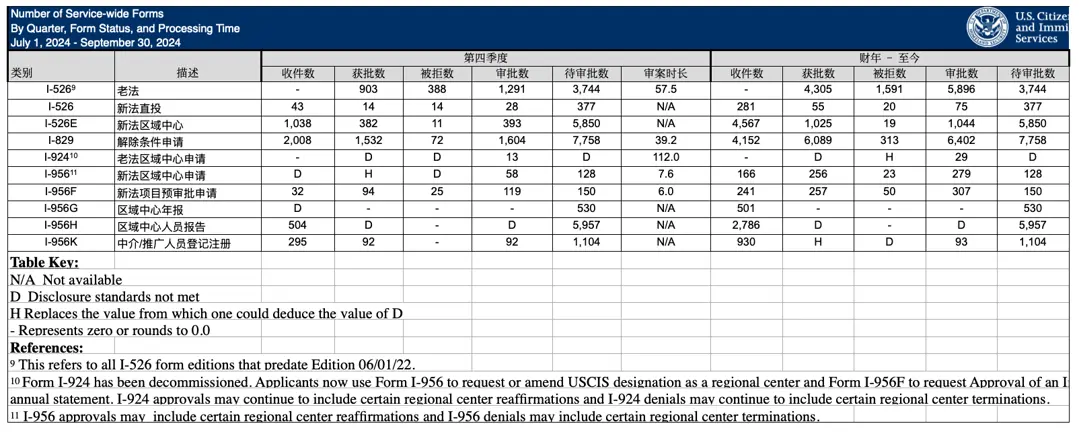
Under the new act, investing in an EB-5 rural project under the reserved visa category is exempt from visa retrogression and grants priority processing by USCIS. Meanwhile, EB-5 applicants already in the U.S., including international students, can perform "concurrent filing" in the U.S. This means that applicants without retrogression can simultaneously file an I-526E immigrant petition and an I-485 application for adjustment of status. They can also apply for travel authorization (I-131) and work authorization (I-765) to legally reside, study, and work in the U.S., enjoying the freedom of a quasi-Green Card in advance and quickly resolving the issue of legal status in the U.S.

For detailed inquiries, please contact Mainland China: 400-138-2929, Hong Kong, China Customer Service Center: (852) 2802 8798
Some materials in this article are sourced from the internet, and the copyright belongs to the original author. If there are any copyright issues, please contact the original author and us for removal.
* Investment involves risks; the above information is for reference only. *