





There is an old saying in the United States: "The only certainties in life are death and taxes." Whether ordinary citizens or high-ranking government officials, no one can escape the obligation to pay taxes and the inevitability of death.
The United States has long been known as the "land of a thousand taxes." This is partly due to the wide variety of taxes, including income tax, estate tax, gift tax, and property tax, all of which have relatively high rates. Another reason is that the United States implements a "global taxation" policy.
However, if one can effectively plan their taxes, many unnecessary tax expenditures can be avoided, making the U.S. tax system seem less daunting.
Currently, the most prominent entrepreneur in the world, NVIDIA CEO Jensen Huang, has recently attracted attention and discussion! It is reported that he has successfully avoided substantial estate taxes by utilizing a series of sophisticated tax tools and strategies, saving his family approximately $8 billion in taxes to date.
At present, Jensen Huang's net worth is $127 billion (approximately 922.7 billion RMB), ranking 10th on the U.S. billionaire list. Theoretically, if he were to pass away, his estate would be subject to taxation at a rate of 40% of the net estate value.
To avoid estate taxes and capital gains taxes, Jensen Huang cleverly employed several high-end financial tools, making the entire operation appear as an art of tax planning. Through the investigation and analysis of disclosed securities and tax documents, The New York Times concluded that Jensen Huang utilized the establishment of trust funds and charitable foundations to transfer a portion of his substantial wealth in a tax-exempt manner.
The Huang couple established a financial tool known as an "irrevocable trust," transferring NVIDIA stock into it, with family heirs as beneficiaries. This way, these stocks are no longer counted as Jensen Huang's estate, thus avoiding the 40% estate tax. The core feature of an irrevocable trust is that once assets are transferred to the trust, the grantor can no longer control them. More cleverly, the trust tool established by Jensen Huang is called an "intentionally defective grantor trust," a special type of trust designed to avoid estate taxes, gift taxes, and even capital gains taxes.
In addition to the irrevocable trust, the Huang couple further optimized their tax structure by establishing grantor retained annuity trusts (GRATs). GRATs are a cleverly designed financial tool where the beneficiary can receive the equivalent of the principal and interest at the end of the trust term, while the appreciation portion is not subject to tax. This operation is so ingenious because when stocks appreciate, the appreciation is not considered part of the estate, thus avoiding taxation. It cleverly utilizes the long-term appreciation potential of the stock market, significantly reducing the burden of estate taxes.
Moreover, Jensen Huang did not stop at trust tools; he also established a foundation to donate some stocks to the foundation. According to U.S. tax law, assets donated to charitable organizations can be deducted before tax, thereby reducing the tax payable.
It must be said that billionaires, through the establishment of trusts and charitable foundations, not only avoid estate and gift taxes but also maintain a degree of control over their wealth, allowing it to be passed down within the family. Excellent financial planning enables them to use various legal means to leave their wealth to future generations without bearing a heavy tax burden.
Therefore, experts from WorldWay Immigration Group recommend that applicants, while planning for immigration to the United States, also engage in tax planning under the guidance of professionals, keeping abreast of current U.S. tax laws and related information to pave the way for future life in the United States.
The U.S. New Immigrant Alliance, initiated by WorldWay Immigration Group, is located in Boston, USA, and aims to provide comprehensive services to new immigrants. If you have any questions regarding tax planning, you can seek support and answers from the U.S. New Immigrant Alliance.
For high-net-worth families, the focus is first on the reasonable distribution of wealth and diversification of investment portfolios to reduce risk and increase returns. At the same time, they also pay great attention to their children's education and upbringing, as well as family health and entertainment, to achieve comprehensive life development. Having an overseas identity can address many areas of concern for high-net-worth individuals.
Identity planning is not something that can be accomplished overnight; it requires advance preparation and planning. The EB-5 investment immigration program in the United States has relaxed conditions, with no restrictions on age, education, language, business, or work experience. One application allows the entire family to immigrate to the United States, making it a very simple and fast immigration channel for high-net-worth individuals.
For those intending to immigrate to the United States through the EB-5 program, it is essential to seize the golden "window period" for the implementation of the new EB-5 law and submit applications as early as possible to lock in priority dates and realize the dream of immigrating to the United States sooner.
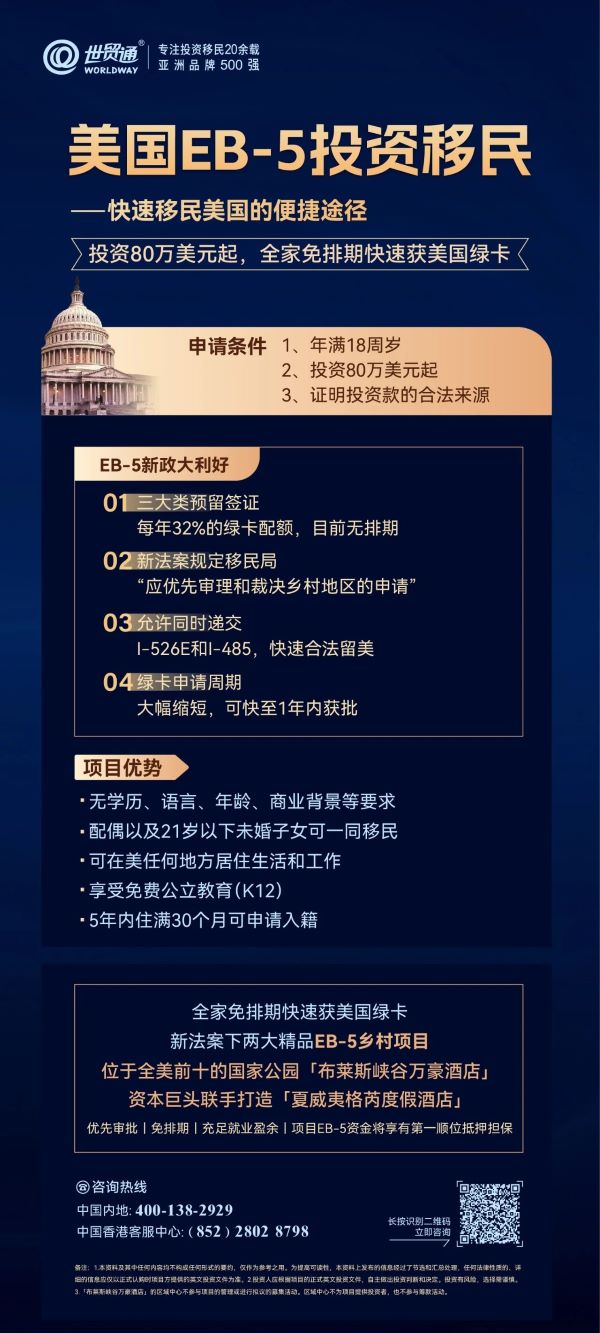
For inquiries in mainland China: 400-138-2929, Hong Kong customer service center: (852)2802 8798
Some materials in this article are sourced from the internet, and the copyright belongs to the original author. If there are any copyright issues, please contact the original author and us for removal.
* Investment involves risks; the above information is for reference only.*