





Recently, the official website of U.S. Citizenship and Immigration Services (USCIS) issued a formal announcement stating that the H-1B lottery process for the 2025 fiscal year has fully concluded, and no third round of selection will be conducted.
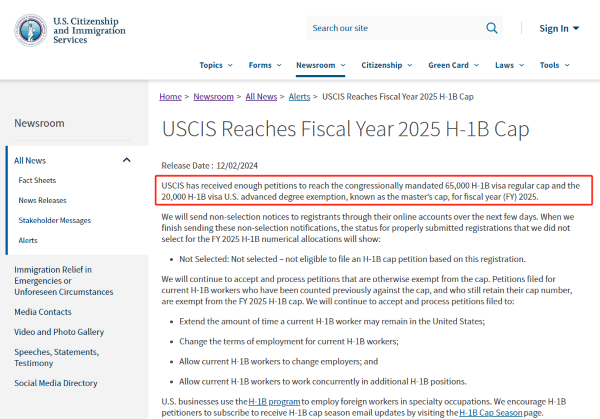
USCIS stated: The number of petitions received is sufficient to reach the congressionally mandated 65,000 H-1B visa regular cap and the 20,000 H-1B U.S. advanced degree exemption cap (i.e., the master's cap) for the 2025 fiscal year.
In the coming days, USCIS will also send non-selection notices to registrants via their online accounts. Once USCIS has completed sending these non-selection notices, the status for properly submitted registrations that were not selected for the FY2025 H-1B numerical allocation will display: Not Selected—not eligible to file an H-1B cap-subject petition based on this registration.
You can log in to your personal USCIS account to check the Registration Selection status. If you were selected in this fiscal year's H-1B lottery, it will display "Selected"; if not, it will display "Not Selected".
As the primary pathway for international students and others to obtain a work visa and legally remain in the U.S., the H-1B has become increasingly competitive and has long been a case of "too many monks and too little gruel." In the first and second rounds of the FY2025 H-1B lottery, a total of 135,137 individuals were selected from 479,953 registrations, with 470,342 valid registrations. The rough selection rate was 28%, and based on the limited quota, the actual selection rate was only 20%. The news that there will be no third round of selection has caused many unselected applicants to feel even more pressure, prompting everyone to re-evaluate their career and immigration plans. For international students holding F-1 visas, staying in the U.S. after graduation requires overcoming "three great mountains": the OPT stage, the H-1B stage, and the EB-2/EB-3 green card transition stage. Each mountain is full of challenges and exceptionally difficult.
With the government transition approaching in January 2025, U.S. immigration policy seems to be caught in a whirlwind of change, potentially causing ripples and numerous uncertainties. Recently, the immigration sector has been on edge, with many companies announcing they will no longer provide employer sponsorship for international students. Meanwhile, many universities have issued warnings, strongly advising international students to return to the U.S. before January 20, 2025, to avoid unknown risks caused by policy changes. These messages have left the international student community in the U.S. feeling anxious.
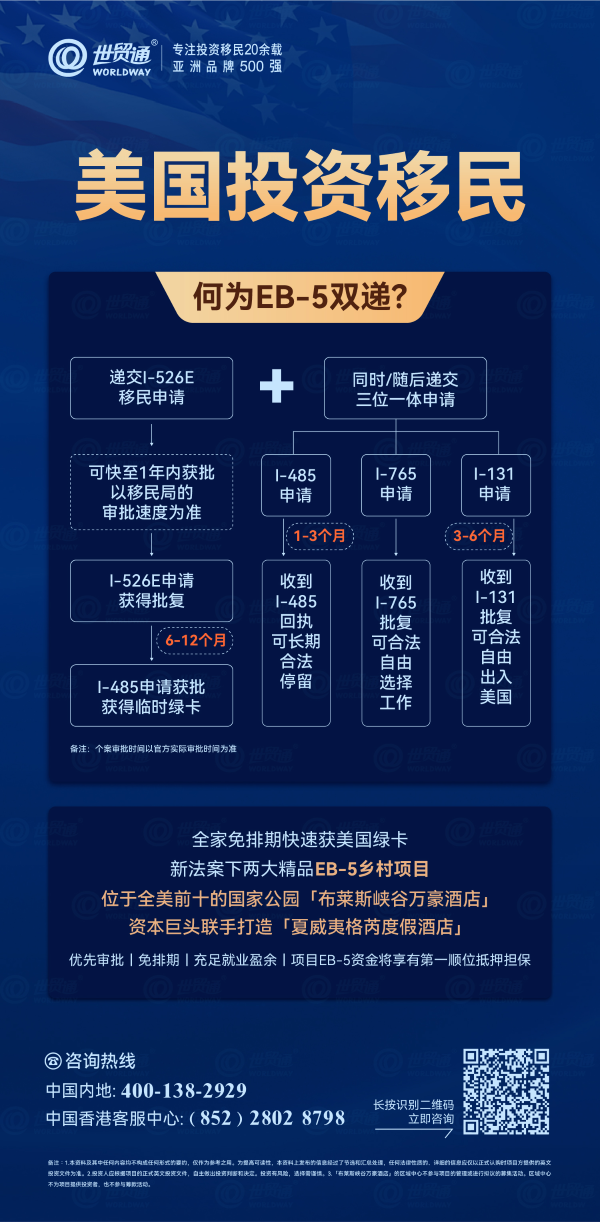
For international students and families planning to study abroad, the most secure solution is to obtain a U.S. green card quickly and plan for the future in advance. Under the new act, investing in an EB-5 rural project under the EB-5 reserved visa category is exempt from visa backlogs and grants priority processing rights from USCIS. At the same time, EB-5 applicants already in the U.S., including international students, can perform "concurrent filing" within the U.S. This means that applicants without a visa backlog can simultaneously file an I-526E immigrant petition and an I-485 application to adjust status. They can also apply for travel authorization (I-131) and work authorization (I-765) to legally reside, study, and work in the U.S., enjoying the freedom of a quasi-green card in advance and quickly resolving the issue of legal status in the U.S.
For detailed inquiries in Mainland China: 400-138-2929; Hong Kong, China Customer Service Center: (852) 2802 8798
Some materials in this article are sourced from the internet, and the copyright belongs to the original author. If there are any copyright issues, please contact us so we can remove them.
* Investment involves risks; the above information is for reference only. *