





In the context of global asset allocation, an increasing number of investors are considering identity planning solutions based on diverse needs such as children's education, global mobility, wealth inheritance, and retirement planning. Acquiring a second identity has become a recognized necessity for them. Under the demand for "immigration without relocation," projects with simple application requirements, no residency obligations, and quick identity acquisition have gained favor among many investors. You may be surprised to learn that many investors are quietly "keeping" this second identity.
According to data from the Japan Immigration Bureau, there are currently over 3.3 million foreigners living in Japan long-term. This country, which is not traditionally known as an immigration powerhouse, has shown a significant upward trend in its efforts to attract immigrants. So, what exactly is attracting so many people to immigrate to Japan?
High Level of Medical Care
According to reports from the World Health Organization (WHO) and the Organisation for Economic Co-operation and Development (OECD):
◆ Japan's overall medical evaluation ranks No. 1 in the world
◆ The health level and healthy life expectancy of Japanese people also rank No. 1
◆ Among OECD countries, medical expenses rank No. 18, indicating a relatively low level of medical costs
Japan not only has abundant medical resources, but its medical technology is also at the forefront of the world. More importantly, Japan implements a universal health insurance system, allowing every citizen, regardless of wealth, to access high-quality medical services, which ensures fairness. At the same time, the Japanese government provides substantial medical subsidies for the elderly and children, covering 70-90% of costs, which offers strong support for people's health security. Additionally, Japan has a separation of medicine and pharmacy system, where hospitals only issue prescriptions, and patients can go to any pharmacy nationwide to fill their prescriptions. Drug prices are uniformly regulated across the country.
High-Quality Education
Public schools offer free compulsory education, and there are high reductions in higher education costs, instilling a sense of responsibility and contribution from a young age. In recent years, Japan has continuously improved educational welfare, eliminating kindergarten and university tuition fees, and some regions, such as Osaka, will achieve free high school education by 2026. Meanwhile, Japan has a strong teaching workforce, sufficient investment in educational resources, and the quality of education has long been at the world-leading level.
Comprehensive Pension Benefits
Japan is the most experienced country in the world in dealing with aging populations, with high pensions, detailed nursing home services, and advanced facilities for elderly activities. In addressing the issue of population aging, Japan has established a relatively complete social security system, which consists of pension insurance, labor insurance, medical insurance, and nursing care insurance. In Japan, individuals must pay into pension insurance for at least 10 years and can start receiving retirement pensions at age 65. The government provides monthly allowances and housing subsidies to low-income individuals.
It must be said that Japan has a well-established welfare system, allowing every citizen to enjoy various comprehensive social welfare benefits from birth to old age, including child welfare, pension benefits, disability benefits, and support for low-income individuals. So, how can one immigrate to Japan?
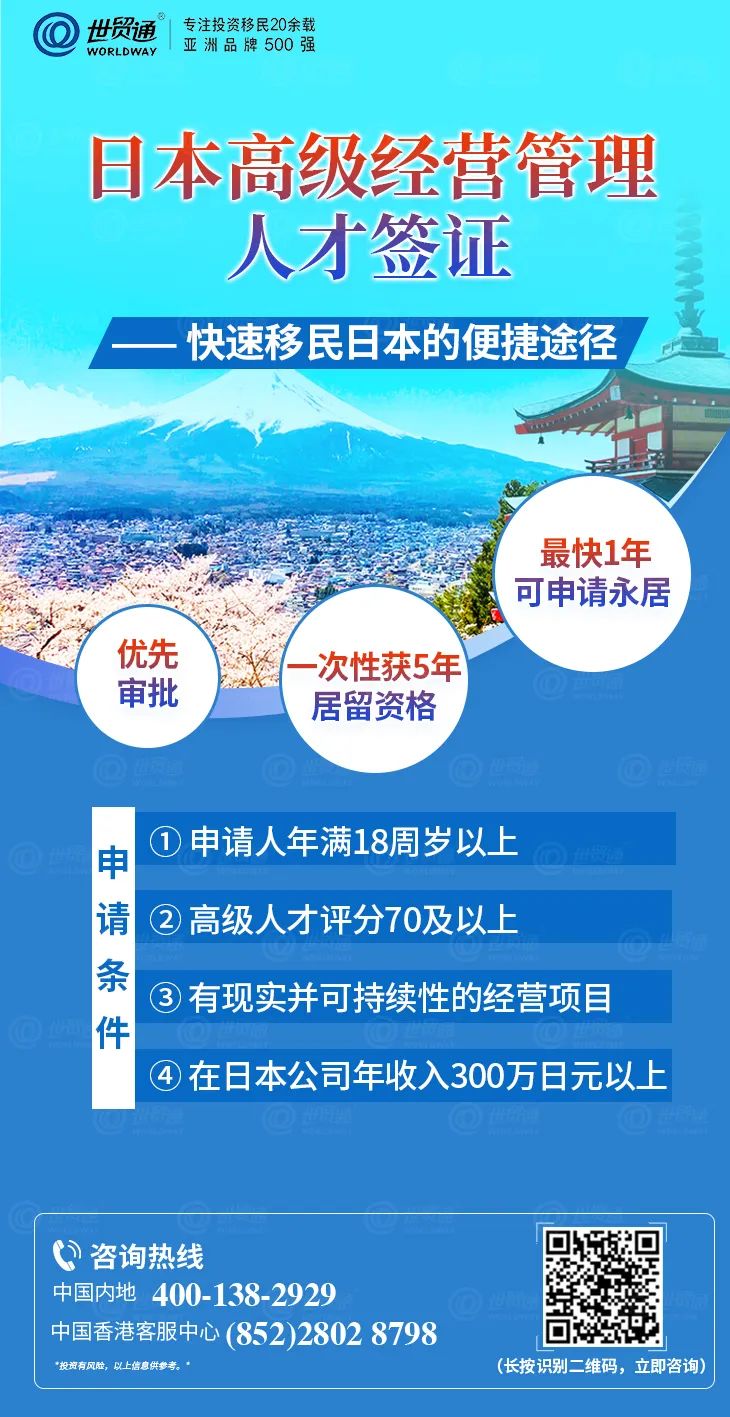
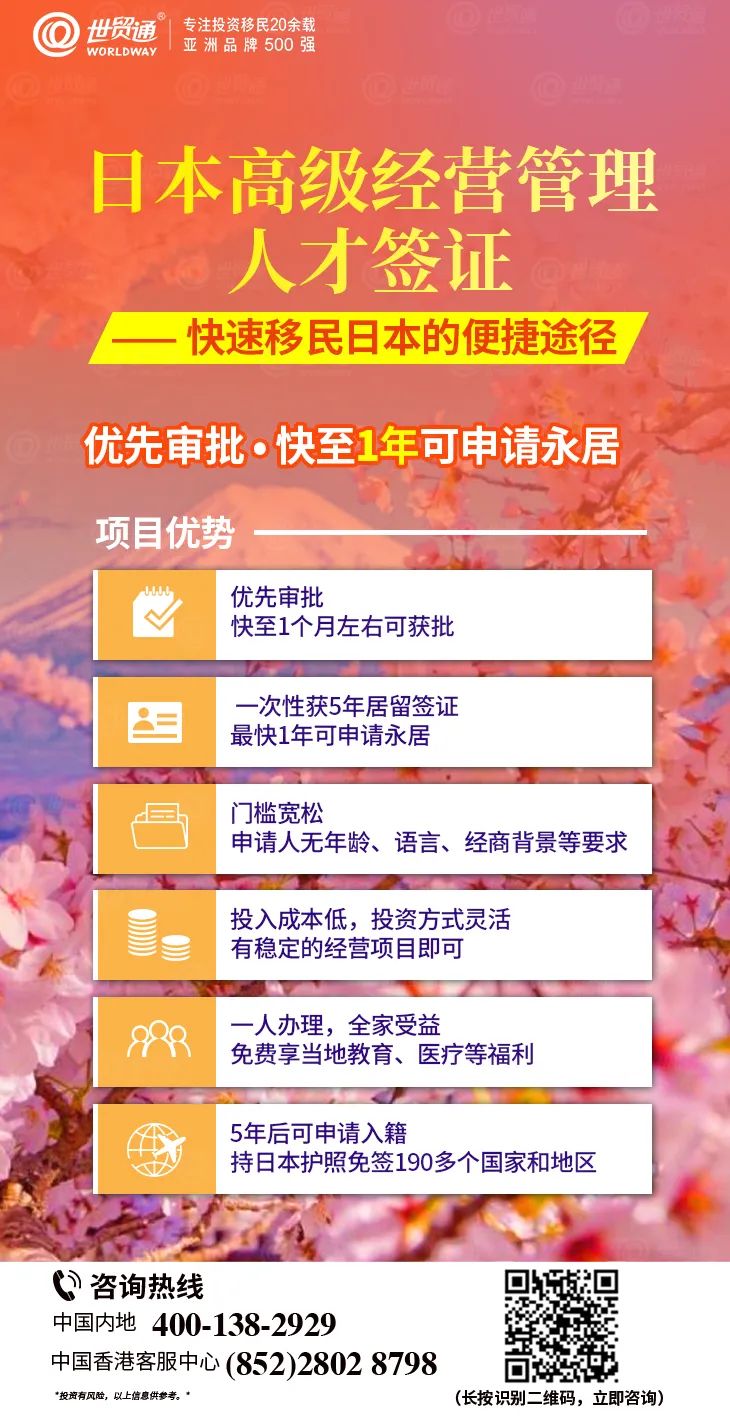
Currently, the Highly Skilled Professional Visa is a convenient pathway for rapid immigration to Japan, with priority approval and the possibility of applying for permanent residency in as little as one year. Applicants are scored based on their education, work experience, age, and annual income, and those who achieve a score of 70 can apply for the visa. Interested investors are welcome to contact WorldWay Immigration for a professional assessment.
In addition, the General Business Manager Visa is also a way to immigrate to Japan. Applicants must have a stable business location in Japan and a registered capital of over 5 million yen; the annual income of the Japanese company must exceed 2 million yen. The initial visa is valid for one year, after which it can be renewed, and after five years of renewal, one can apply for citizenship. After ten years of renewal, one can apply for permanent residency.
For detailed inquiries, please contact mainland China: 400-138-2929, Hong Kong customer service center: (852)2802 8798