Recently, the application for the lottery-based H-1B visa for the fiscal year 2025 in the United States has officially begun! The online electronic registration period for the lottery-based H-1B visa is from 12:00 PM Eastern Time on Wednesday, March 6, 2024, to 12:00 PM Eastern Time on Friday, March 22, 2024.
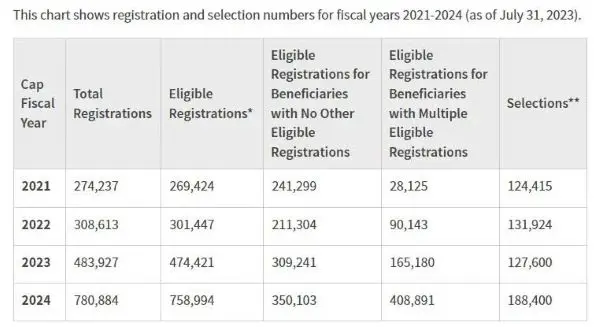
Since 2014, the H-1B visa has been allocated through a lottery system. The already low acceptance rate has gradually decreased with the significant increase in applications each year. In the fiscal year 2024, there were 780,000 applicants, with an acceptance rate of only 10.9%.

As we know, for international students holding an F-1 visa, graduating and staying in the United States requires overcoming the "three mountains": the OPT phase — the H-1B phase — and the EB2/EB3 green card transition phase.
OPT Phase
OPT (Optional Practical Training) is a temporary visa that allows international students in the United States to participate in a work authorization program after completing their studies. Depending on their field of study, students may have 1 year after graduation, while students in STEM-related fields have a 36-month OPT limit (12+24). However, to apply for STEM OPT, one must be employed full-time, hold a STEM-related degree, have obtained 12 months of regular OPT authorization, and be contracted with an E-Verify registered employer willing to complete the I-983 Form. It is important to note that OPT has a 90-day unemployment limit; if a job is not found, the individual must leave the United States. Even if an internship is secured, one must apply for an H-1B visa before the OPT ends to continue working in the United States after the internship period.
H-1B Phase
The H-1B visa is a short-term work visa issued to foreign professionals with specialized skills, classified as a non-immigrant visa. The H-1B visa is valid for 3 years and can be renewed once, allowing a total of 6 years of work in the United States.
Each fiscal year, there are only 65,000 regular H-1B work visa slots (Regular Cap), which includes 6,800 slots for citizens of Singapore and Chile. Additionally, there are 20,000 slots (Master’s Exemption) for beneficiaries who have obtained a master's degree or higher in the United States. If the number of applicants exceeds these 85,000 slots, the immigration lottery system is activated. In recent years, the acceptance rate for the H-1B lottery has continued to decline, with an acceptance rate of only 10.9% in the fiscal year 2024.

It is important to note that the H-1B visa ties the applicant to the employer. If the H-1B work visa is terminated, the individual must find a new job within 60 days, or they must leave the United States. From 2022 to early 2023, over 85,000 employees holding H-1B work visas were laid off.
EB2/EB3 Green Card Transition Phase
To apply for an EB2 or EB3 green card, one must first obtain a PERM labor certification. In simple terms, before a U.S. employer can apply for a labor certification for foreign workers, they must conduct a series of recruitment activities to test the labor market and prove that there are no qualified U.S. workers (including U.S. citizens and permanent residents) willing to work at the minimum standards. Therefore, the employer must spend thousands of dollars in local newspapers to prove that they cannot hire local U.S. workers to replace you, and this process can take several months to obtain a labor certification (PERM). This is not an easy task.
Additionally, recent graduates cannot directly apply for EB2/EB3. To apply for EB2, the job position requires a master's degree or a bachelor's degree plus five years of work experience. To apply for EB3, a bachelor's degree is required, or at least two years of work experience or training (the skilled worker category does not require a degree).
More importantly, whether through EB2 or EB3, applicants from mainland China face a waiting period of 8 to 16 years. According to the latest visa bulletin from the Department of State, the EB2 waiting time is February 1, 2020, and there are currently 43,450 EB2 applicants from mainland China waiting for approval. Assuming there are 2,800 visa slots available each year (140,000 * 28.6% * 7% country limit), the waiting period could be 16 years. The latest visa bulletin indicates that the EB3 waiting time is September 1, 2020, with 22,786 EB3 applicants from mainland China currently waiting for approval, which could result in an 8-year waiting period assuming the same number of visa slots.


It is evident that whether for graduates participating in the H-1B lottery or those already holding H-1B work visas seeking to obtain a U.S. green card through EB2 or EB3, this path is filled with challenges and difficulties. So, what other avenues are available for F-1 visa holders to obtain a U.S. green card? Are there more convenient options?
Currently, the mainstream option is the EB-5 immigration program. According to the Concurrent Filing provision in the new EB-5 law, EB-5 applicants in the United States, including international students, can submit their I-526E investment immigration application simultaneously with their I-485 adjustment of status application, provided that the EB-5 project category has no waiting period. Therefore, applicants can legally stay in the United States, study, and work while waiting for their green card approval results, without the need for employer sponsorship, enjoying the benefits of a quasi-green card in advance.
Today, more and more savvy parents are choosing to combine education and identity planning. As a top 500 Asian brand, the WorldWay Group has focused on investment immigration for over 20 years, responding to customer needs and market trends, and has proposed the concept of "2024 Education Planning Year," establishing it as the annual theme for 2024! For those who wish for their children to study in the United States to pursue broader development opportunities and higher quality educational resources, allowing their children to hold a green card while studying in the U.S. not only provides better education and comprehensive development opportunities but also aids in their career development and future life paths.

Immigration has two key elements — timing and choice. The EB-5 "dual filing" window of opportunity is fleeting; seize the moment to catch the last train! For investors with a strong need to immigrate to the United States, the rural projects in the EB-5 reserved visa channel are currently the preferred option for quickly obtaining a U.S. green card.


For more details, please message us in the comments section or call the WorldWay Group service hotline: Mainland China: 400-138-2929, Hong Kong Customer Service Center: (852) 2802 8798
Some materials in this article are sourced from the internet, and the copyright belongs to the original author. If there are any copyright issues, please contact the original author and us for removal.
Note: 1. The EB-5 funding must meet certain conditions to obtain the first priority mortgage right; please refer to the official English investment documents of the project for details. 2. This information and any content herein do not constitute any form of offer and are for reference only. To improve readability, the information published in this material has been excerpted and summarized; any legally binding and detailed information should be based solely on the official English investment documents provided by the project party at the time of subscription. 3. Investors should make their own investment judgments and decisions based on the official English investment documents of the project. Investment carries risks; choices should be made with caution. 4. The "University Town Hilton" regional center does not participate in the management of the project or the proposed fundraising activities. This regional center does not provide investors for the project and does not participate in fundraising activities.