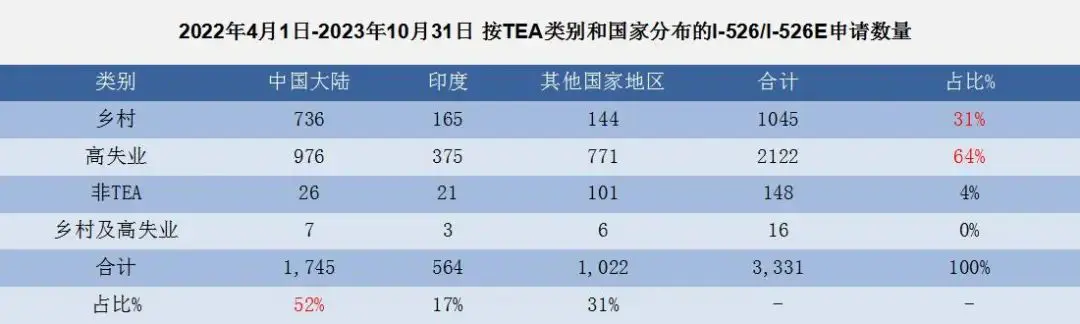
Recently, the AIIA (American Immigration Investment Alliance) obtained new data from the U.S. Citizenship and Immigration Services through a Freedom of Information Act request. This includes detailed data on EB-5 applications from the implementation of the EB-5 Reform and Integrity Act (RIA) until October 2023, categorized by TEA designation and applicant nationality. The release of this data is extremely important for estimating visa backlogs.


From the table above, we can see that as of October 31, 2023, a total of 2,122 families worldwide have applied for urban high-unemployment area (TEA) projects, of which 976 families are from China. A total of 1,045 families have applied for rural area (TEA) projects, of which 736 families are from China.

Assuming an average of 2.5 visa needs per applying family, as of October 31, 2023, the visa demand for urban high-unemployment area (TEA) projects is 5,305, and for rural area (TEA) projects, it is 2,613.
According to data released by the U.S. Department of State, the quota for employment-based immigration visas for fiscal year 2024 is 161,000, of which the EB-5 visa quota (accounting for 7.1% of the total quota) is approximately 11,431, with 3,658 reserved EB-5 visas. According to the new legislation, the 4,478 unused reserved visas from fiscal year 2023 will roll over to the same category for the following year, thus the total quota for reserved EB-5 visas in fiscal year 2024 is approximately 8,136.
Under the new legislation, the quota for reserved EB-5 visas for rural area (TEA) projects is 20%, and for high-unemployment area (TEA) projects, it is 10%. Therefore, it can be inferred that the quota for rural projects in fiscal year 2024 is approximately 5,085, and for urban high-unemployment projects, it is approximately 2,542.
Based on the above data, the currently available quota for rural area (TEA) projects in fiscal year 2024 is 2,472 (5,085 - 2,613), which is sufficient; however, the currently available quota for urban high-unemployment area (TEA) projects is -2,763 (2,542 - 5,305), indicating that demand far exceeds visa supply, leading to a serious backlog!
Thus, from the perspective of quota factors, rural projects currently not only have more available slots but also fewer applicants, coupled with priority processing by the immigration bureau, making rural projects a premium choice for Chinese applicants to quickly obtain a green card.
WorldWay Immigration kindly reminds: As urban high-unemployment area (TEA) projects enter substantial backlogs, rural projects will become more popular among investors. It is recommended that families with immigration intentions choose quality rural projects and submit applications as soon as possible to prioritize obtaining green cards and start their American journey.


For more details, please send us a private message in the comments section or call the WorldWay Immigration service hotline: Mainland China: 400-138-2929, Hong Kong: (852) 2802 8798.
Some materials in this article are sourced from the internet, and the copyright belongs to the original authors. If there are any copyright issues, please contact the original authors and us for removal.
Note: 1. To obtain the first priority mortgage right for EB-5 funds, certain conditions must be met; please refer to the official English investment documents of the project for details. 2. This information and any content herein do not constitute any form of offer and are for reference only. To improve readability, the information published in this document has been excerpted and summarized; any legally binding and detailed information should be based solely on the official English investment documents provided by the project party at the time of subscription. 3. Investors should make their own investment judgments and decisions based on the official English investment documents of the project. Investment carries risks; please choose carefully. 4. The "University Town Hilton Hotel" regional center does not participate in the management of the project or conduct proposed fundraising activities. This regional center does not provide investors for the project nor participate in fundraising activities.