





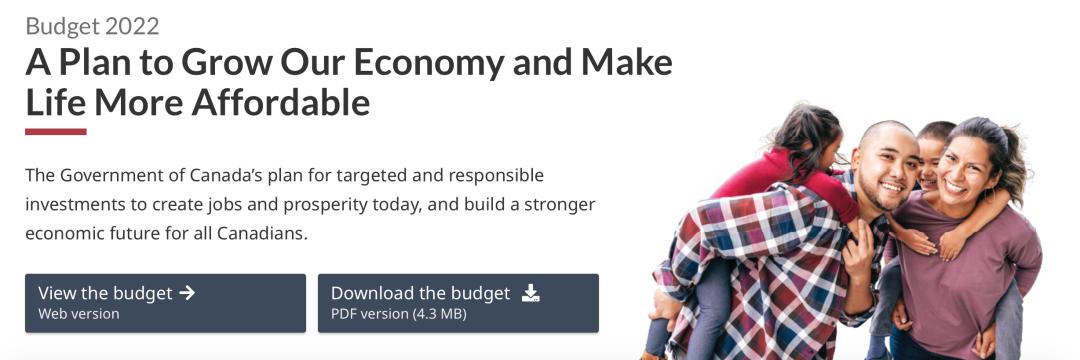
Recently, Deputy Prime Minister and Minister of Finance Chrystia Freeland released the '2022 Budget: A Plan to Grow Our Economy and Make Life More Affordable.' The budget report focuses on immigration, housing, dental care, and environmental protection, while outlining various immigration priorities planned for implementation.
Immigration
In the new federal budget, the Canadian government announced its immigration priorities and pledged to invest over 2 billion Canadian dollars into the immigration department over the coming years!
To support the goal of welcoming over 400,000 new immigrants annually, the federal government plans to invest 2.1 billion Canadian dollars over five years, with ongoing funding of 317.6 million Canadian dollars. According to the '2022-2024 Immigration Levels Plan,' Canada plans to welcome the following number of new immigrants over the next three years: 431,645 new permanent residents in 2022, 447,055 in 2023, and 451,000 in 2024.
Meanwhile, to improve the immigration department's current capacity to respond to inquiries, the 2022 budget proposes an investment of 187.3 million Canadian dollars over five years. This includes an allocation of 37.2 million Canadian dollars for IRCC to better support clients with technology and tools. Furthermore, the Canadian government plans to amend the Citizenship Act to optimize existing citizenship applications through automated processing, assisted processing, and secure, reliable biometric systems.
Free Dental Care for Children
The agreement between the Liberal Party and the New Democratic Party recognizes a new commitment to dental care. The budget proposes 5.3 billion Canadian dollars in funding over five years, plus 1.7 billion Canadian dollars in ongoing expenditures, to expand access to dental care for Canadians.
The program begins this year for children under 12, who will receive free dental care through insurance. The final plan will be fully implemented for all age groups by 2025. Currently, it is limited to children in families with an annual income of less than 90,000 Canadian dollars. For families with an income below 70,000 Canadian dollars, no co-payment is required.
Housing
Housing is a major focus of this budget. As the federal government tightens its budget, it has decided to allocate 10 billion Canadian dollars to address housing issues. The federal government will ban foreign buyers from purchasing non-recreational residential properties in Canada for the next two years; however, Canadian permanent residents, foreign workers, and students are exempt from this new measure, as are foreigners purchasing housing in Canada as their primary residence. Additional measures include: launching the 'Tax-Free First Home Savings Account'; extending and providing more flexibility for the First-Time Home Buyer Incentive; planning to double the First-Time Home Buyers' Tax Credit; allocating 4 billion Canadian dollars to help municipalities update their planning and permitting systems; using 1 billion Canadian dollars to build more affordable housing; and providing 1.5 billion Canadian dollars in loans and funding for co-operative housing.
Other Aspects Affecting Daily Life
Reducing childcare costs: Working with provinces and territories to fund a nationwide early learning and childcare system. By the end of 2022, childcare fees will be reduced by an average of 50%, and by 2025-26, the average childcare fee for all regulated childcare centers in Canada will reach 10 Canadian dollars per day.
Providing the Canada Child Benefit for families, increasing it to a maximum of 6,833 Canadian dollars per child this year; expanding the Canada Workers Benefit to support an estimated additional 1 million Canadians, meaning workers earning the full-time minimum wage could see an income increase of 1,000 Canadian dollars per year; raising the federal minimum wage to 15.55 Canadian dollars per hour; increasing the maximum Guaranteed Income Supplement (GIS) for single seniors by 10%, and reverting the eligibility age for Old Age Security (OAS) and GIS from 67 back to 65; providing 10 days of paid sick leave for all federally regulated private-sector employees; increasing the climate action incentive payment, where 8 out of 10 people in provinces where the federal system applies will receive more in rebates than they pay; and making post-secondary education more affordable by waiving interest on Canada Student Loans until March 2023 and strengthening repayment assistance to ensure those earning less than 40,000 Canadian dollars will not need to make payments on federal student loans in the future.
It is clear that the 2022 federal budget announces numerous benefits that will tangibly permeate every aspect of people's lives. Canada has long been favored as a major welfare state, and this new wave of benefits maintains the country's consistent style as a high-welfare society.
As a traditional major immigration destination, Canada has become a preferred country for many due to its beautiful environment, high-quality education, and generous welfare. According to the 2022-2024 Immigration Levels Plan, Canada plans to welcome a total of 1,329,700 immigrants over the next three years. Those wishing to immigrate to Canada should seize this policy dividend period and get on board as soon as possible. The massive immigration quota accommodates applicants from different backgrounds. Good opportunities are rare, so act now!

As one of the Top 500 Asian Brands, WorldWay Group possesses a powerful project analysis team, a professional documentation team, and a comprehensive customer service team. By collaborating with numerous reputable Canadian institutions, we provide investors with professional, comprehensive, and diversified services, sparing no effort to help investors seize the golden period for low-threshold immigration to Canada!
For more details, please send us a private message in the comments section or call the WorldWay service hotline: Mainland China: 400-138-2929, Hong Kong, China: (852) 2802 8798.
Some materials in this article are sourced from the internet, and the copyright belongs to the original author. If there are any copyright issues, please contact us for removal.
*Investment involves risks; the above information is for reference only.*