




Recently, the world higher education research institution QS (Quacquarelli Symonds) released its latest annual ranking—the 2022 QS Graduate Employability Rankings. This ranking includes 550 universities, 50 more than last year, making it the largest Graduate Employability Ranking in QS history.
In this ranking, a total of 18 Canadian universities were listed. Among them, the University of Toronto, the University of Waterloo, and Western University performed exceptionally well, all breaking into the global top 50, with 5 universities entering the global top 100.
Ranking Indicators and Weighting:
l Employer reputation: 30%
Based on nearly 45,000 responses from the QS employer survey, employers are asked to identify where their most competitive, innovative, and efficient graduates come from.
l Alumni outcomes: 25%
Analyzes more than 40,000 of the world's most innovative, creative, wealthy, entrepreneurial, and philanthropic individuals to determine which universities are producing world-changers. Undergraduate degrees are weighted more heavily than postgraduate degrees, as it is believed that the early stages of higher education have a greater impact on an individual's employability.
l Partnerships with Employers per Faculty: 25%
Uses databases to identify which universities are successfully collaborating with global companies for sustainable, transformative research. It considers work-related partnerships reported by institutions and verified by the QS research team.
l Employer/Student Connections: 10%
Includes the number of individual employers who have been actively involved in campus activities at a university over the past year, as well as the number of opportunities provided for motivated students to access/obtain information (career fairs, organized company presentations, or any other self-promotion activities).
l Graduate employment rate: 10%
Includes the proportion of graduates (excluding those who choose to continue their studies or are unable to work) who are in full-time or part-time employment within 12 months of graduation.
From these indicators, we can see that beyond simple employment rate data, QS places greater emphasis on employer reputation, the quality of student employment, and the employment support the school can provide to students. Naturally, with the support of these factors, high graduate employment rates and quality positions follow as a matter of course. It can be said that this ranking provides a relatively practical perspective, and it is well worth referring to when choosing a school based on the employment prospects of graduates.
Children's education has always been the focus of every family. Of course, each ranking has different focuses and evaluation weights; some care more about educational quality, some value research levels, some focus on student experience, and others conduct horizontal comparisons of specific majors. Therefore, international students and immigrant families need to conduct cross-comparisons both vertically and horizontally while referring to various rankings. Rational choice is the truly wise move.
Education is always an important motivation for immigration. In recent years, Canadian education has been highly valued by families with study abroad and immigration plans. Canada has a sound education system and rich educational resources, and its education is very attractive to both local and international students. Canada implements 12 years of compulsory education. In fact, as long as they are Canadian residents or permanent residents, their children can complete K-12 basic education in Canadian public schools for free. Furthermore, in Canada, the Ministry of Education directly manages the school district boards, and teachers and principals are uniformly and regularly allocated by the school boards. There are no exams for primary school enrollment, junior high school enrollment, or high school enrollment; it is entirely based on proximity, with no competitive pressure. At the same time, there is no national college entrance exam for high school to university transition.
As the saying goes, education planning comes with status. If you want your children to enjoy high-quality education in Canada, giving them Canadian status is a better choice. Compared with international students, having Canadian status offers more advantages in terms of enrollment opportunities, tuition standards, employment opportunities, and medical benefits. At the same time, for families immigrating to Canada, they can allow their children to return to China to participate in the Joint Entrance Exam for Overseas Chinese Students as overseas Chinese students, easily entering top-tier universities such as 985 and 211 institutions to enjoy mainland higher education. Alternatively, they can choose to let their children study in Canada and receive a pure overseas education.
Children's education cannot wait, and status planning must be done early. Interested families can seize the current great opportunity of Canada's million-immigrant plan. With an investment starting from 100,000 CAD, you can immigrate to Canada quickly with low thresholds and low costs, and the whole family can obtain a Maple Leaf Card in one step, planning for your children's future in advance! Currently, the application conditions for the Ontario Immigrant Nominee Program (OINP) for employer-sponsored immigration are relaxed, with no language requirements and no need to take the IELTS. Investors should act as soon as possible; apply early, enter the pool early, and benefit early. Seize the opportunity of the Ontario employer-sponsored immigration EOI launch, and immigrate to Canada quickly with low thresholds—now is the time!
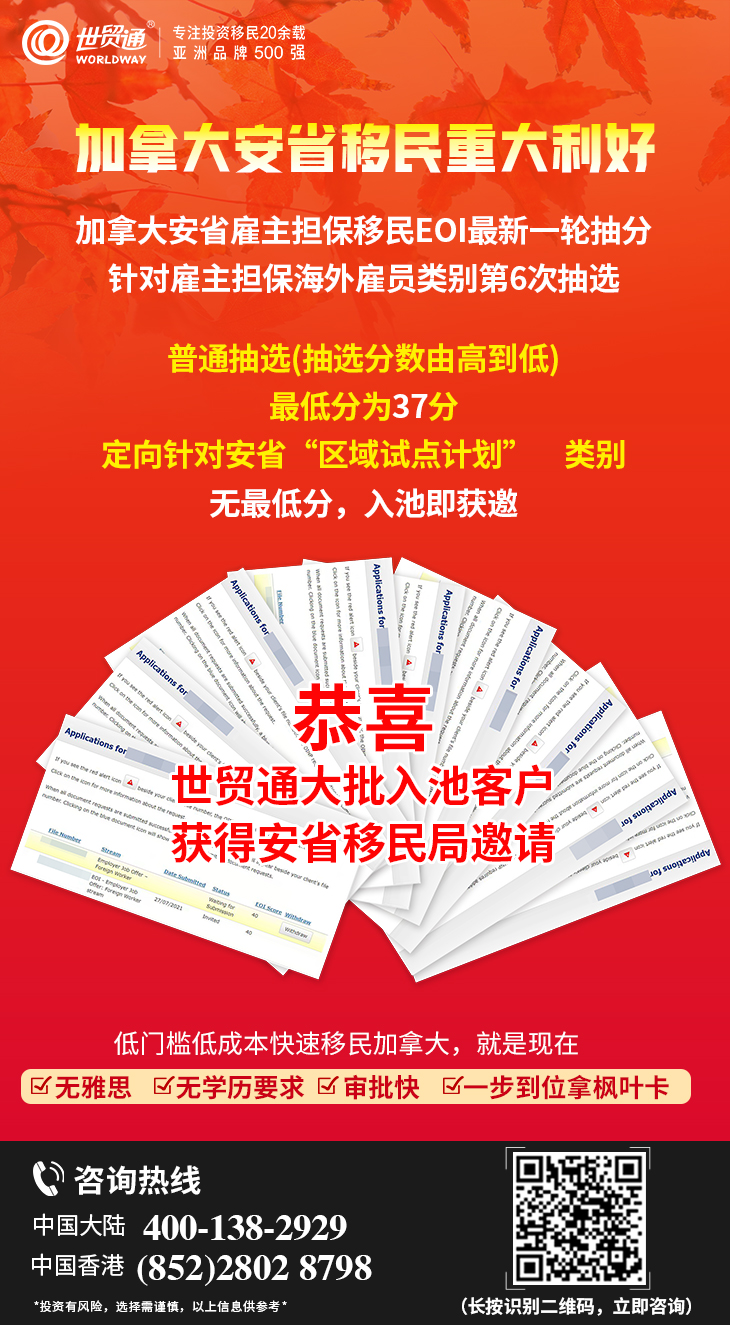
As a top 500 Asian brand, WorldWay Group possesses a powerful project analysis team, a professional documentation team, and a comprehensive customer service team in the industry. We cooperate with numerous powerful Canadian institutions to provide investors with professional, comprehensive, and diversified services, sparing no effort to help investors seize the golden period for low-threshold immigration to Canada!
Great news! Canada immigration full-line feedback: apply for Canadian immigration and receive an IELTS gift package. From now until October 31, 2021, spots are limited and available while supplies last. For more details, please call the WorldWay service hotline: Mainland China: 400-138-2929, Hong Kong, China: (852) 2802 8798.

Some materials in this article are sourced from the internet, and the copyright belongs to the original author. If there are any copyright issues, please contact us for removal.
*Investment involves risks; the above information is for reference only.*