





Recently, the U.S. House of Representatives released the draft text of the immigration section of the budget reconciliation bill. This draft primarily addresses two major themes: first, resolving the status of certain eligible undocumented immigrants in the U.S.; second, alleviating and resolving the visa backlog for a large number of legal immigrants waiting in line.
Family and employment-based immigrants, essential workers, Temporary Protected Status (TPS) individuals, and those granted deferred enforced departure will be the biggest beneficiaries of this draft bill. Regarding the alleviation and resolution of visa backlogs for legal immigrants (especially EB-5 investment immigrants), the draft bill provides two significant solutions: reactivating historically unused visa quotas for redistribution and offering a visa backlog exemption for adjustment of status applications (I-485 applications) through payment. The specific interpretations are as follows:
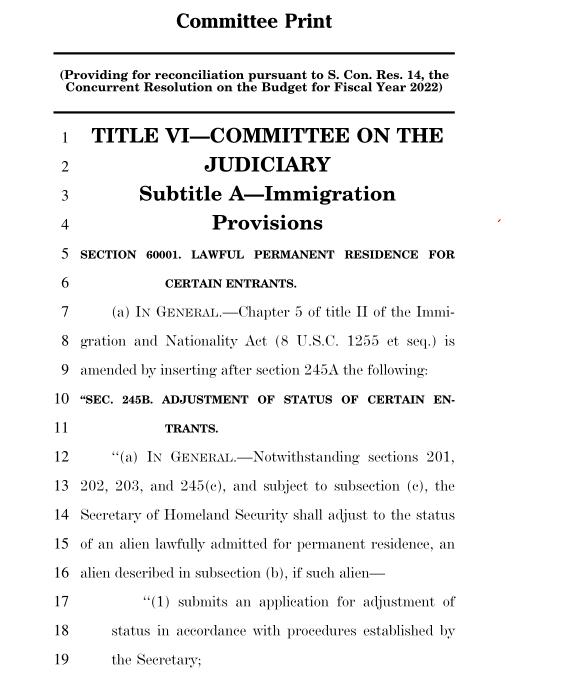
1. Reactivating historically unused visa quotas for redistribution
Family and employment-based immigrants (with EB-5 investment immigrants falling under the fifth preference category) can reactivate visa quotas that were unused from 1992 to 2021 for redistribution. According to previous estimates by AILA (American Immigration Lawyers Association), this plan could reactivate hundreds of thousands of visa quotas, significantly increasing the visa quotas allocated to the EB-5 investment immigrant category. With this alone, EB-5 investors will no longer need to worry about the waste of visa quotas due to the pandemic over the past two years; at the same time, the backlog of EB-5 visa processing will be alleviated all at once.
2. Visa backlog exemption for adjustment of status applications (I-485 applications) through payment
Currently, the adjustment of status application policy for EB-5 immigrant applicants within the U.S. states that applicants who are already in the U.S. and have obtained other legal residency statuses can submit an I-485 adjustment of status application when their priority date is earlier than the cutoff date published monthly by the U.S. Department of State and when the immigration agency simultaneously announces that the cutoff date is open. After submitting the I-485, they can first obtain a Combo Card (a combination of EAD work permit and AP re-entry permit), which allows EB-5 applicants to legally study, work, and live in the U.S.; the immigration agency will only process the adjustment of status application and grant a conditional green card when the applicant's priority date is earlier than the cutoff date published monthly by the U.S. Department of State.
Under the provisions of the draft bill: if the priority date of the EB-5 applicant (generally the submission date of the I-526 application, which may be delayed by 1-2 days based on the date shown on the submission receipt sent by the immigration agency) exceeds two years, the visa applicant can choose:
1) To pay an additional fee ($1,500 for the main applicant + $250 for dependents) to qualify for early submission of the I-485 adjustment of status application to obtain a Combo Card (EAD work permit + AP re-entry permit), thereby allowing them to work, study, and live in the U.S.;
2) To pay an additional fee of $50,000 to waive the visa backlog and obtain approval for the adjustment of status application to receive a conditional green card.
The draft bill is undoubtedly a significant boon for EB-5 applicants from mainland China who are troubled by the EB-5 visa backlog.
It is expected that the draft bill may undergo a series of revisions before being finalized, and it will still need to be passed by votes in the House of Representatives and the Senate before being signed into law by the President. There are still many uncertainties in the process of the draft bill becoming law. Regardless, the introduction of the draft bill has once again shown us the current U.S. government's determination to address visa backlogs. WorldWay Immigration will continue to follow the progress of the draft bill and provide subsequent reports.
For more details, please call the WorldWay Immigration service hotline: Mainland China: 400-138-2929 Hong Kong: (852)2802 8798.
This article is copyrighted by WorldWay Immigration Group. If you need to reproduce, link, forward, or copy this article in any other way, please be sure to indicate that the article is sourced from WorldWay Immigration Group; otherwise, legal responsibility will be pursued.
*Investment involves risks; the above information is for reference only.*