





Recently, Statistics Canada released a report on university tuition fees for this year. For domestic students in Canada, tuition fees have decreased in some regions, but for Chinese international students, university tuition fees have increased by 7 percentage points this year.
According to the report, in the 2019-2020 academic year, the average undergraduate tuition fee for local students in Canada was $6,463, a decrease of 5.3% compared to last year. Graduate tuition fees also decreased to $7,056. However, this year, the tuition fee for international undergraduate students is $29,714, an increase of 7.6% compared to last year. Graduate tuition fees are $17,744, an increase of 4.4%.
Taking Ontario as an example, this year, the tuition fees for local students in Ontario have decreased, with undergraduate tuition fees dropping by 9.9%. However, the tuition fees for international undergraduate students in Ontario have reached $38,276, which is 9.2% more expensive than last year.
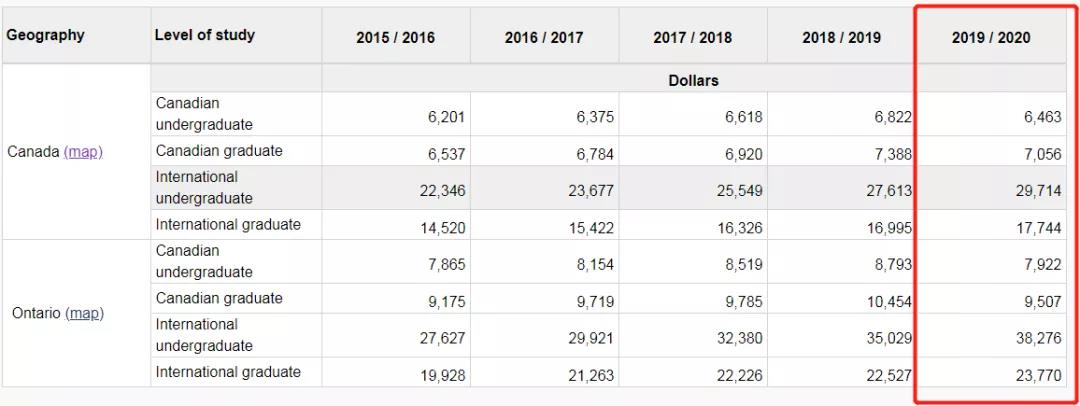
Average Tuition Fees for Students in Canada and Ontario
For example, at some universities in Canada this year, the tuition fees for international students have increased significantly. At the University of Waterloo, the tuition fee for engineering students is $54,600; for architecture students, it is $51,600; for computer science students, the tuition fee for the 2019/20 academic year from September to December has increased from CAD 15,823 to CAD 25,653, a staggering increase of 62.1%. At McGill University, the tuition fees for international students are three times higher than for local students; for engineering students, each credit costs $1,349.77, and an average of 30 credits per year means an annual tuition fee of approximately $40,500. In summary, many universities are continuously raising tuition fees for international students.
For international students, in addition to rising tuition fees and increased living expenses, the current rise in exchange rates has further exacerbated the situation, making the cost of studying abroad increasingly high.
As the saying goes, education planning and immigration status should come first. Planning for your child's immigration status in advance can not only save costs but also provide better options for your child in many aspects. Compared to international students, having Canadian immigration status offers advantages in terms of admission opportunities, tuition standards, employment opportunities, and healthcare benefits.
It is well known that Canada is a country with a high quality of education and advanced educational concepts. Canada has a comprehensive education system and places great importance on education, with a high per capita investment in education. If one can become a permanent resident of Canada, they can enjoy twelve years of compulsory education at a very low tuition fee, along with various scholarships, grants, and interest-free loans available for students. In the future, children will have better choices for university, graduation, and employment.
Children's education cannot wait, and immigration planning must be done early. The Asia Brand 500 Group, WorldWay Immigration, offers low-threshold Quebec investment immigration for obtaining a Maple Leaf Card, as well as quick landing options for Saskatchewan entrepreneur immigration, Prince Edward Island entrepreneur immigration, Manitoba entrepreneur immigration, and New Brunswick entrepreneur immigration, among other Canadian investment immigration programs, to help investors realize their dreams of moving to Canada. Consultation hotline: 400-138-2929.

Some materials in this article are sourced from the internet, and the copyright belongs to the original authors. If there are any copyright issues, please contact the original authors or us for removal.