The annual June graduation season is approaching, which means a series of intense, battle-like activities such as submitting resumes, interviewing, and interning will soon kick off across China. So, what are the employment advantages for university graduates in Europe? Let's find out with WorldWay.
According to data recently released by the European Commission, Malta's graduate employment rate (94.5%) ranks first in Europe, nearly 4 percentage points ahead of second-place Germany (90.9%). This figure far exceeds the 82% average graduate employment rate projected for the EU in last year's report.

According to survey data, Malta's graduate employment rate is 94.5%, ranking first in Europe, followed by Germany (90.9%), the Netherlands (90.4%), the Czech Republic (89.9%), Austria (89.4%), Luxembourg (88.5%), and Sweden (88.3%), while the employment rate for fresh graduates in the UK is 86.6%.
High Employment Rate, High Income
A country's employment rate often reflects its stability. Malta not only has an exceptionally high graduate employment rate, but its overall employment rate is also very high, reaching 96.5%. Furthermore, average wages in Malta are among the best in the EU.
EU economic indicator data shows that from 2001 to 2018, Malta's average annual wage increased year by year. As of the fourth quarter of 2018, this figure was 19,035.61 EUR/year, equivalent to approximately 144,600 RMB/year.
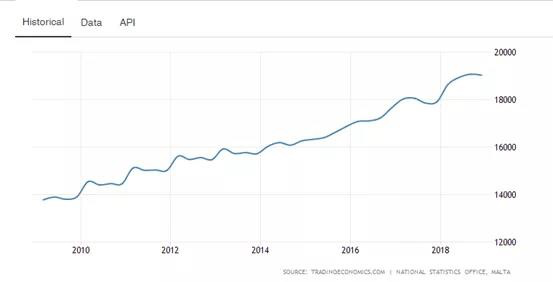
Malta's Average Wage Growth Curve Over the Last 10 Years
Abundant Holidays and Low Taxes
In addition to high income, Malta has short statutory working hours, averaging 139 hours per month, which means there are plenty of holidays. This also implies that Malta's average hourly wage is quite high. Working in Malta can truly be described as "good pay, light workload, and low risk of unemployment."
Moreover, to attract high-quality talent to stay in Malta, the Maltese government has introduced incentive policies for the employment of highly educated individuals: master's graduates are exempt from personal income tax in their first year of work, and doctoral graduates are exempt for their first two years. Furthermore, to strengthen the professional skills of job seekers, the Maltese employment department provides free vocational training courses for citizens and residents, which are diverse and highly practical.
The recent "996" work culture has sparked widespread controversy. For families looking to immigrate overseas, provide their children with local education, ensure easy employment after graduation, and maintain a work-life balance, Malta is an excellent choice.

Through the Malta Residence and Visa Programme (MRVP), you can apply for immigration to Malta for four generations of your family with an investment starting from just 80,000 EUR. You pay the interest and gain permanent residency in the Schengen Area for four generations, with no worries about bond depreciation or the hassle of liquidating bonds. It also allows your children to enjoy Malta's authentic British-style education, secure easy employment after graduation, and enjoy high salaries—a multi-benefit solution. For more details, please call: 400-138-2929.