





The two most common types of U.S. visas are B1/B2, which refers to business/personal visit visas, and F-1, which refers to student visas for full-time study at accredited institutions. Today, we will explain the process for students to apply for an F-1 student visa after receiving their university acceptance.
Obtain the I-20
After receiving the school acceptance and deciding to attend a specific institution, students must pay a deposit as required by the school, which can range from several dozen to several hundred dollars. Subsequently, the student's admission information will be forwarded to the department that handles international student affairs at the school. This department will contact the student to request proof of funds, passport, and other materials or to confirm mailing address information. Once the school verifies all the student's information, the I-20 will be sent via international courier (commonly DHL, UPS, FedEx, etc.), and it is generally received within a week after dispatch (some schools may send the I-20 directly after acceptance).
Upon receiving the I-20, it is essential to verify that all information is correct. If there are any errors, contact the school promptly for corrections. The I-20 form is a document that all international students (F-1 visa holders) must obtain, guaranteed by the admitting school and issued by the U.S. Citizenship and Immigration Services, and it is a necessary document for applying for the F-1 student visa.
After obtaining the I-20 form, we can proceed with the student visa application process, as illustrated in the following diagram.
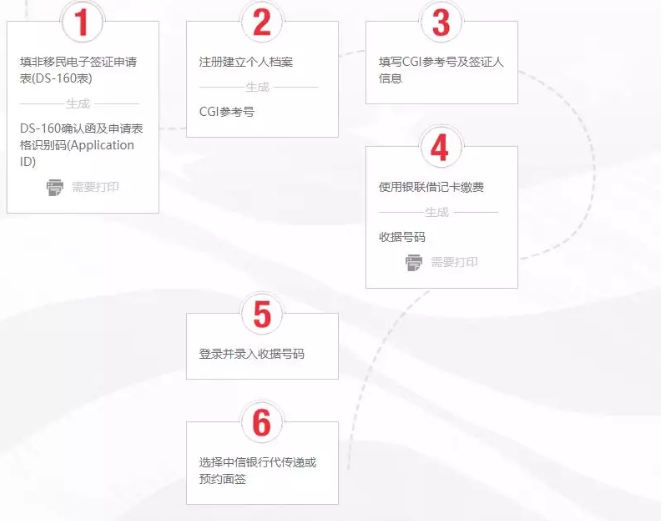
Complete the DS-160 Each applicant must have their own DS-160 visa application form. This form is an online application required by the U.S. Embassy for all visa applicants, which will record the applicant's personal information, passport information, educational background, travel information, work information, family information, and security information.
Before the visa interview, the DS-160 form must be completed and submitted online.
When attending the interview at the consulate, bring a clearly printed confirmation page with a barcode (there is no need to print the entire DS-160).
Before filling out the DS-160, prepare a digital photo with dimensions of 1275px*1275px on a white background (glasses are not allowed), and have your passport, admission notice, and I-20 form ready for reference.
The DS-160 can be manually saved as a temporary file for later completion.
The DS-160 filling website: https://ceac.state.gov/genniv/
After completing the form, print the confirmation page with the barcode.
Pay the SEVIS Fee
SEVIS stands for Student and Exchange Visitor Information System, which is an online database established by the U.S. Department of Homeland Security to monitor all foreign students and exchange scholars. Therefore, foreign students must pay the SEVIS fee and obtain a receipt before applying for a visa to study in the U.S. to prove payment during the interview. The SEVIS fee will be used for the daily maintenance of the database.
The fixed fee for F-1 students is $200.
SEVIS payment website: https://www.fmjfee.com/i901fee/
After completing the payment, print the confirmation page.
Schedule an Interview Appointment and Pay the Visa Fee As of March 16, 2013, the U.S. Embassy and Consulates in China have eliminated the phone appointment process and paper visa fee receipts. All visa interview appointments and visa fee payments are now processed through the following website: http://www.ustraveldocs.com/
When scheduling a visa interview, ensure that your passport, DS-160 confirmation page, and I-20 form are at hand. Choose the embassy/consulate where you wish to schedule the appointment. Note that this selection must match the interview location chosen when filling out the DS-160.
The current visa fee is $160, equivalent to 1104 Chinese Yuan. After filling out personal information on the aforementioned website, proceed to the payment page. After successfully scheduling the payment, a "MRV Fee Payment" page will appear, displaying the CGI REFERENCE NUMBER, AMOUNT, etc.