May is the eighth month of the 2019 fiscal year, making this the eighth visa bulletin release for the 2019 fiscal year. Family-sponsored immigration performed exceptionally well this month, with various immigration categories showing varying degrees of advancement. Following a period of steady progress in immigration visa bulletins from December 2018 to March 2019, the EB-1 category remained stagnant this month, marking a total of two months of stagnation as of May.
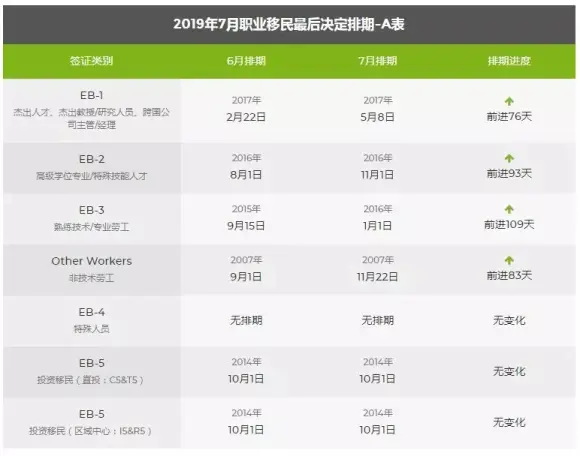
EB-1: The EB-1 visa bulletin remained stagnant this month, with the priority date remaining at February 22, 2017. As the first preference category for U.S. employment-based immigration, this category has officially entered a two-year normal visa bulletin cycle for applicants born in mainland China since it became subject to global visa bulletins in August 2018. The two-month stagnation indicates a surge in EB-1 applications received by U.S. Citizenship and Immigration Services (USCIS) from around the world in recent months. This category has 40,000 spots available globally each year, and USCIS needs to monitor the overall application situation before appropriately opening up spots for applicants from China and India.
The visa bulletin for EB-1 applicants born in mainland China began in August 2016, and the bulletin ended in October of the same year due to the start of a new fiscal year and the release of new quotas. It subsequently entered the visa bulletin again in June 2017 and ended in October of the same year. In April 2018, applicants born in mainland China entered the visa bulletin again. Four months later, in August 2018, not only did applicants born in China and India continue to face visa bulletins, but applicants from other parts of the world also entered the visa bulletin for the first time. October 2018 was the first month of the new fiscal year (FY 2019), and while new quotas were expected to be released, the status did not return to a non-bulletin state, marking the official entry of global EB-1 applicants into a normal visa bulletin cycle.
This month, the U.S. Department of State also issued a special statement regarding EB-1 for applicants born in mainland China and India. The statement indicated that USCIS has received and will continue to receive an extremely high rate of demand for EB-1 applications; therefore, to limit the number of future applications (I-140) and adjustment of status applications (I-485), the visa bulletin for this category may retrogress in the future. This retrogression may continue until the beginning of the 2020 fiscal year, which is October 2019. According to this statement, the October 2019 visa bulletin will return to the most recent visa bulletin date of the 2019 fiscal year, which is February 22, 2017.
Based on the current situation, if an applicant born in mainland China submits an application now, it will take at least two years from the approval of the I-140 petition to landing in the U.S. and obtaining a green card. It is not difficult to see that the fundamental reason for the increasingly long EB-1 visa bulletin is the increase in the number of applicants, which has led to a shortage of available quotas. The development history of the visa bulletin above and the special statement from the U.S. Department of State regarding applicants born in mainland China are also intuitive reflections of the growing popularity of this type of application. In the future, the visa bulletin will only get longer, and competition will become increasingly fierce.
EB-2: The second preference for employment-based immigration, EB-2, continues to show strong momentum this month. EB-2 advanced by 44 days this month, with the priority date reaching May 15, 2016. Since EB-2 is a primary pathway for many Chinese students to obtain a green card, students who have already applied for EB-2 may want to pay attention to whether USCIS will open up Table B applications in the future to submit I-485s as early as possible. The priority date for EB-2 Table B this month is September 1, 2016. For NIW applicants within China, they need to wait for notification from the NVC based on the situation in Table A. According to the current situation, EB-2 (NIW) has a visa bulletin of approximately 5-6 years.
EB-3: This month, EB-3 advanced slightly by 21 days to August 22, 2015. Also as a primary pathway for Chinese students to obtain a green card, we believe it will take 5-6 years from the time of application to green card approval.
EB-5: The visa bulletin for investment immigration (direct investment) advanced slightly by 7 days this month, with a priority date of September 22, 2014. The priority date for the EB-5 Regional Center program also returned to September 22, 2014, this month. Since the beginning of this fiscal year in October 2018, through May 2019, there has been a cumulative advancement of 38 days over 8 months. At the current speed of the visa bulletin, it will take at least 10 years from the time of application to finally obtaining a green card for investment immigration.
FAMILY-SPONSORED PREFERENCE CASES
Unmarried children over 21 of U.S. citizens (F1): Table A advanced by 40 days last month to December 1, 2011, and continued to advance by 38 days this month to January 8, 2012. Table B advanced by 70 days last month to July 1, 2012, and advanced by 52 days this month to August 22, 2012.
Spouses and children of green card holders (F2A): Table A advanced by 52 days last month to March 1, 2017, and advanced significantly by 75 days this month to May 15, 2017. Table B advanced by 7 days last month to December 15, 2017, and advanced by 24 days this month to January 8, 2018.
Unmarried adult children of green card holders (F2B): Table A advanced by 82 days last month to October 22, 2012, and advanced significantly by 102 days this month to February 1, 2013. Table B advanced by 9 days last month to July 1, 2014, and advanced by 31 days this month to August 1, 2014.
Married children of U.S. citizens (F3): Table A advanced by 14 days last month to September 22, 2006, and advanced by 47 days this month to November 8, 2006. Table B advanced by 61 days this month to June 22, 2007.
Siblings of adult U.S. citizens (F4): Table A advanced by 101 days last month to January 1, 2006, and maintained its momentum this month, advancing by 45 days to February 15, 2006. Table B advanced by 61 days this month to October 1, 2006.
In addition, you may notice that there are some family relationships we have not mentioned, such as spouses, parents, and minor children of U.S. citizens. These categories are not subject to quota limitations. As long as the conditions are met, applications can be submitted at any time without a visa bulletin. The specific time to obtain a green card depends solely on the speed at which USCIS processes the cases.