





As 2018 draws to a close, the Student and Exchange Visitor Program (SEVP), which oversees international student affairs in the U.S., has finally released the latest international student statistics—a comprehensive report on international students in the U.S. by country for 2017. This includes an overview of OPT and STEM OPT usage, as well as data on companies that tend to hire international students using OPT, reflecting the current status of students in the U.S.
Chinese Students Rank First in Number
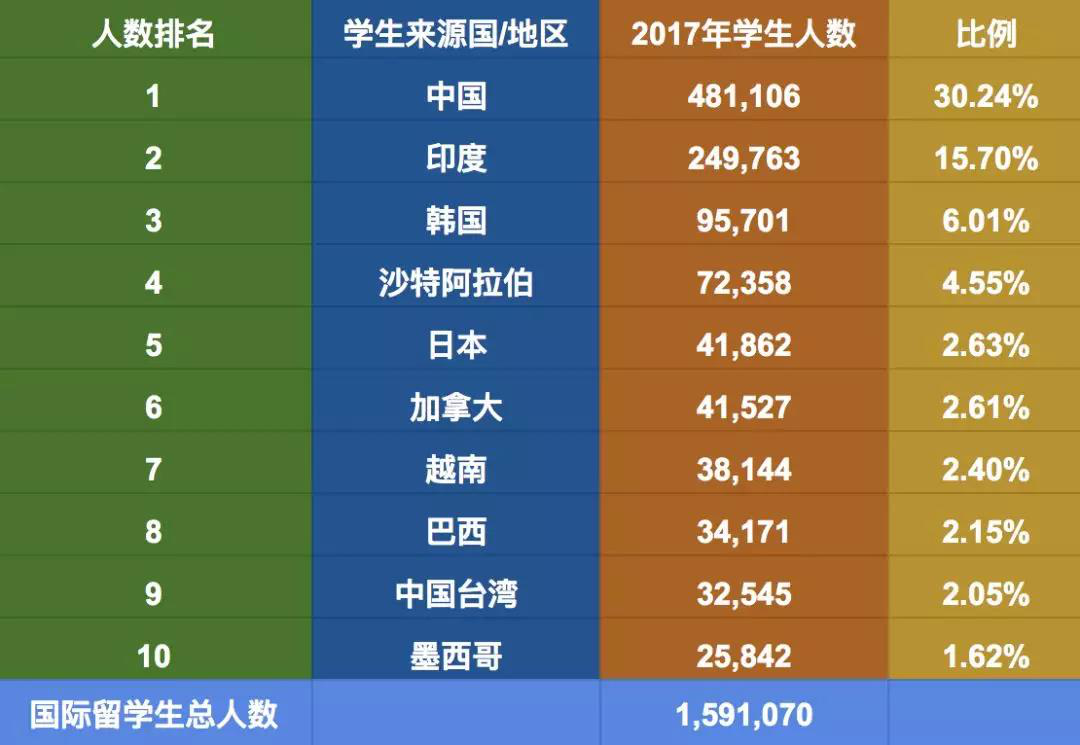
Data shows that in 2017, the number of registered international students in the U.S. was 1,591,070. Among them, Chinese students ranked first with 481,106, accounting for over 30% of the total international student population in the U.S.; India, South Korea, Saudi Arabia, and Japan followed closely behind; Asian countries firmly occupy the top five spots on the U.S. international student rankings.
The Number of Chinese Students Applying for OPT Is Puzzling
According to the 2017 comprehensive statistics on international students in the U.S., nearly one-third of international students choose to gain work experience in the U.S. while studying or immediately after graduation. Furthermore, the number of applications for OPT (Optional Practical Training) has maintained a continuous upward trend over the past decade, with more and more people choosing to work in the U.S. after graduation.
OPT is a legal work period of 12 months (36 months for STEM majors) granted to international students in the U.S. after completing their studies, subject to approval by the immigration authorities. The longer the OPT, the more favorable it is for internships/employment in the U.S.
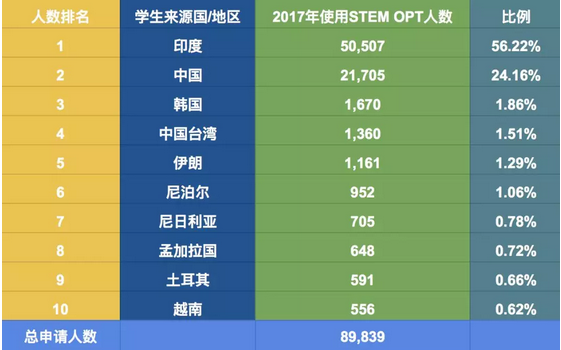
In 2017, the total number of applicants for STEM OPT was 89,839, of which 21,705 were Chinese students, accounting for 24.16% of the total usage, which is less than half of the number of students from India, who ranked first. Although Chinese students have an absolute advantage in total numbers, the number of STEM OPT users is puzzling.
So, why is the situation regarding OPT usage among Chinese students, who rank first in the total number of international students in the U.S., presenting a different picture?
Transitioning from OPT to H-1B Is Not That Simple
The growth rate of OPT has dropped sharply. According to relevant analysis, newly approved OPTs in 2017 increased by 8% compared to 2016, while the growth rate in 2016 was 34%. This is the largest annual decline in growth rate since 2004. The main reason is that the Trump administration's unstable immigration policies have caused companies to have more concerns about hiring international students.
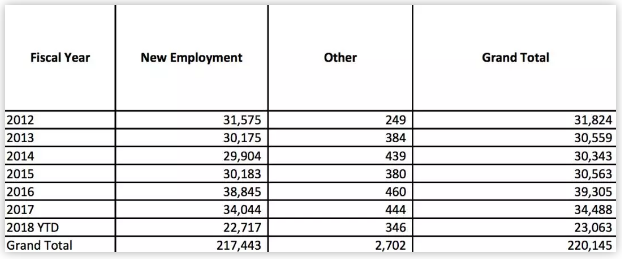
Every international student struggling in the U.S. has a difficult path, and status is the biggest shackle. For companies, hiring international students means facing the loss of talent if they fail to secure an H-1B visa after their internship. Some companies are unwilling to hire international students and will even openly state this rule in their job advertisements. At the same time, among approximately 6 million U.S. companies, only 0.5% apply for H-1B visas for international students. According to the latest H-1B approval data from immigration authorities, the number of people who have successfully transitioned from F-1 to H-1B status via OPT has declined for three consecutive years. This means that using OPT as a path to transition to H-1B to stay in the U.S. is becoming increasingly difficult.
It Is Harder for International Students to Find Jobs; How Should They Respond?
Many parents send their children to study in the U.S. hoping they can obtain U.S. status in the future. However, with the current tightening of H-1B visas and the less-than-optimistic outlook for OPT or STEM OPT, this path is clearly becoming more difficult. In fact, rather than "studying abroad first and immigrating later," it is better to "immigrate first and study abroad later." Once the whole family obtains a U.S. Green Card, children can enjoy the many benefits that come with resident status.
At the same time, studying abroad is an expensive investment. Nowadays in the U.S., the average tuition for a private undergraduate degree is $43,562. Including living expenses, the annual cost is 400,000 RMB, and a four-year undergraduate degree costs 1.6 million RMB. Through EB-5 investment immigration, investors only need to invest $500,000 to immigrate the whole family to the U.S. Obtaining a U.S. Green Card allows international students to be free from the restrictions of status and work visas after graduation, giving them priority access to internships and job opportunities at Fortune 500 companies, government agencies, and non-profit organizations, allowing them to choose their careers freely and receive the same salary and benefits as locals.
Therefore, experts from WorldWay Group suggest that those who have the idea of sending their children to the U.S. for high-quality education or immigrating the whole family to the U.S. should act as soon as possible. A Green Card is very important for children! Investors can choose high-quality projects that have been approved by the immigration authorities, have the potential to shorten waiting times, have completed all employment requirements, and offer first-priority repayment guarantees. This will greatly protect the interests of investors and help them successfully immigrate to the U.S.

Currently, the highly popular WorldWay EB-5 projects in the EB-5 market: the No. 9 Manhattan Luxury Boutique Hotel and Dallas No. 1 are both rare, high-quality projects. Good projects do not wait, and children's education cannot wait. Green Card applications must be made early. Please call for consultation as soon as possible: 400-138-2929.