





As is well known, under U.S. law, every individual residing in the United States who has income and meets certain eligibility requirements is responsible for participating in annual tax filing as required by the Internal Revenue Service (IRS). Therefore, whether you are a permanent resident holding a Green Card or a foreign worker holding a work visa, you are required to report your global income for the previous year during the tax season.
So, for EB-5 investors, how should you file your taxes after receiving the K-1 form issued by the project entity? Today, the editors at Worldway Immigration Group will share relevant tax filing information for EB-5 investors after receiving the K-1 form.
1. What is Form K-1?
Generally, the project entity for an EB-5 project is a limited partnership, consisting of one general partner and many limited partners. Similar to China, in the United States, a limited partnership itself does not pay corporate income tax. According to the profit and loss distribution rules established in the partnership agreement, all income and expenses flowing from the enterprise to the partners must be reported on their respective tax returns.
Form K-1 is the form used to report to the IRS each partner's share of the partnership's income, expenses, dividends, and all capital and potential corresponding liabilities. The partnership must aggregate this form with other tax filing-related forms to file the partnership income tax return with the IRS.
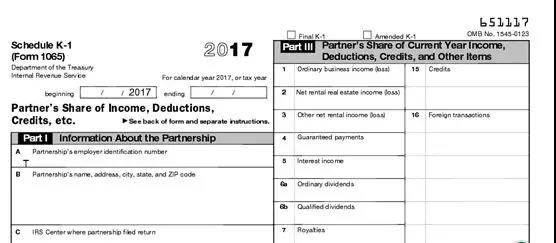
2. What information does Form K-1 mainly reflect?
In an EB-5 Regional Center project, every EB-5 investor, as a limited partner, may receive a project K-1 form issued by the project's limited partnership annually, serving as an income voucher reflecting the project's operations for the previous year.
The K-1 mainly reflects the increase or decrease in the investment amount of the project limited partner (i.e., each individual EB-5 investor) in the project, liabilities assumed (which are usually absent in EB-5 projects), and data such as a portion of income, gains, losses, and expenses obtained annually according to the investment ratio or other rules established in the enterprise agreement.
3. When is Form K-1 generally filed with the IRS?
The project partnership files the partnership income tax return with the IRS on March 15 this year, and the IRS allows companies to extend this to September 15.
Whether you are a U.S. tax resident or a non-tax resident with income generated within the United States, you need to determine, based on your situation, whether you need to file tax documents, including the K-1 form (if you participated in a limited partnership investment), with the IRS before the annual personal income tax filing deadline (generally April 15; in 2018, because April 15 and the following days were weekends and holidays, the deadline was April 17; the deadline for non-tax residents without earned income and tax residents living overseas is June 15).
If the project entity delays the filing of its partnership income tax return to September 15, under the delayed filing status of the K-1 form, each investor's personal income tax return can also be extended accordingly, which can be extended to October 15 this year. However, you need to estimate your other income and confirm whether there is any tax to be paid before this date.
If there is tax to be paid, it must still be paid before April 17; otherwise, penalties and interest may be incurred. If you do not extend and file your income tax return first, and there is income on the K-1 form, you must submit an amended return to the IRS, and tax officials will review the tax return one by one again.
4. Why are the income and expense columns on some EB-5 project K-1 audit forms blank?
According to the capital account balance of the partnership, even if a limited partner has not been allocated any income, gains, losses, or deductions from the partnership for the current year, the partnership is still required to send a K-1 form to all limited partners who have a cash balance in the partnership account during the year.
Therefore, for some EB-5 projects where there is no income or expense in the first year, or the investor's funds have not yet entered the project from the escrow account, many EB-5 investors receive K-1 forms that only show the basic information of the project investor, with the income and expense columns left blank.
5. Do I need to file taxes if I receive a project K-1 form showing income?
1) If you are not in the United States, or if you are on an F1 student visa and have been in the U.S. for less than five years, and have no other taxable income in the U.S., you are not a U.S. tax resident.
When there is no income on the K-1 form, you only need to retain the K-1.
If there is income on the K-1 form, the project partnership will usually withhold income tax in accordance with the regulations requiring withholding tax for foreign investors in the tax law (the stipulated withholding tax rate may be higher than the investor's actual tax rate).
If there is a high withholding tax amount on the K-1 form, the investor can calculate whether a tax refund is generated based on the U.S. income tax rate. If so, you can apply for a tax ID number to file a non-U.S. tax resident income tax return and apply for a tax refund.
2) If you are not in the United States but have other income within the United States, such as rent from U.S. rental properties that needs to be reported, you need to include the K-1 income to file a non-U.S. tax resident income tax return and calculate whether the corresponding income tax needs to be paid according to regulations.
3) If you are in the United States, have been on an F1 student visa for more than five years, or have other visa statuses such as an H1B work visa, or have been in the U.S. for more than 183 days in three consecutive years on a business/travel visa (days in the current year + 1/3 of the days in the previous year + 1/6 of the days in the year before last, with the weighted total exceeding 183 days), you are a U.S. tax resident even if you have not obtained a Green Card.
When you receive a K-1, aggregate the project K-1 form into your income and expense information and report it on your personal income tax return for the previous year.
As a student, you may usually have no income. In this case, if the K-1 income does not exceed the standard deduction for that year ($10,400 in 2017, $12,000 in 2018), you may choose not to file.
4) If the EB-5 project investor is a tax resident who has already obtained a U.S. Green Card, the K-1 form is just one of all their tax filing materials. Therefore, they need to aggregate the project K-1 form into their income and expense information before the tax filing deadline, generally reporting it on their personal income tax return for the previous year.
6. What are the common income and expenses that may appear on an EB-5 project K-1 form?
The most common income and expenses that may appear on an EB-5 project K-1 form are as follows:
Line 1: Ordinary Business Income (Loss), ordinary business income, such as gains generated during the operation of the project enterprise, usually reported on Schedule E of the personal income tax return.
Line 5: Interest Income, interest income, such as interest obtained from project enterprise loans, usually reported on Schedule B of the personal income tax return.
Line 13: Other Deductions, other deductions, usually including various business expenses incurred in the operation of the project enterprise, such as management fees, loan interest, etc. According to different categories, there are more specific explanations of expenses in this line, usually reported on Schedule A of the personal income tax return. However, some expense deductions need to be confirmed separately; it is best to consult a professional tax advisor.
For U.S. EB-5 investment immigration applicants, the busyness of work, lack of experience, language barriers, and information asymmetry make tax filing issues even more difficult. Therefore, Worldway Immigration Group experts suggest that while planning for U.S. immigration, applicants should also make advance plans for U.S. taxation under the guidance of professionals, timely understand current U.S. tax laws and related information, and pave the way for future life in the United States.
As a leading institution in the investment immigration industry, Worldway Immigration Group has been committed to selecting high-quality projects for high-end clients for 21 years, and regularly holds various types of thematic lectures on U.S. real estate, education, life, financial investment, medical insurance, tax planning, and social welfare, making the investors' immigration journey more secure and successfully realizing their immigration dreams. Consultation Hotline: 400-138-2929.
Disclaimer: Some of the material in this article is from the internet, and the copyright belongs to the original author. The information or views in this article are for reference only. If there are issues such as copyright, please contact the original author and us.