





2017 was the inaugural year of CRS, and 2018 was the first year of its implementation. China's CRS tax-related financial information was scheduled for its first external exchange in September 2018. Simply put, the exchange of CRS tax-related financial information means that in the future, China will collect and submit account information of foreign tax residents in China to their respective national tax authorities; conversely, information on the overseas accounts of Chinese tax residents will be collected by foreign tax departments and submitted to Chinese tax authorities. This means that Chinese tax authorities will be able to obtain information from overseas financial institutions regarding the amount of assets Chinese citizens hold abroad, the balance in their bank accounts, and more.
As information on the overseas assets of high-net-worth individuals becomes increasingly transparent, how can you plan your tax residency status to properly address CRS?
High-net-worth individuals can effectively address CRS by accurately determining their tax residency status, conducting a detailed review of their overseas financial accounts, comprehensively assessing relevant tax risks associated with overseas financial assets, and then immigrating to low-tax countries or regions. Other measures, such as investing in non-financial assets like overseas real estate, jewelry, or artwork, are also viable options.
Taking immigration to low-tax countries or regions as an example, these jurisdictions typically share common characteristics: extremely low tax rates or even exemptions for certain taxes. Examples include Commonwealth countries in the Caribbean and South Pacific regions, such as Saint Lucia, Dominica, Saint Kitts and Nevis, Antigua and Barbuda, and Vanuatu.
Under the CRS framework, nationality is not necessarily an indicator of tax residency; CRS determines tax residency based on the country of current residence. When financial institutions determine the specific country for information exchange, the location of an individual's tax residency is crucial, as it dictates which country's tax authorities will receive the tax information.
If an individual is considered a Chinese tax resident, their bank accounts opened in many overseas countries and regions must be reported to the Chinese tax authorities. Therefore, conducting nationality planning as soon as possible and obtaining a second passport from a low-tax country is the only way to reasonably resolve this issue.
A Commonwealth passport helps you reasonably address CRS
Commonwealth countries such as Saint Lucia, Dominica, Saint Kitts and Nevis, Antigua and Barbuda, and Vanuatu are world-class tax havens that do not impose global taxation. They have no capital gains tax, net wealth tax, estate tax, or inheritance tax, and no tax on overseas income. Consequently, their passports are highly favored and sought after by global investors. With an investment starting from just $100,000, the whole family can immigrate and obtain Commonwealth citizenship.
Advantages of Commonwealth passport programs such as Saint Lucia and Dominica:
1. Reasonable global asset allocation to achieve asset preservation and appreciation
Holding a Commonwealth passport allows for reasonable asset planning. As a citizen of a Commonwealth country, you can conduct global asset planning, open overseas accounts, purchase overseas insurance, and establish overseas family trusts to achieve reasonable wealth allocation and facilitate the convenient transfer of wealth to preserve assets.
2. Reasonable tax planning to enjoy the freedom of a tax haven
Possessing a Commonwealth passport—represented by countries such as Saint Lucia, Dominica, Saint Kitts and Nevis, Antigua and Barbuda, and Vanuatu—enables reasonable tax planning. Assets and tax information held under a non-Chinese identity do not need to be reported to the State Taxation Administration. Most Commonwealth countries do not impose personal income tax, capital gains tax, property transfer tax, or inheritance tax on their citizens, and there is no global taxation.
3. Developed offshore finance to facilitate WorldWay expansion
Establishing an offshore company in a Commonwealth country can easily and quickly facilitate overseas listing and internationalize your business. By opening an account in the offshore department of a domestic bank, you will find that Commonwealth countries have almost no other regulations or requirements for tax declaration, other than company registration and annual filing fees. Opening an offshore company facilitates foreign exchange transactions, simplifies investment and operations, and keeps shareholder information confidential, which is convenient for overseas investments.
4. Obtain a second citizenship quickly in one step
The application process for a Commonwealth passport is simple and the approval is fast; the whole family can obtain a Commonwealth passport in just a few months. In addition, Commonwealth countries recognize dual citizenship, which does not affect your domestic career or life.
5. Visa-free access to many countries, allowing free travel globally
A Commonwealth passport provides visa-free, visa-on-arrival, or e-visa access to over 100 countries and regions worldwide, including the UK, EU countries, Schengen countries, and some developed countries and regions in Asia. With a Commonwealth passport in hand, you can easily travel whenever you want, whether for business trips or vacations.
6. Children receive a true international education
Holding a Commonwealth passport makes it easy for children to go abroad to enjoy international Commonwealth education. It also allows children to attend authentic international schools domestically as foreign nationals and gain easier admission to prestigious universities like Tsinghua University without taking the Gaokao.
Immigration experts at WorldWay state that with the development of economic globalization, the increasing awareness of global asset allocation among Chinese citizens, and the start of the first year of CRS implementation, it is believed that Commonwealth passport programs with tax haven advantages will become the most sought-after passport programs.
WorldWay Group
The only officially authorized Chinese immigration agency for Saint Lucia and Dominica
Your first choice for processing a Commonwealth passport
Immigration is a long-term and complex matter. It is important to choose a formal, professional immigration agency with good government relations.
After investors and their families obtain citizenship through immigration, they will have lifelong ties with that country. For example, they may need to reissue a lost passport, renew an expired passport, require Commonwealth consular protection during international travel, or need assistance with marriage status, no criminal record certificates, birth certificates, proof of kinship, proof of address, proof of residence, tax identification numbers, etc. All these aspects, which concern a citizen's life and career, may require government assistance and the issuance of valid supporting documents. These matters require the assistance of an agency with good government relations. This is the unique advantage of WorldWay Group!
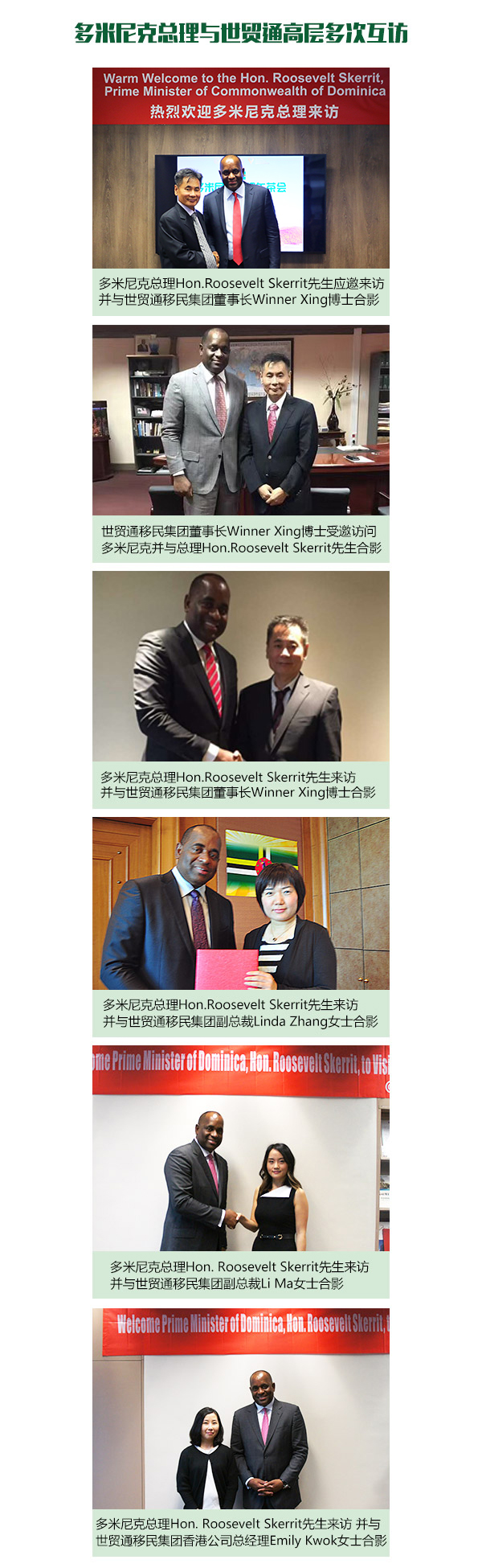
As a top 500 Asian brand, WorldWay Group, as a pioneer in Commonwealth passport programs, has always maintained good trust, interaction, and cooperative relationships with the governments of various Commonwealth countries. It is the only officially authorized Chinese immigration agency for Saint Lucia and Dominica, making it your best choice for processing a Commonwealth passport program. For more details, please consult: 400-138-2929.