





Mr. Bernard Wolfsdorf, former President of the American Immigration Lawyers Association, six-time consecutive 'Most Respected Immigration Lawyer' in Los Angeles, 2018 Los Angeles 'Immigration Lawyer of the Year', and Managing Partner of Wolfsdorf Rosenthal LLP, a top-tier EB-5 immigration law firm, delivered a brilliant speech at the launch event for the 'Manhattan 9 Luxury Boutique Hotel' project—a Manhattan EB-5 project with potential for shortened retrogression—hosted by Worldway Immigration Group from January 13th to 14th. He addressed issues such as retrogression for Chinese investors, the current status of EB-5 reform, and potential solutions to retrogression, garnering widespread attention from investors. In response to the needs of our investors, Worldway Immigration Group has compiled and shared the content as follows:
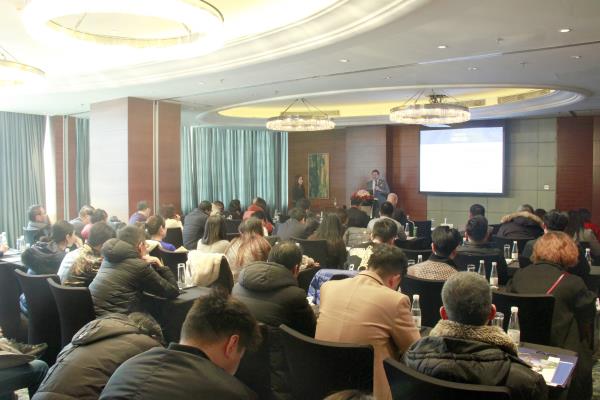
Good afternoon, distinguished guests. It is a great honor to be invited by Worldway Immigration Group, a leading domestic immigration agency, and its Chairman, Dr. Xing, to share the latest news regarding the EB-5 program with you all. Please allow me to introduce myself: I am Bernard Wolfsdorf, an attorney from WR Immigration. I am deeply honored to have served as the President of the American Immigration Lawyers Association, to have been named the 'Most Respected Immigration Lawyer' in Los Angeles for six consecutive years, and to be the 2018 Los Angeles 'Immigration Lawyer of the Year'.
Today, I will mainly share topics of concern to investors from mainland China, such as the current retrogression issues faced by Chinese investors, the status of EB-5 reform, and some anticipated solutions to address retrogression.
As everyone knows, for investors born in China, the issue of retrogression is a particularly hot topic of concern, and it has become a major obstacle on the path to U.S. immigration for investors born in mainland China. As an attorney, my advice is that investors must seize the right investment timing, formulate a sound investment plan, select a high-quality project, and submit their I-526 applications as early as possible. To use a simple analogy: when boarding a plane at Beijing Capital International Airport, you have to wait in line. If your flight departs in one hour, you arrive at the airport at least two hours early; if it departs in two hours, you arrive at least three hours early. By extension, obtaining a visa through retrogression also requires waiting in line. Therefore, investors should plan their immigration early and join the queue as soon as possible, rather than hesitating and waiting.
I believe the primary goal for many investors immigrating to the United States is to provide their children with access to top-tier American education. Among the cases handled by WR Immigration, we have successfully helped 14-year-old minors immigrate to the U.S. as primary applicants. In the future, we will strive to develop more solutions for minors as young as 10 to immigrate as primary applicants, which I believe will be one of the best ways to address retrogression.
As the old Chinese saying goes, 'When water comes, earth covers it.' We believe every problem has a solution, and today I will share some solutions for retrogression. Clients following U.S. investment immigration likely know that the current EB-5 program has been extended multiple times, with the current expiration date being January 19, 2018, and it may be briefly extended again until February 16.
Currently, the U.S. government, Congress, and the Department of State are all very concerned about the issue of retrogression, and intense discussions are underway within Congress with the hope of making positive progress. From a professional legal perspective, I can confidently tell you that a definitive bill will be introduced within the next 1 to 2 months. Once this final bill is enacted, from a legislative standpoint, we will have a very stable 5 to 6-year period, and the new bill will be extended without changes.
Assuming you have made up your mind to immigrate to the U.S. through EB-5 investment for your children's education, I sincerely advise you to plan your immigration in advance to secure your priority date in the retrogression queue. Under the current EB-5 program, the minimum investment amount for a Targeted Employment Area (TEA) is $500,000. Before the investment amount increases, locking in the $500,000 investment is a very economical and practical way to immigrate to the U.S.
Below, I will share several solutions for resolving retrogression from the legislative, Congressional, and Department of State levels. First, under current law, the 10,000 green card quota is allocated to 10,000 families. Chinese investors generally follow a three-person family model—you, your spouse, and your child. Allocating the quota among these 10,000 green cards effectively means only about 3,000 families can be accommodated each year. After the new bill is passed, these 10,000+ green cards will be allocated to 10,000+ families, rather than 3,000+ families, as your spouse and children will not be counted toward the visa quota. I believe this is the fastest way to resolve retrogression, but the likelihood of this happening is relatively low because it involves changes to the number of visas.
Second, the 10,000 green card quota is actually divided based on the investor's country of birth. Each country is limited to 7%, meaning that mainland China receives approximately 700 visa quotas per year. A solution currently under discussion is to remove the 700-visa limit and open the 10,000 quotas to all investors worldwide, which would significantly shorten the retrogression for mainland Chinese investors. Many people ask: why should a country with a population of 1 million or 10 million receive the same visa quota as a major country like China? A major reason why investors born in mainland China face retrogression is the 7% per-country limit. The good news is that the proposal to remove the 7% per-country limit has already been discussed within Congress, and there is currently a very mature bill that has received joint support from 300 members of Congress. I believe a clear bill will be introduced by the end of this year, and the bill code is HR392.
Third, in the current U.S. immigration policy, there is a program called the Diversity Visa Lottery, which provides approximately 55,000 visa quotas annually. It is actually issued to individuals from countries with fewer U.S. immigration applicants, and this policy will also be cancelled this year. The industry is working towards reallocating these 55,000 cancelled visa quotas to the EB-5 U.S. investment immigration program, as EB-5 investment creates jobs and stimulates capital investment in the U.S., bringing numerous positive impacts.
Fourth, the current EB-5 Regional Center Program is temporarily valid until January 19, 2018. I personally believe that a new bill should be introduced around the Chinese Lunar New Year. This new bill is mainly led by Grassley and Goodlatte, who are key figures in the U.S. Senate and House of Representatives, respectively. In particular, Goodlatte is the Chairman of the U.S. House Judiciary Committee. The 'American Job Creation and Investment Promotion Reform Act of 2017' (draft) promoted by Grassley serves as the basis for the legislative reforms currently being discussed in Congress.
Many investors may be waiting for the new bill to be released. Let me use an analogy: for stock investors, if you buy at the peak of the stock market, it is very unfavorable for you. In fact, the same applies to EB-5 U.S. investment immigration. After the new bill is introduced, there will be an increase in the investment amount. If you only apply for I-526 after the bill is introduced, it will not be cost-effective. Therefore, I suggest that everyone seize the opportunity to submit their applications now and take advantage of the current low investment amount.
Currently, the status quo of U.S. investment immigration is mainly being changed through two channels: Congressional legislation and administrative regulations from the USCIS. If Congress does not pass a new bill, the USCIS will also issue new administrative regulations. Below, I will share some specific clauses in the bill reform, such as the investment amount issue that investors are most concerned about.
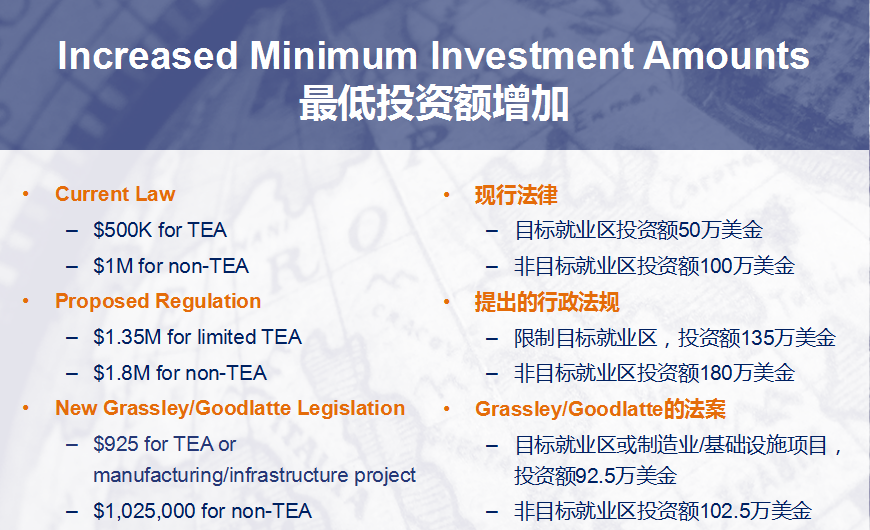
As shown in the figure above, under current law, the investment amount for a Targeted Employment Area (TEA) is $500,000. In the administrative regulations proposed by the USCIS, the investment amount for a TEA would be increased from $500,000 to $1.35 million. At the Congressional level, the reform proposes increasing the TEA investment amount from $500,000 to $925,000.
As you can see, whether it is through Congressional legislation or USCIS administrative reform, the government's determination to increase the investment amount is very firm. I believe that in the future new bill, the investment amount for a TEA will not be $500,000; it may double or triple.
Of course, the increase in the EB-5 investment amount may not be the issue everyone is currently concerned about; retrogression is. But please imagine, since you are doing U.S. investment immigration anyway, why not take action now while the prices are favorable and the policies are loose!
Regarding the increase in the minimum investment amount, all sectors of the U.S. and the government consider it a certainty. In current government discussions, the definition of a Targeted Employment Area (TEA) has become a greater focus. There will be greater restrictions on its definition, including which projects and regions will be eligible for preferential policies to shorten retrogression after this definition is released.
The two most hotly discussed topics now are the definition of regions that may shorten retrogression and the specific distribution of policies that may shorten retrogression. In the current reforms, the definition of a TEA is reduced to three categories: first, priority urban investment areas; second, rural areas; and third, closed military bases.
If a project meets the new TEA definition, it can actually enjoy the possibility of shortened retrogression, bypass the retrogression hurdle, and obtain a green card quickly. One option is to invest in projects in priority urban investment areas or rural areas. However, generally speaking, rural projects are distributed in less economically developed areas, and these types of real estate or property projects are called third- or fourth-tier investment projects in China. I believe all investors present understand that when you invest in real estate, the core is its location. If you buy a house in a first-tier city like Shenzhen, Shanghai, or Beijing, the future appreciation potential is definitely greater. This is why projects in priority urban investment areas have greater advantages compared to rural projects, and at the same time, they also have the possibility of shortening retrogression. This logic is the same in the United States; for example, real estate in metropolitan areas like New York, San Francisco, and Seattle definitely has more investment value. Therefore, I suggest that since both can help you potentially shorten retrogression and obtain a green card quickly, projects in priority urban investment areas are definitely a better choice, because they not only help you in terms of immigration but also in terms of investment.
Below, I would like to focus on introducing the concept of TEA areas, called priority urban investment areas. The 'American Job Creation and Investment Promotion Reform Act of 2017' (draft) proposed by Senator Grassley in April 2017 contains a clause specifying priority urban investment areas. Mr. Grassley is also the current Chairman of the U.S. Senate Judiciary Committee.
Under current laws and bills, perhaps more than 90% of the projects on the market are currently eligible for TEA status. Everyone knows the benefits of TEA projects: first, you can definitely immigrate to the U.S. with a relatively low investment amount. However, after the new bill reform, with the tightening of the TEA definition, 80% to 90% of the projects on the market will no longer meet the TEA definition. At this time, I believe that projects in priority urban investment areas will definitely be a better choice to help you realize your American dream.
So, how are priority urban investment areas defined? They must meet 2 out of the 3 items listed in the New Markets Tax Credit (NMTC) standards.
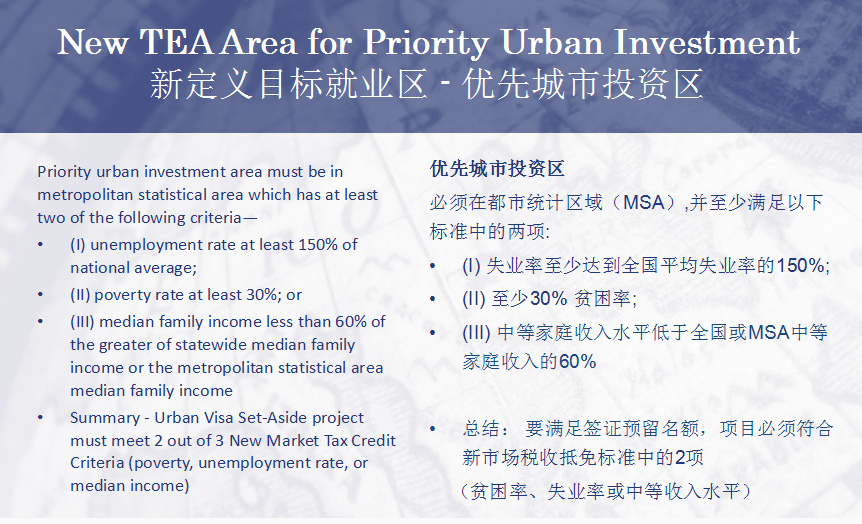
I can confidently tell you that the definition in the image above is very likely to be the final definition of priority urban investment areas. Under current laws and bills, the definition of a TEA only requires you to meet the first requirement, which is that the unemployment rate must be at least 150% of the national average unemployment rate to obtain a lower investment amount. Under the premise of the new bill reform, the TEA definition will be tightened. In addition to meeting the unemployment rate condition, you must also meet either the median family income or the poverty rate condition; that is, you must meet at least two of the three conditions.
When a project meets 2 out of the 3 items in the New Markets Tax Credit standards, it meets the requirements for shortening retrogression. The visa quota reserved for the policy of shortening retrogression in the 2018 fiscal year is 7.5% for projects in priority urban areas and rural areas, respectively, which is 750 priority visa quotas. In the 2019 fiscal year, 15% will be reserved for projects in priority urban areas and rural areas, respectively, which is nearly 1,500 visas per region per year. This is the system for visa quota allocation mentioned in the new bill reform by Senator Grassley. I believe everyone now has an understanding of the new content and direction of this bill.
So, what impact will this new bill have on you after it is introduced? First, investing in high-quality real estate projects will require higher investment funds, meaning that an increase in the EB-5 investment amount is certain. Second, the new EB-5 bill reform involves many extensive clauses, providing greater transparent disclosure for the safety of EB-5 investors' funds. For example, when you manage private accounts, you can also see the inflow and outflow of funds and the investment status through online banking. In the future, new regulations will further strengthen integrity measures in EB-5 investment. Third, for investors, before the deadline in February or April 2018, you have a short window to enjoy a more economical investment amount, while potentially benefiting from future policies that may shorten retrogression.
If you have made up your mind to immigrate to the U.S. through the EB-5 method, please be sure to pay attention to the following three points. First, you must choose a good project; a good project basically determines 90% of whether your immigration will be successful. So, what are the criteria for judging a good project? It mainly depends on two aspects: on one hand, this project can provide you with a very secure green card, and on the other hand, this project will liquidate and return your principal to you after your loan term expires. Second, you need a very experienced immigration agency. This immigration agency is also indispensable in the process of submitting your case. I have been working with Worldway for a long time, and I have personally witnessed the professionalism of Worldway and its sense of responsibility to its clients. Worldway is a very capable immigration company. Third, choose a top-tier American expert, an American immigration lawyer.
A good immigration agency can be judged mainly from three aspects. First, the immigration agency has an excellent reputation and rich experience. Only in this way can it accumulate a large number of case submissions and more accurately grasp the trends of USCIS case adjudication, so as to prepare initial financial materials for you. Second, it needs to know how to choose good projects. Third, it needs documentation experience for fast and accurate document preparation.
I hope my speech today will be helpful to your decision. I also believe that the United States is a fertile ground for children to succeed, and I hope your future path to U.S. immigration will be very smooth and successful. Thank you all. For more information, please call: 400-138-2929.
Copyright and Disclaimer:
The copyright of this article belongs to Worldway Immigration Group. If you need to reproduce or publish this article by means of reprinting, linking, reposting, or any other method, please be sure to indicate that the copyright of the article comes from Worldway Immigration Group; otherwise, legal responsibility will be pursued. The information or views in this article are for reference only.