





As more and more new immigrants successfully obtain their U.S. green cards, they begin to pay attention to the process of naturalizing as U.S. citizens. The WorldWay Immigration Group provides a detailed explanation of the five major issues regarding U.S. immigration naturalization and citizenship as follows:
Q1. What is U.S. immigration naturalization and citizenship?
Any individual who is at least 18 years old, has held U.S. permanent residency (green card) for five years (with some exceptions), and meets the residency requirements may apply to become a U.S. citizen through the U.S. Citizenship and Immigration Services and federal courts. This application process for U.S. citizenship is called naturalization.
While the U.S. government grants many rights to U.S. citizens, it also imposes corresponding civic duties. Therefore, whether to apply for naturalization is a matter that requires careful consideration for the new immigrant community in the United States.
Q2. What are the benefits of naturalizing as a U.S. citizen?
1. You can apply for immigration for relatives, achieving family reunification sooner.
2. Holding a U.S. passport allows visa-free entry to over 100 countries worldwide.
3. Enjoy specific financial assistance available only to citizens.
4. Have the right to vote, serve on juries, and participate in democratic politics.
5. Eliminate the need to renew your green card.
Q3. What are the requirements for applying for citizenship?
1. The applicant must be at least 18 years old and a lawful permanent resident of the United States (these two requirements apply to applicants submitting their applications independently).
2. The applicant must have continuously resided in the United States for five years (if married to a U.S. citizen, the applicant may apply for citizenship after three years of marriage). During these five years, the applicant must have physically lived in the United States for at least half of that time, which is more than 30 months (if married to a U.S. citizen, the physical presence requirement is 18 months).
3. The applicant must have resided in the state where they are applying for the last three months of the five-year period.
4. The applicant must have a basic ability to read, write, and speak English.
5. The applicant must understand U.S. history and government and be committed to the principles of the U.S. Constitution.
6. The applicant must have good moral character and adhere to the U.S. Constitution.
Q4. What are the basic steps for permanent residents to apply for citizenship?
1. Complete Form N-400 and prepare the application fee;
2. Mail the completed Form N-400, required supporting documents, and application fee to the designated processing center;
3. After receiving notification from the processing center, the applicant must bring their permanent resident card, driver's license or state-issued ID, and fingerprint notification to the fingerprint center to have their fingerprints taken (applicants over 75 years old may be exempt from fingerprinting).
4. If the applicant successfully passes the background check, the immigration office will notify them for an interview. During the interview, the applicant must pass the English test and the civics test;
5. Once the interview is passed, the applicant will generally receive notification from the immigration office to take the citizenship oath within about six months, and upon taking the oath, they will receive their U.S. citizenship certificate and officially become a U.S. citizen.
Note: Keep backups of all documents and materials.
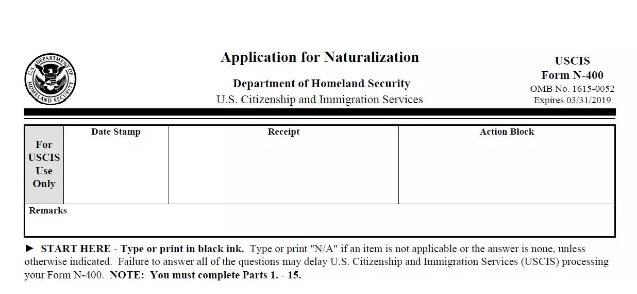
Form N-400
Q5. How to deal with some special situations?
★ You can submit Form N-400 up to 90 days before meeting the continuous residency requirement.
★ Children under 18 years old can submit an application (Form N-600) for citizenship, provided that their parents are U.S. citizens and proof of the parent-child relationship is provided.
★ If you are 50 years old or older at the time of application and have been a permanent resident in the United States for a total of at least 20 years, or if you are 55 years old or older at the time of application and have been a permanent resident in the United States for a total of at least 15 years, you are exempt from the English test.
★ If you are 65 years old or older at the time of application and have been a permanent resident in the United States for a total of at least 20 years, you are exempt from the English test and may take a simplified version of the civics test.

In recent years, domestic investors have shown increasing enthusiasm for U.S. immigration, with EB-5 investment immigration becoming the mainstream investment method for Chinese citizens immigrating to the United States. The EB-5 program has been in place for 27 years since its establishment in 1990, with the investment amount remaining at $500,000 (or $1 million in non-TEA areas). Against the backdrop of other major countries raising their investment immigration thresholds, there is a consensus that the minimum investment amount for EB-5 will increase, and a price hike is imminent. Therefore, before the EB-5 reform on September 30, every EB-5 investor wants to seize the opportunity before the new policy is implemented.
The WorldWay Immigration Group reminds: There are only a little over 20 days left for the last chance to invest $500,000 for U.S. immigration. Time is of the essence for this golden opportunity, and we advise investors to invest early to obtain their green cards sooner and mitigate the risks of policy changes and price increases. For more information, please call: 400-138-2929
Disclaimer: Some of the materials and images in this article are sourced from the internet, and the copyright belongs to the original authors. The information or opinions in this article are for reference only. If there are any copyright issues, please contact the original authors or us.