Bermuda, the British Virgin Islands, and the Cayman Islands are globally renowned "tax havens" and offshore financial centers, also favored registration locations for Chinese companies. Some prominent Chinese enterprises, such as Alibaba, Dangdang, Sina, and 360, have registered in the far-off Caribbean Cayman Islands. It is said that there are over 200,000 Chinese companies registered in the British Virgin Islands.
However, with the advent of the global taxation era under CRS, offshore companies established in these countries and regions are facing significant challenges, as the real controllers behind these offshore companies will be made transparent with the implementation of CRS.
According to the CRS implementation timeline, financial institutions in mainland China officially began customer due diligence on July 1 of this year, collecting information not only on non-tax residents but also on dual tax residents.
Currently, 101 countries and regions, including China, have joined CRS. According to the CRS agreement, CRS implementers are divided into two batches, with the first batch of countries and regions exchanging information this year, including the British Virgin Islands, the Cayman Islands, and Bermuda; the second batch will exchange information in 2018, including China and Hong Kong. This means that in the future, the hidden assets of wealthy individuals establishing offshore companies in these "tax havens" will largely be exposed.
Given this background of CRS, these "tax havens" have either already fallen or are about to fall. How should high-net-worth individuals protect the integrity of their assets? Obtaining a third-country passport from a tax haven, such as a Dominica passport, Saint Lucia passport, Antigua passport, Saint Kitts passport, or Vanuatu passport, and using this passport to establish offshore businesses and personal accounts is the reasonable way to ensure asset preservation and appreciation.
Taking the Dominica passport as an example, firstly, Dominica is a world-class tax haven, offering favorable tax policies to investors, exempting them from capital gains tax, inheritance tax, and gift tax, among others. Additionally, Dominica is one of the few non-global taxation countries, helping investors achieve global asset allocation while facilitating more reasonable tax planning.
Secondly, Dominica is one of the world-renowned offshore financial centers. Holding a Dominica passport allows individuals to open offshore accounts as a Dominican citizen, transferring assets to overseas accounts, which not only reasonably avoids CRS but also removes the limitations of a single identity, offering richer and more suitable investment channels in a broader overseas market for more extensive asset allocation, making it easier to achieve asset transfer and global configuration.
How to apply for a Dominica passport? You can do so through the following two methods:
1. Invest (donate) at least $100,000 to the Dominica government fund;
2. Invest in real estate for citizenship: Invest no less than $200,000 in a government-approved real estate project (with annual returns).
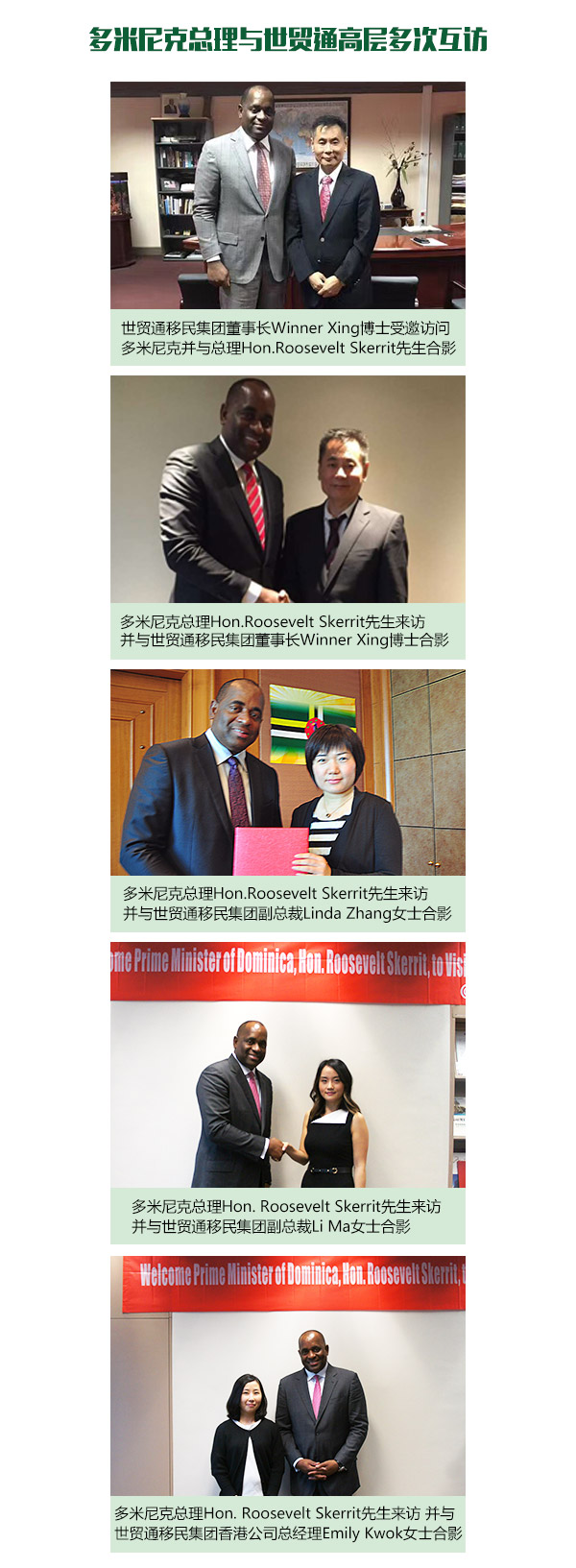
WorldWide Immigration Services, as one of the first immigration companies to introduce the Dominica investment citizenship project to China, has also successfully promoted the Dominica passport and has maintained good government relations over the years. The Prime Minister of Dominica, Hon. Roosevelt Skerrit, has conducted several mutual visits with senior management of WorldWide Immigration Services, providing advantages such as simplified application materials and expedited approval processes for WorldWide clients. In the future, WorldWide Group will continue to collaborate closely with the Dominica government to provide investors with more professional, comprehensive, and thoughtful services, leading the development of the immigration industry. Choose WorldWide Immigration Services for Dominica immigration to make your immigration journey smoother! For more details, please contact: 400-138-2929.