





Marriage-based immigration is one of the most convenient and efficient ways to immigrate to the United States. Many immigrants choose this path, though some have resorted to fraudulent marriages to achieve their goals. Recently, the U.S. Citizenship and Immigration Services (USCIS) issued a new regulation, which has made it more difficult to obtain a Green Card through this method and has also significantly increased the costs involved.
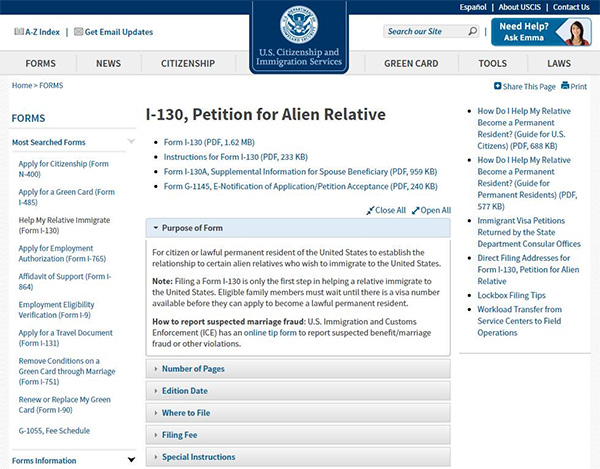
USCIS announces the launch of the new Form I-130
New regulation from USCIS: Effective April 28, applicants for relative-based immigration must use the new version of Form I-130. Compared to the old version, the new form has increased from 2 pages to 12 pages. Information previously required only for spousal petitions—such as ethnicity, hair color, height, weight, and eye color—must now be provided by applicants in other family-based categories as well. For marriage-based Green Card applicants, the G-325A form, which was previously required, has been replaced by the new I-130A form.
Where is the main focus?
The new form filing instructions clearly state that if an applicant obtained their Green Card through marriage to a U.S. citizen or permanent resident, they are ineligible to petition for a new spouse unless one of the following conditions is met: the applicant has become a U.S. citizen, the applicant has held a Green Card for at least five years, the applicant can provide evidence that their previous marriage—through which they obtained their Green Card—was bona fide, or the previous marriage was terminated due to the death of the spouse.
There are many ways to obtain a U.S. Green Card. Those with relatives in the U.S. can apply via family-based immigration; those with excellent work performance can apply for employment-based immigration; professional technical talent can apply through special talent categories; and those with substantial financial resources may consider investment immigration.
However, all of the above pathways require a waiting period of at least one year. Not only is the process long, but if an error occurs in the middle, the chance of obtaining a Green Card could be lost.
The only path without a waiting period is marriage-based immigration. As a result, it is widely known that many cases of fraudulent marriage immigration have appeared within the Chinese community. Xiao Zhengyi, who was recently sentenced, long colluded with his daughter to help at least 87 Chinese citizens obtain Green Cards through sham marriages and was sentenced to two years in prison.
According to reports, in the past, some individuals in the Chinese community obtained Green Cards through sham marriages. In order to make quick money, some began to "cash in" on their own Green Cards. Working with illegal immigration agencies, they would act as intermediaries to marry individuals without status and then use the sham marriage to help them secure a Green Card.
All of this has one purpose: to prevent sham marriages!
This new regulation from USCIS puts an end to such illegal behavior, which will inevitably lead to a reduction in the number of people who can obtain a Green Card through sham marriages, thereby increasing the cost of such illegal activities.