






UK immigration perspective on doing business in the UK: UK Chancellor of the Exchequer George-Osborne(George Osborne) arrived in Beijing on the 20th to announce the start of a "Golden Decade" in China-UK relations, reinforcing his role as a leading supporter of China and its slowing economy.
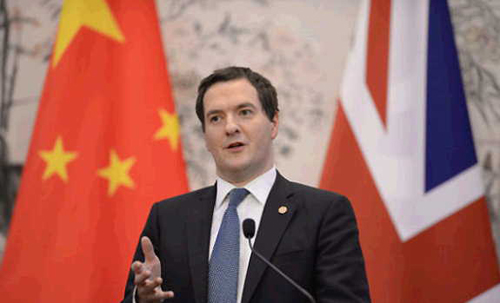
At a time when geopolitical tensions have strained US-China relations, Osborne views his 5-day visit as a prime opportunity to boost UK-China trade and secure investment. "The visit is primarily focused on the two countries' annual Economic and Financial Dialogue, but of course, there will be some important issues raised in an appropriate manner," said an aide to Osborne.
Accompanied by several ministerial officials, business leaders, committee chairs, and cultural figures, Osborne did not miss the opportunity to downplay the impact of the Chinese stock market crash this summer.
Osborne stated that he would visit the Shanghai Stock Exchange this week to demonstrate his support and confidence that China will continue to serve as an engine for global economic growth. "According to our estimates, the spillover effects on other financial markets have been relatively limited so far," he told a group of tech entrepreneurs in Beijing. "Even if the Chinese economy no longer grows at a double-digit rate, the economic increment over the next 5 years will still be at least equivalent to the size of the UK economy," he said. "China is undergoing a very important economic transformation—which is what both the Chinese government and the Chinese people hope to see—shifting from the investment-driven economy of the past to a consumption-driven economy of the future," he added, "When going through such a transformation, you will find it quite challenging."
Also accompanying him on the visit is Commercial Secretary to the Treasury Jim-O'Neill(Jim O'Neill), who coined the term "BRIC" to describe emerging economies; Lord O'Neill stated that the slowdown in the Chinese economy was foreseeable but needs to be viewed objectively.
The scale of Osborne's China trip is equivalent to that of a Prime Ministerial visit, with the first day dedicated to showcasing British soft power, as cultural institutions such as the Tate and the Royal Opera House joined the charm offensive. Chinese versions of the National Theatre's "War Horse" and the Globe Theatre's "Richard III" were performed, and Osborne also announced funding of 750,000 pounds to support the British Museum's "A History of the World in 100 Objects" exhibition in China.
The British Library will exhibit manuscripts and early editions from Shakespeare to Arthur-Conan-Doyle(Arthur Conan Doyle), while the Southbank Centre will receive 500,000 pounds over 3 years to promote UK-China cultural relations.
The main purpose of Osborne's trip is to convince China that "no other Western economy is as open to Chinese investment as the UK," as evidenced by his proposal for China to participate on a large scale in the revival of the UK's nuclear power industry.
George-Osborne will visit Shanghai on Tuesday, hoping to drum up business for the City of London, but his greater goal is to secure Chinese investment for his "northern powerhouse" plan before Chinese President Xi Jinping's state visit to the UK in October. To demonstrate his view that cities outside of traditionally powerful ones also need investment, Osborne will also visit the western Chinese cities of Chengdu and Urumqi.
