



WorldWay · Interpretation of U.S. Immigration Policies
— · —
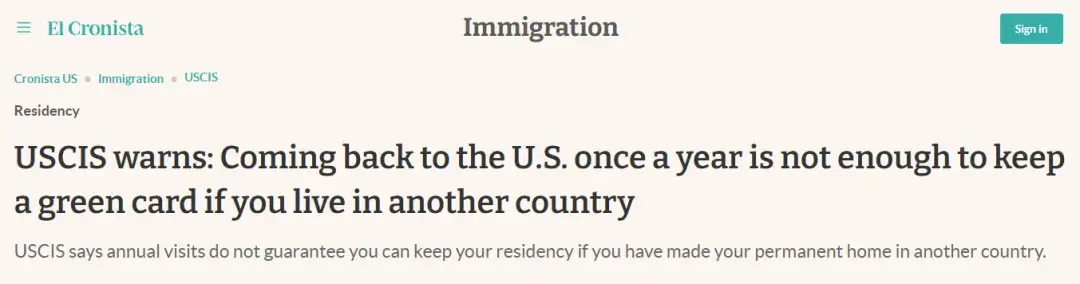
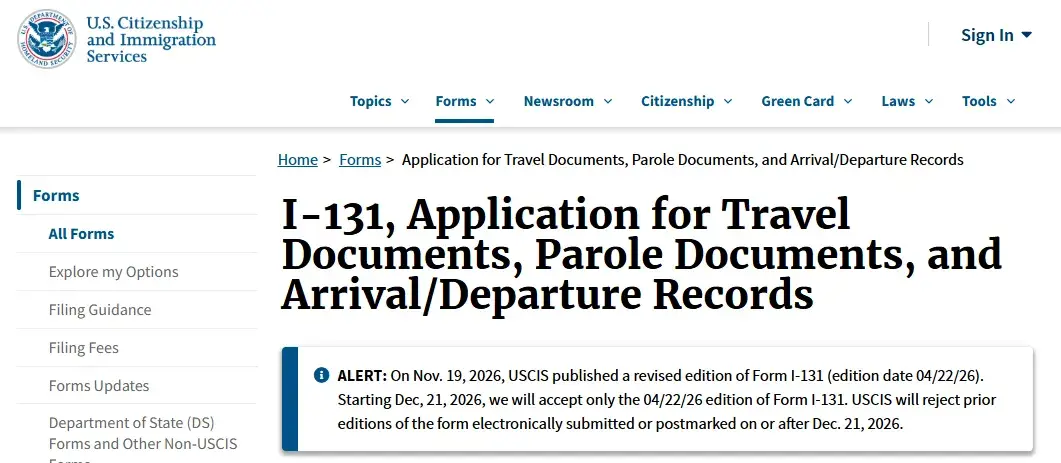
Recently, the U.S. Citizenship and Immigration Services (USCIS) issued another reminder that for green card holders residing overseas for extended periods, merely returning to the U.S. briefly once a year is not sufficient to maintain permanent resident status. Meanwhile, starting from December 21, 2026, reentry permit applications will require the new edition of Form I-131, accompanied by updated submission rules.
In light of these two updates, WorldWay integrates key policy points to analyze the underlying logic and practical essentials of green card maintenance, providing a reference for investor friends with cross-border life plans.
01
The Essence of Green Card Maintenance: Intent to Reside Is the Core
USCIS explicitly states in its official guide for new immigrants that green card holders residing abroad for long periods and merely returning briefly each year cannot automatically preserve their permanent resident status. The key lies in whether you continue to regard the United States as your permanent home. Even if a single departure does not exceed one year, or is only 6 to 12 months, if an individual has established a long-term residence, stable employment, or significantly shifted their focus of life overseas, immigration authorities may still determine that they have “abandoned their green card”.
This reminder is not a new regulation, but a reaffirmation of an established principle. In other words, a green card is essentially legal proof of an “intent to reside permanently”—“whether you actually live in the U.S.” matters more than “how many times you have returned.”
02
Compliance Tool for Long-Term Absences: Reentry Permit (I-131)
If you need to stay overseas for an extended period due to family, career, or other reasons, taking the right measures is essential. The primary tool recommended by USCIS is the “Reentry Permit”—a travel document issued by USCIS to permanent residents to demonstrate that their departure from the U.S. is temporary and that they have no intention of abandoning their U.S. permanent resident status.
According to the USCIS M-618 New Immigrant Guide, green card holders expecting to remain outside the U.S. for more than 12 months should file Form I-131 to apply for a Reentry Permit prior to departing to prove that the departure is a temporary arrangement without intention to abandon status. In conjunction with the latest notices, the following points are worth noting:
1Form Update: Starting December 21, 2026, only the new edition of Form I-131 will be accepted; older editions will no longer be processed;
2Paper Filing Only: Reentry permit applications currently do not support online filing; furthermore, both on the day of mailing and on the day USCIS receives the application, the applicant must be physically present in the United States—there have been cases where applicants received a denial after an adjudication period of approximately 16 months simply because they were outside the country when the package was received;
3Not an Absolute Guarantee: Even with a Reentry Permit, entry into the U.S. upon return is not unconditionally guaranteed; the final determination remains subject to individual case circumstances.
Therefore, green card holders planning to live, work, or care for family members in their home countries long-term should set aside sufficient application time well in advance, rather than initiating the process right before departure.
03
The Essence of Status Planning: From “Passive Check-in” to “Proactive Planning”
The convergence of these two updates points to the same conclusion: green card maintenance is shifting from broad management based on “frequency of entry” toward granular scrutiny of “intent to reside + documentary compliance.” For families frequently traveling back and forth, it is necessary to assess the length of stay outside the U.S. earlier, reserve a window to apply for a Reentry Permit, and maintain a chain of evidence in the U.S. including residence, tax filings, and family ties.
For families who have not yet obtained a green card and are currently planning their immigration pathway, this trend is equally relevant—the starting point of status planning should be a clear judgment regarding the future center of life, rather than passive reactions after approval. If you are planning a global footprint for your family's future while seeking to maintain U.S. permanent resident status stably, the choice of immigration pathway itself is a critical step in the planning process.
The reason EB-5 investment immigration attracts significant attention is precisely that its logic closely aligns with the underlying demands of “green card maintenance”: through the core mechanism of “investing to create jobs,” it establishes from the very beginning a lawful and positive bond deeply tied to the local U.S. economic development. An ongoing EB-5 project itself serves as one of the strongest proofs of your “U.S. center of life.”
As a pathway where one can control their own pacing, EB-5 investment immigration allows applicants to flexibly arrange affairs between China and the U.S. during the waiting period. WorldWay has observed throughout its practice that an increasing number of families incorporate whether they will reside in the U.S. long-term into their decision-making framework right at the inception of EB-5, rather than viewing green card acquisition as the sole objective. Deeply rooted in U.S. immigration for 20 years, WorldWay is committed to helping clients build a solid, sustainable blueprint for U.S. living right from the start of status planning.
Conclusion
Understanding the evolving review logic of USCIS, planning departures ahead of time, and preserving evidence of residency intent form the bedrock of long-term U.S. status stability. Those facing extended absences should evaluate their departure duration early, apply for a Reentry Permit when necessary, and pay attention to the filing requirements for the new Form I-131; families yet to structure their status might consider taking the current policy window into account to mitigate status risks at the source. Immigration is a long-term decision; compliance and proactive planning must always precede remedial measures. To learn more about EB-5 policy details and family status planning solutions, feel free to contact a WorldWay consultant/customer service representative for consultation and evaluation.

Source of Information: USCIS official guidelines and public announcements; does not constitute legal advice. Investments carry risks; the above information is for reference only.