Today, in order to help children plan a more diversified educational path, many parents are considering switching tracks for their children, with international schools being one of the popular choices.
Currently, international schools are divided into three categories: schools for foreign nationals (with overseas identity requirements), bilingual international schools (with no nationality or residency requirements), and international departments of public schools (with nationality and enrollment requirements). Among these, schools for foreign nationals are the most recognized and welcomed by parents, as they offer a mature and well-established overseas curriculum system and a strong international atmosphere. If parents or children have an overseas identity, they can apply to pure foreign national schools. Some schools require both parents and children to have an identity, while others only require the child to have an identity. Some schools require one parent and the child to have an identity; these require students and parents to understand the school's enrollment policies.
Additionally, for families considering transitioning their children to international schools after middle school, it is essential to first understand the current international curriculum systems available. Choosing the appropriate international curriculum system for children is a key step in selecting a school. There are various international curriculum systems, including the well-known A-Level, AP, IB, OSSD, and DSE, suitable for students with different personalities and logical thinking. The overall difficulty ranges from high to low as follows: IB > AP > A-Level > DSE > OSSD.
Students with strong learning abilities and good self-management skills can choose IB; those who prefer the American system and enjoy a free learning style can opt for AP; those inclined towards exam-oriented education can choose A-Level; if a student has average grades and not much energy, they can choose DSE or OSSD. Of course, regardless of which course is chosen, reasonable planning is necessary.
In summary, parents send their children to international schools primarily hoping they can receive better education and more comprehensive growth. In international schools, children not only have rich extracurricular activities but also cultivate confidence, creativity, and imagination in an atmosphere that respects individual styles, while enjoying the advantages of an English-speaking environment. Furthermore, the foreign education system can help children better adapt to future life in prestigious overseas schools.
As mentioned earlier, due to the teaching model of pure foreign national schools being closer to that of foreign countries, many parents hope their children can learn in this relatively "pure" environment, making these schools highly favored among parents. Therefore, to enroll children in this type of international school, it is essential to first have an overseas identity.
At the same time, many families currently attending international schools in China plan to send their children to study abroad in major educational countries such as the United States, Canada, and the United Kingdom. Having an identity not only allows free movement in these countries but also provides access to various educational benefits. For example, in the United States, allowing children to study with a green card not only affects tuition costs, scholarship applications, and student loans but also plays a crucial role in future employment opportunities and admission chances to prestigious schools. Students can also enjoy the hidden benefits that come with "green card status."
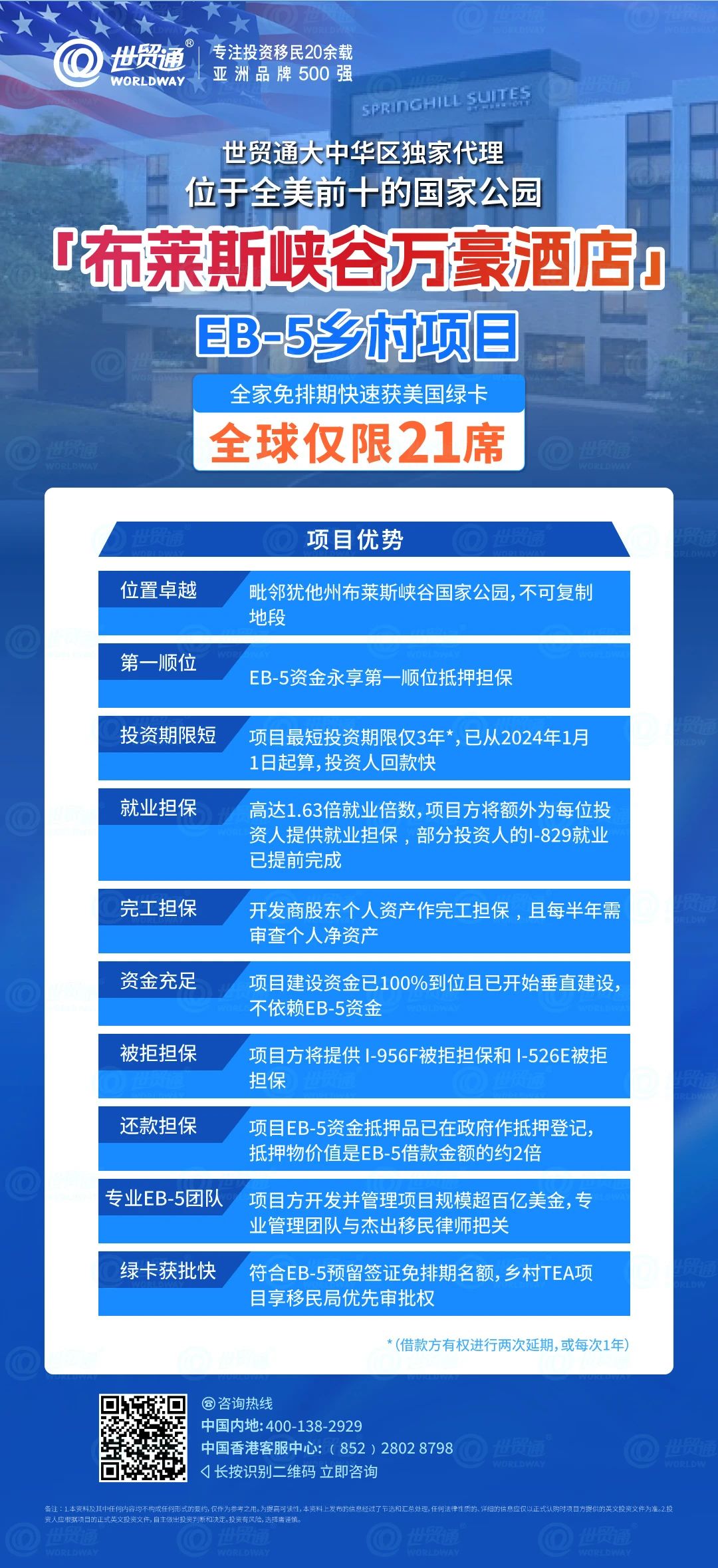
Currently, the EB-5 investment immigration program in the United States is an effective way to quickly obtain a U.S. green card. The two popular EB-5 projects currently on the market, exclusively represented by Worldway in the Greater China region, are the "Bryce Canyon Marriott" located in one of the top ten national parks in the United States and the "Hawaii Grand Resort" developed by capital giants. Both are high-quality EB-5 rural projects that have been meticulously selected and rigorously vetted by Worldway Group, making them excellent choices for rapid immigration to the United States.
These two premium EB-5 projects comply with the new rural TEA project regulations, not only enjoying reserved quotas for EB-5 visas but also receiving priority processing from the immigration bureau. They offer numerous advantages, including no waiting period, priority approval, and first-priority mortgage guarantees for EB-5 funds, with investments starting at $800,000. One application allows the entire family to quickly obtain green cards, with limited quotas available, so prompt action is advised.

Worldway Group, ranked among Asia's top 500 brands, has focused on investment immigration for over 20 years, specializing in U.S. investment immigration for 18 years. We have a professional team with over 18 years of service experience, having successfully assisted more than 6,000 families in immigrating to the United States, with extensive experience in processing over ten thousand U.S. green cards. In 2006, we became one of the first professional immigration agencies in China to promote the U.S. EB-5 investment immigration program; we were among the first to propose the concept of selecting quality projects and established a professional analyst team; we emphasized the importance of project selection in U.S. EB-5 investments and treated clients sincerely. Worldway has repeatedly won the "Best Immigration Agency Award" at the U.S. EB-5 Annual Conference; our senior management has met with several U.S. Congress members and maintains good interactions with various U.S. legislators, governors, mayors, senior officials, and well-known figures in the EB-5 industry, making us a reliable choice for your U.S. investment immigration needs!
For inquiries in mainland China: 400-138-2929, Hong Kong customer service center: (852) 2802 8798