






During Tuesday's European trading session, the US Dollar Index surpassed the 93 mark, hitting a new high for the year.
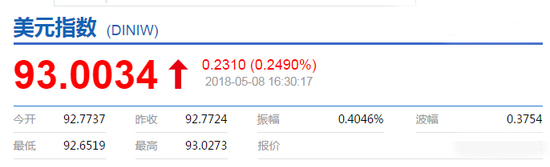
Recently, the US dollar has staged a strong rebound, with a cumulative gain of over 4% in the last month. Every "move" of the dollar is closely watched by investors. Analysts point out that higher-than-expected US inflation and the covering of US Treasury short positions are among the factors driving the dollar's rise.
Impact on Emerging Markets
As the US dollar surges, investors in some emerging market countries have been left in a cold sweat. The emerging currencies seeing the steepest depreciation are the familiar ones, including the Argentine peso and the Turkish lira, along with other emerging currencies with massive current account deficits.
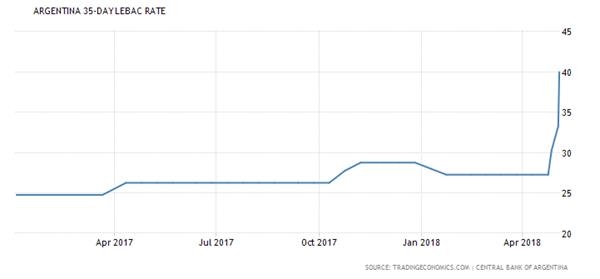
Data shows that on May 3, the Argentine peso plummeted another 8.5%, marking its largest drop in nearly two and a half years. To prevent further depreciation of the peso, Argentina raised its benchmark interest rate for the third time in a single week on the 4th.
In terms of global financial market performance, data released by EPFR Global, a firm that tracks fund movements, shows that "$4 billion in capital flowed out of emerging market bond funds in March, the largest monthly outflow since the second half of 2016."
A strong US dollar has investors worried about the debt repayment capacity of those with foreign currency debt in emerging markets. According to the IIF (Institute of International Finance), "over the past decade, Turkey, Mexico, and Indonesia have seen the fastest growth in foreign currency debt, while Hungary and Russia have significantly reduced their reliance on foreign currency debt. Currently, Argentina, Turkey, Hungary, and Indonesia hold the highest levels of foreign currency debt."
In response to the impact of the US dollar rate hike and the strengthening dollar, Argentina raised its interest rate to 40%, leaving emerging market investors highly anxious.
What factors are boosting the sharp rise of the US dollar?
Research from Minsheng Securities indicates that this round of US dollar strengthening is primarily due to higher-than-expected US inflation and the covering of US Treasury short positions.
First, US inflation has trended upward beyond expectations. The imposition of tariffs on steel and aluminum has caused a sharp rise in domestic steel prices in the US; driven by these cost-side price increases, the significant rise in inflation in March exceeded market expectations.
Second, the covering of US Treasury short positions has pushed Treasury yields sharply higher. In March, US Treasury yields rose rapidly, leading to a scramble to unwind short positions; open interest in Treasury futures dropped by 21.5% that month. In mid-to-late April, short-covering began in the US Treasury market, causing yields to spike.
Third, since the beginning of 2018, the European economy has performed weaker than that of the US. First-quarter economic data for the Eurozone was temporarily soft, pushing the euro lower against the US dollar. Meanwhile, the Eurozone PMI has declined for five consecutive months, whereas the US real GDP grew at an annualized rate of 2.3% in the first quarter, the best for the same period since 2015.
Furthermore, Kit Juckes, head of FX strategy at Société Générale, analyzed that when the action of shorting the US dollar reaches an extreme, the possibility of a reversal increases. "Factors that led to a weaker dollar, such as the flash crash of US stocks in February and trade disputes in March, have dissipated, allowing the oversold dollar to strengthen once again."
