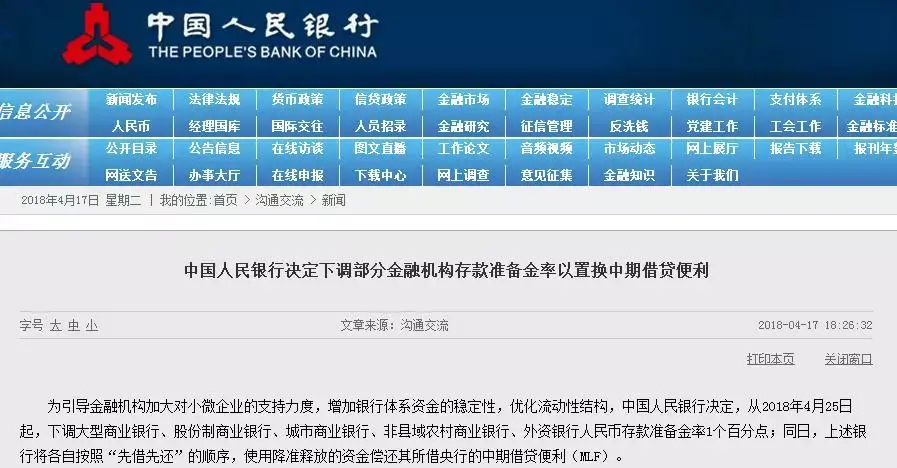
On the evening of April 17, the Central Bank decided to lower the reserve requirement ratio for large commercial banks, joint-stock commercial banks, urban commercial banks, non-county rural commercial banks, and foreign banks by 1 percentage point, effective from April 25; on the same day, the aforementioned banks will use the funds released from the reserve requirement reduction to repay the MLF borrowed from the Central Bank in the order of "first borrowed, first repaid."

Key Points:
Scope of the reserve requirement reduction: large commercial banks, joint-stock commercial banks, urban commercial banks, non-county rural commercial banks, and foreign banks (most of them will be reduced).
Magnitude of the reserve requirement reduction: 1 percentage point, with the reserve requirement ratio after the reduction being 16% or 14%.
Use of funds: primarily for repaying the MLF borrowed from the Central Bank, "first borrowed, first repaid."
Scale of released funds: approximately 1.3 trillion yuan. Repayment of MLF is about 900 billion yuan, releasing incremental funds of about 400 billion yuan, with most of the increment going to urban commercial banks and non-county rural commercial banks.
Purpose of the reserve requirement reduction: to increase support for small and micro enterprises. First, it can increase the supply of long-term funds, and the cost of bank funds will decrease. Replacing MLF will reduce the interest cost for commercial banks, which is beneficial for lowering the financing cost for enterprises. Second, releasing 400 billion yuan of incremental funds increases the low-cost funding sources for small and micro enterprise loans. It is required that the new funds be primarily used for small and micro enterprise loan issuance.
Specific operations: First, from April 25, 2018, the reserve requirement ratio for the aforementioned types of banks will be lowered by 1 percentage point; second, on the day of the reserve requirement reduction, banks holding outstanding MLF will repay the MLF borrowed from the Central Bank using the funds released from the reserve requirement reduction in the order of "first borrowed, first repaid."
How does it affect your wallet? 4 Major Impacts Related to You
1. Decrease in bank wealth management yields
The reserve requirement reduction will have a significant impact on the investable assets of bank wealth management, leading to a reduction in investable assets and a decline in asset yields, which in turn will force a decrease in bank wealth management yields.
Based on the experience of the last two reserve requirement reductions, the yields of bank wealth management will show a significant decline three months after the reserve requirement reduction is initiated, with an average annual decline of about 1%. If the reserve requirement reduction continues in the future, it is expected that the decline in bank wealth management yields in 2015 may also reach 1%.
2. Increased demand for bonds, bond yields will decline
The reserve requirement reduction has a significant impact on the asset allocation of bank wealth management. In the current economic downturn, the 400 billion yuan of funds added to commercial banks' proprietary accounts after the reserve requirement reduction may not necessarily be used for loans, but will definitely be used to buy bonds, leading to a significant decline in bond yields.
Currently, the asset allocation of bank wealth management consists of 35% non-standard assets and over 65% standardized assets, with bond assets accounting for about 60%. Since the supply of bonds in the market is limited, the bonds and yields available for bank wealth management will decline.
3. Impact on the stock market
Industry insiders indicate that the reserve requirement reduction is a significant positive for the stock market, and the Shanghai and Shenzhen stock exchanges are likely to open higher in the one or two trading days following the announcement. However, considering that since 2008, the Shanghai Composite Index has often opened high and then declined or even plummeted after each reserve requirement reduction, investors should be cautious of repeating the tragedy of being trapped by chasing high prices.
For example, after the Central Bank announced the reserve requirement reduction on February 4 of this year, the Shanghai and Shenzhen stock markets both closed lower the next day. The three major sectors benefiting from the stock market are: funds-sensitive varieties, commodities, and high-dividend new blue chips.
4. What impact does the reserve requirement reduction have on the real estate market?
Some market analysts claim that the Central Bank's reserve requirement reduction policy will help achieve a more relaxed mortgage environment.
However, it is worth noting that to prevent credit funds from flowing into financial institutions or real estate, the Central Bank has specifically emphasized that relevant financial institutions should primarily use the new funds for small and micro enterprise loans and appropriately reduce the financing costs for small and micro enterprises, improving financial services for small and micro enterprises. Therefore, the possibility of a surge in the domestic real estate market is low.
At WorldWay Immigration Wealth Club, we sincerely aim to enrich your global financial investment perspective and advocate a high-end international quality lifestyle. With twenty years of professional top-level asset allocation experience, we strive to create an international quality elite business exchange circle for you at the top of the pyramid. Consultation hotline: 400-186-0266