





After the real estate sector is suppressed, will there be another industry in China that is as "profitable" as real estate?
The answer is: every industry has the opportunity for "excessive profits", but no industry can remain "profitable" forever!
The so-called "excessive profits" are relative; they are an inevitable stage for every industry transitioning from market cultivation to maturity. The same can be said for the home appliance, pager, mobile phone, and computer industries of the past. The reason real estate attracts so much attention is due to its connection to people's lives and its significant impact on livelihoods.
Before 1980, China did not have a real estate industry. At that time, people's understanding of "real estate" was as unfamiliar as the current understanding of the potential emergence of "agricultural real estate or ecological farms" in the future.
The so-called "agricultural real estate" refers to the emerging industry in China that is likely to develop within the next 5-10 years, focusing on leasing rural land or establishing organic agricultural production bases. This industry will rapidly form under a series of macro policies and incentives such as "land transfer", "urbanization construction", and "farmers moving to cities".
First, a large amount of rural land that is transferred will be leased for compensation to relevant consortiums and institutions under the intervention and planning of local governments, generating long-term and stable local fiscal revenue through the collection of land rent from the large-scale transferred land.
Second, the consortiums and institutions leasing the land will operate high-value-added economic crops, engage in agricultural product supply chain control, or modern agricultural large-scale production on the leased land to obtain profits.
Third, the "land agents" engaged in land leasing intermediary services will receive corresponding service fees.
Fourth, the vast number of farmers will receive a substantial one-time cash compensation by transferring land use rights, and thereafter, they will sell their remaining labor to become "professional farmers".
The above inferences are not baseless; experts believe the reasons for the formation of the "agricultural real estate" industry are as follows:
1. The appreciation of the Renminbi against the US dollar, regardless of who is right or wrong, will inevitably lead to significant losses in foreign trade exports, one of the three driving forces of China's economic growth. The national proposal to "change the direction of development and alter development thinking" has clearly indicated the crisis and risks of a macro development direction primarily based on processing foreign trade. Among the other two driving forces for China's economic growth, the only one that remains strong is the "domestic demand" market. The "important pillar" industry driving domestic demand is "real estate" and "automobile manufacturing"; clearly, relying solely on "private cars" cannot sustain long-term GDP growth.
2. The turmoil in the real estate industry is not merely a problem of "excessive housing prices" in certain cities. The phenomenon of "land finance", which accounts for an average of 79% of local government fiscal revenue (according to China Central Television), cannot be sustained for long. The pace of "urbanization" will also be unable to meet the fiscal demands of the government as urban expansion reaches the "land limit". In contrast, rural land is currently the only stable and reusable source of fiscal security for local governments.
3. The "land transfer" proposed by the central government at the end of 2008, along with the acceleration of rural urbanization construction, fundamentally aims to concentrate the "surplus" labor and "idle" land in rural areas. The best way to achieve this "concentration" of rural land is through leasing.
4. A large number of well-known domestic companies, such as "Lenovo", have quietly shifted their funds to rural areas, and their purpose is certainly not simply to "grow rice".
China is a major agricultural country, and the current "business opportunities" have already emerged. As the only traditional industry that has not been thoroughly integrated, agriculture appears to have opportunities and attractiveness, prompting various industry leaders to step in to seize the initiative in the integration and transformation of the agricultural sector and gain excessive profits.
Agriculture, the next real estate industry?
In the past, the most profitable industries in China were real estate, finance, and electronic information, while agriculture was neglected by investors and young people. With the continuous increase in national investment in agriculture, the growing subsidies for farmers, and various supportive policies introduced by the government, a major integration of the agricultural industry has begun. Will this major transformation, as Rogers said, bring wealth opportunities that surpass the real estate industry in the future?
1. Insights from the Development History of the Real Estate Industry
After the reform and opening up, China's real estate industry began in the special economic zones of Shenzhen and Zhuhai. However, for the domestic populace, it was still during the planned economy period, and individuals relied on their work units for housing, with no concept of buying a home.
From 1993 to 2013, the real estate industry in China went through a difficult first decade and a brilliant second decade, permeating and influencing dozens of industries and capturing the attention of every urban resident. The real estate industry also became the sector that produced the most billionaires in China. After twenty years, a relatively monopolistic structure has formed, with about 50 well-known real estate companies nationwide, and major developers controlling most of the available land resources due to their capital advantages. In the last decade following the end of integration, housing prices have soared.
The transition of the real estate industry from "dispersed" to "concentrated" has generated excessive profits and a large number of wealthy individuals, confirming a conclusion: any industry whose structure transitions from "dispersed" to "concentrated" will form relative monopolies, leading to excessive profits and opportunities for wealth!
2. Agriculture is also undergoing a similar integration process as real estate
Agriculture seems to be experiencing a transition from "dispersed" to "concentrated" similar to the real estate industry. Here, I will mainly discuss this issue in terms of crop cultivation, as it is closely related to the agricultural input sub-industry we are in.
As shown in the figure, let us look at the performance of agriculture transitioning from "dispersed" to "concentrated":
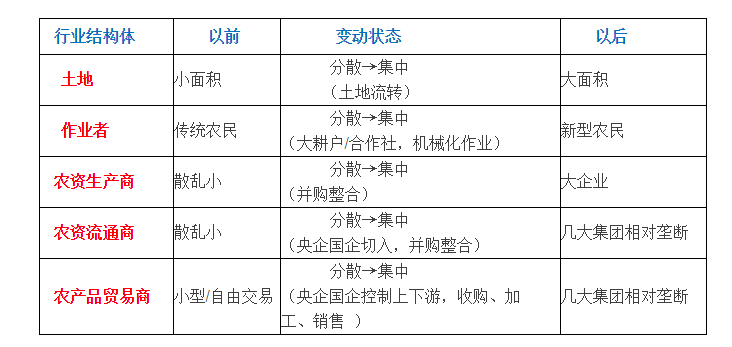
China's crop cultivation seems to be following a path:
Self-sufficient small supply (dispersed) → Large farmers/cooperatives begin to appear (concentrated) → Farm owners (relative monopoly)
The identity of farmers is also changing:
In the Central Document No. 1 of 2012, the term "professional farmers" first appeared, and in 2013, "family farms" became the key term in the Central Document No. 1. The structure of land operators—farmers—is undergoing profound changes, and "farmers" will become a profession for the wealthy, while the traditional concept of "farmers" will face replacement and elimination.
The scale of the industry has become an important driving factor accelerating the transformation of agriculture. Opportunities in the agricultural sector are continuously emerging, and under the backdrop of national economic structural adjustments and strong support for agriculture, a large amount of social capital is flowing into the agricultural field. New agriculture contains enormous potential and is a field worth investors' expectations.
The rise of new agriculture requires capital to drive it, emphasizing long-term returns, and a good business profit model for sustainable development.
In recent years, some business tycoons have also ventured into agriculture, such as [Lenovo] entering aquaculture, [NetEase] Ding Lei raising pigs, [JD.com] Liu Qiangdong growing rice, Chu Shijian planting "paper oranges", and Chen Guangbiao entering the green food sector... These business magnates, with their keen business acumen, have deeply sensed the opportunities brought by the major transformation in agriculture and have stepped in. They are investing hundreds of millions, far exceeding the small-scale operations previously conducted by industry insiders.
It can be seen that after agriculture transitions from "dispersed" to "concentrated", changing the previously backward business model can also create high-profit opportunities.
The ongoing major integration of the agricultural industry, like the "first ten years" experienced by the real estate industry, is believed to usher in a bright "last ten years" after the industry's major integration.
At the WorldWay Immigration Wealth Club, we sincerely aim to enrich your global financial investment perspective and advocate a high-end international quality lifestyle. With twenty years of professional top-level asset allocation experience, we strive to create an international quality elite business exchange circle for you at the pinnacle of the pyramid. For more details, please consult: 400-186-0266
