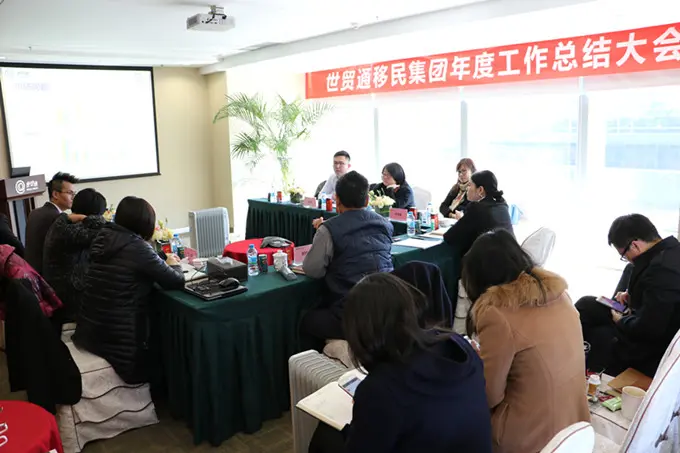
On November 14, 2015, the Real Estate Globalization Summit Forum was grandly held at the China World Hotel in Beijing. Dr. Winner Xing, President of the Worldway Immigration Group, attended as a key guest and shared important insights on "Major Methods of Overseas Asset Allocation" with overseas investment institutions and real estate experts at the forum.

Dr. Winner Xing pointed out that overseas asset allocation, also known as transnational asset allocation, has evolved. With the development of the Chinese economy over the years, our asset allocation is no longer confined to the 9.6 million square kilometers of land within China; instead, we should look beyond our borders and consider transnational asset allocation on a global scale. This year, the euro exchange rate fell to a 12-year low, the renminbi has also shown a downward trend, and with the US dollar interest rate adjustment pending, the exchange rate has entered an upward channel. Under such circumstances, it is clearly not a sound decision to limit asset allocation to domestic borders. On the other hand, the Chinese economy is increasingly integrating into the global economy, and the pace of renminbi internationalization is accelerating. It is based on these reflections that Worldway put forward the concept of "2015: The Year of Overseas Investment" at the beginning of this year.
There are two forms of transnational asset allocation: corporate asset allocation and personal asset allocation. Overseas investment by Chinese enterprises is mainly manifested as acquisition-based and centralized investment. Personal asset allocation is characterized by personalized and diversified approaches. In 2015, the topic of personal asset allocation has become a primary focus, with investment immigration emerging as the dominant or leading form of overseas asset allocation. However, because our world still has visa or residence barriers, one must first resolve the issue of the legal right to manage overseas assets to engage in substantial personal asset investment abroad. This is a matter of work rights, which are linked to residency rights; thus, one must resolve personal overseas asset investment through investment immigration, which often leads to subsequent investments.

Investment immigration is mainly manifested as overseas real estate investment and overseas fund investment. Overseas real estate investment is a unique way of investing. If we cannot recognize the uniqueness of immigration-related real estate and confuse it with ordinary domestic real estate investment, the investment is likely to fail. Personal overseas asset allocation should be linked to the internationalization of one's lifestyle. Investment immigration today is very different from that of the past; formerly, overseas Chinese emigrated for survival, whereas current investment immigration is a means to achieve an international lifestyle. European citizens do not face visa barriers, allowing them to live freely throughout Europe. For Chinese individuals to achieve such a lifestyle, they must complete it through investment immigration. So, what should one buy for personal overseas investment? You should buy something you cannot buy in China: land. By investing in European land through investment immigration, one can realize dreams of land ownership, manor life, and an international lifestyle. Land is the most fundamental wealth of humanity; since the Roman era, social hierarchy has been defined by the size of land holdings. Now, the European economic crisis has opened the door to previously restricted land purchases, giving Chinese individuals the opportunity to acquire land that is unavailable in China.
Another form of transnational asset allocation is overseas fund investment, as well as various other forms of immigration finance. Investment immigration is a form of capital investment in a different sense. Capital investment should not simply pursue the maximization of capital profits; instead, two accounts must be calculated: economic value and social value. Social value is the recognition of the social value of the immigration status obtained through investment immigration; its significance lies in the acquisition of immigration status and the safety of the principal.
Dr. Winner Xing's speech won rounds of applause and received approval from the overseas investment experts and institutions in attendance. The audience's enthusiasm for overseas investment was fully ignited, and they raised their hands to ask questions. Dr. Winner Xing concluded by pointing out that when purchasing land in Europe, one should consider the value of social identity recognition. Over the past few years, personal overseas asset allocation has grown in tandem with the booming development of investment immigration. Investment immigration is subject to both investment regulations and immigration laws. Here, I would like to specifically emphasize that in personal investment, one should not ignore the fact that investment immigration is the dominant and leading form, and one must remain vigilant against high-interest traps.